






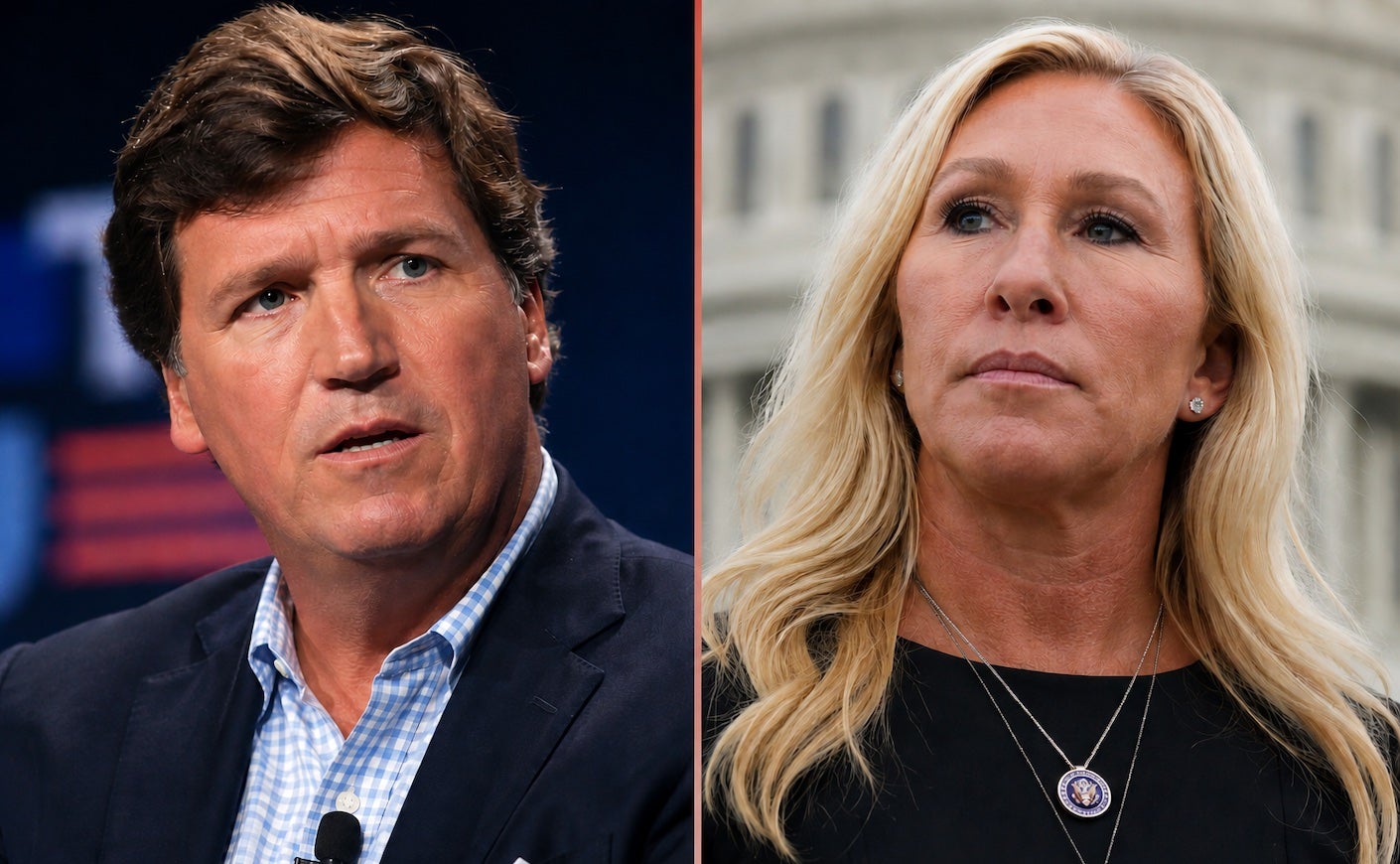
- Carlson and Greene publicly broke with the Republican Party and are discussing building a new third political party.
- Their comments reflect growing unease in the MAGA coalition, especially over foreign policy and what "America First" should prioritize.
- Polls show widespread dissatisfaction with both parties and interest in a third party, but voters worry about wasted votes and viability.
- Institutional barriers like winner take all, the Electoral College, and ballot access make a successful third party extremely difficult.
Not long ago, the idea of Tucker Carlson and Marjorie Taylor Greene openly discussing a third party would have seemed unthinkable. Both were among the most influential voices in the MAGA movement. Now, after publicly breaking with the Republican Party, they're doing just that — Carlson says he wants to help build a new political party, while Greene says she's having "serious conversations" about launching one of her own.
The chances of either effort resulting in a viable third party are slim. But that's not what makes their comments noteworthy. Rather, they reflect growing unease among some of Trump's most influential allies about the direction of the conservative movement.
Calls for a third party are hardly new. But when two of a movement's most recognizable voices begin to question the party they once championed, it's worth asking why — and what their comments reveal about the future of the GOP.
What Tucker Carlson and Marjorie Taylor Greene are proposing
Carlson and Greene aren't the first prominent conservatives to call for a third party. The conversation gained renewed attention last year after Elon Musk announced plans to launch the "America Party" following his public feud with Trump.
Musk argued that Republicans and Democrats alike had abandoned fiscal responsibility. "When it comes to bankrupting our country with waste & graft, we live in a one-party system, not a democracy,” he wrote on X. “Today, the America Party is formed to give you back your freedom."
By a factor of 2 to 1, you want a new political party and you shall have it!
When it comes to bankrupting our country with waste & graft, we live in a one-party system, not a democracy.
Today, the America Party is formed to give you back your freedom. https://t.co/9K8AD04QQN— Elon Musk (@elonmusk) July 5, 2025
While Musk's proposal didn’t actually materialize, interest in an alternative has continued to percolate among some conservatives. In an interview with the Columbia Journalism Review, Carlson said he's committed to helping build a third party, accusing both Democrats and Republicans of operating as a "one-party state posing as a democracy."
"I do know what really matters is war and finance,” he told the publication. “Where does the money come from? Where does it go? And who gets killed? And on those questions, the parties are in lockstep solidarity with each other."
Greene suggested the idea has already moved beyond speculation. During an appearance on Piers Morgan Uncensored last week, she said she is in talks with others to create what she described as a "true America-focused" political party that could bring together "serious players from the right and the left."
Still, Greene acknowledged such an undertaking would take time.
"It's difficult to launch a third party, so the reality is this isn't something that gets off the ground in just a couple of campaign cycles,” she said. “This is a movement that has to be developed and would take time to develop."
When Morgan later asked whether Carlson could play a role in such an effort, Greene said he "would be a great threat to both parties," arguing he has the ability to attract Republicans, Democrats, and independents alike. (Carlson, however, has said he has no interest in running for office himself.)
Why now?
The timing of these comments is significant. Growing divisions within the MAGA coalition over the Trump administration's foreign policy — particularly its approach to Iran — have exposed broader disagreements over what the president’s populist agenda should look like in a second term.
Carlson emerged as one of the most prominent conservative critics of the Trump administration's willingness to consider military action against Iran, arguing that another foreign conflict would be inconsistent with the "America First" promise to avoid overseas entanglements and focus on domestic priorities. Greene has echoed many of those concerns, warning that Republicans risk alienating voters who backed Trump because they believed he would keep the U.S. out of new wars.
For Carlson, however, the disagreement extends beyond Iran. He has argued that Republicans and Democrats have become increasingly aligned on what he considers the country's most important issues — "war and finance" — leaving many populist conservatives without a political home. That argument has become central to his case for building a new political movement.
The dispute also underscores a larger question facing Trump's coalition. For years, Trump has managed to unite Republicans with sharply different views on foreign policy. But the debate over the war in the Middle East has exposed competing visions of what the movement should prioritize — and who gets to define "America First" moving forward.
But do Americans actually want a third party?
Carlson and Greene aren't tapping into a new sentiment.
A Pew Research Center survey published in May found widespread dissatisfaction with both major political parties. Fifty-eight percent of Americans view the Republican Party unfavorably, while 59 percent say the same about the Democratic Party. More than one-quarter of Americans — 26 percent — now have an unfavorable view of both parties, up from 21 percent in 2020.
That discontent has also translated into interest in an alternative. A Gallup poll published last year found that more than 60 percent of Americans believe the country needs a third major political party. Independents were the most likely to hold that view, with 74 percent saying a third party is needed, compared with 58 percent of Democrats and 43 percent of Republicans. Gallup also found that support among Democrats and Republicans tends to rise when the opposing party controls the White House, suggesting enthusiasm for a third party often reflects dissatisfaction with the party in power rather than a lasting desire to reshape the political system.
The polling also highlights a disconnect between what Americans say they want and how they're likely to vote. Just 15 percent of people said they would be "very likely" to back an alternative to the Republican and Democratic parties. Nearly two-thirds also said they worry voting outside the two-party system would either waste their vote on someone unlikely to win or help elect the candidate they like least.
Those concerns reflect the realities of the American electoral system. Winner-take-all elections, the Electoral College, and state-by-state ballot access requirements make it extraordinarily difficult for third parties to compete — and history shows just how formidable those barriers can be. In 1992, Texas businessman Ross Perot captured nearly 19 percent of the popular vote in his independent presidential bid, which marked the strongest showing by a third-party or independent candidate in 80 years. His campaign helped elevate issues such as the federal deficit and trade, but it ultimately failed to fundamentally alter the country's two-party system.
For Carlson and Greene, the challenge may not be convincing voters that the political system is broken — it may be persuading them that a new political party can succeed where so many others have fallen short.
