






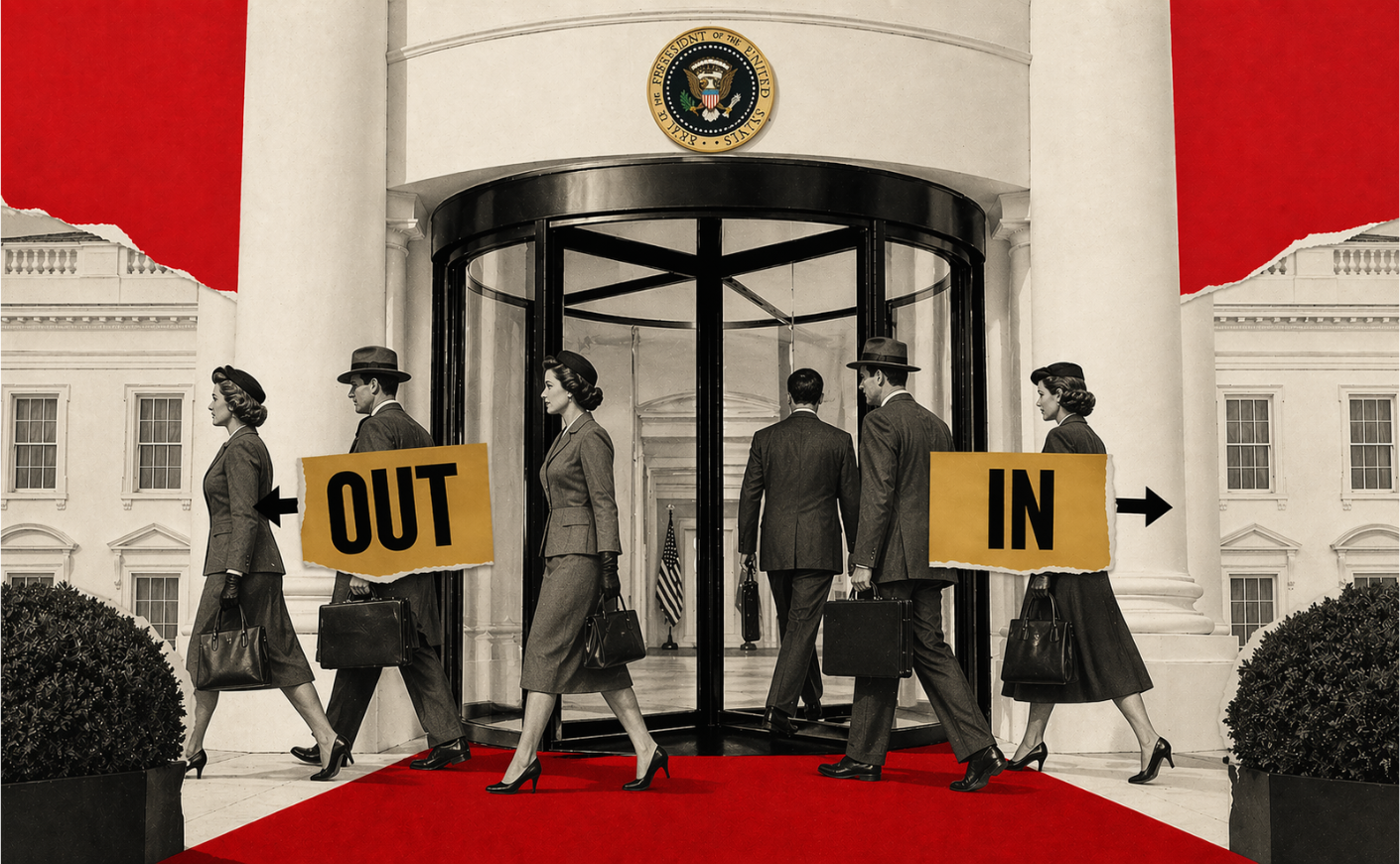
Turnover in Washington isn’t unheard of, but the early exits in President Trump’s second term are starting to add up.
Three of the administration’s most prominent women — Kristi Noem, Pam Bondi, and Lori Chavez-DeRemer — were among its first high-profile departures, all happening within a few months of each other. Now, White House Press Secretary Karoline Leavitt is on her way out, too. That’s a striking turn of events for an administration that initially boasted higher female representation, with women making up about 37 percent of the Cabinet — up from roughly 24 percent in Trump’s first term.
Of course, personnel churn is hardly new to Trump. His first term was defined by headline-making firings and what often felt like a revolving door of high-level exits. This time, the turnover has unfolded less like a dramatic shakeup and more like a steady drip.
Some departures followed weeks of mounting scrutiny. Others were announced with little explanation, framed as “personal decisions” or moves to the private sector. But taken together, the growing list reveals a familiar pattern: a governing style marked by friction, fast-moving personnel changes, and a widening circle of fractured alliances that stretches from the Cabinet and White House to agency leadership and even once-close outside allies like Elon Musk.
We took a closer look at some of the officials who’ve left the administration, and why.
Inside the Cabinet
White House Press Secretary Karoline Leavitt
White House press secretary Karoline Leavitt is stepping down from her role at the end of August. Trump announced the news in a post on Truth Social, saying she was leaving to spend more time with her family.

Leavitt made history in 2025 when she announced she was expecting her second child, becoming the first woman to serve as White House press secretary while pregnant. She gave birth to her daughter, Viviana, in May, took maternity leave, and returned to the briefing room podium in July.
But just weeks after returning, Leavitt said she realized the demands of the job were difficult to reconcile with being home with her two young children.
“The truth is since returning to the White House after the birth of my daughter, I have felt in my heart that I cannot be the best mom my two young children deserve while devoting the constant time, energy, and attention required of the White House Press Secretary — and that is why I have ultimately made the bittersweet decision to depart the White House and embark on a new chapter in my life,” she wrote on X.
Leavitt won’t be leaving Trump’s orbit entirely. Trump said she will now serve as one of his “top outside” advisers and will be “an influential voice within the Republican Party” ahead of the midterms.
DHS Secretary Kristi Noem
Department of Homeland Security Secretary Kristi Noem left due to what one administration official described as “a culmination” of missteps.
There was the fallout from a Minnesota operation in which federal agents killed two civilians, a flashpoint that drew bipartisan scrutiny. Then came the questions around a costly ad campaign she oversaw, urging undocumented immigrants to self-deport — a $200 million effort that prominently featured Noem herself. She told lawmakers that Trump had signed off on it, but the White House quickly disputed that claim.
The controversies didn’t stop there: Noem also faced scrutiny over her relationship with longtime Trump ally Corey Lewandowski — allegations both have denied.
Attorney General Pam Bondi
Trump abruptly ousted then-Attorney General Pam Bondi in April, after reportedly becoming frustrated that some of his top priorities weren’t making progress. But the cracks had been showing for months: A federal judge threw out DOJ cases targeting political adversaries like New York Attorney General Letitia James and former FBI Director James Comey, and in February, the department declined to indict six Democratic lawmakers over a video urging the military to refuse unlawful orders, according to NBC News.
There was also growing internal frustration with how Bondi handled the Epstein files. In an interview with Vanity Fair in December, White House Chief of Staff Susie Wiles said Bondi “completely whiffed” on them. Early on, Bondi hinted that explosive material could still be coming, but the eventual release of heavily redacted files seemed only to undercut that claim.
Still, Trump framed her exit as a transition, saying she’ll move on to a “much-needed and important” role in the private sector.
Labor Secretary Lori Chavez-DeRemer
After weeks of mounting scrutiny — including an investigation into whether she pursued a romantic relationship with a subordinate on her security detail, who was placed on leave in January — Chavez-DeRemer resigned. Her attorney, Nick Oberheiden, told NBC News that the resignation “is not the result of legal wrongdoings,” but a personal decision. White House communications director Steven Cheung said she is expected to take a job in the private sector.
The news didn’t come as much of a surprise — controversy had been mounting for weeks. In early March, two of her top aides stepped down amid a “travel fraud” probe tied to personal trips. And in February, The New York Times reported that Chavez-DeRemer’s husband had been barred from Labor Department headquarters after two employees accused him of sexual assault — allegations he has since denied.
Across federal agencies
CDC Director Susan Monarez
After less than a month on the job, Monarez was ousted as director of the Centers for Disease Control and Prevention in August 2025. The Department of Health and Human Services announced her departure on social media, offering no explanation.
Her lawyers later pushed back, saying Monarez had been targeted for “protecting the public over serving a political agenda” and casting her removal as part of a broader “dangerous politicization of science.”
Her exit didn’t happen in isolation, though: It came alongside a wave of high-level departures at the Centers for Disease Control and Prevention, including deputy director Debra Houry, Daniel Jernigan, who led the agency’s National Center for Emerging and Zoonotic Infectious Diseases, and Demetre Daskalakis, who headed the National Center for Immunization and Respiratory Diseases.
Navy Secretary John Phelan
Navy Secretary John Phelan’s departure has raised questions about what prompted his exit — and the Pentagon hasn’t offered many answers.
Pentagon spokesman Sean Parnell thanked Phelan for his service but offered no details about why he stepped down or whether the decision was his. An administration official later told The Hill that Phelan had been asked to resign.
Phelan, a billionaire art collector and longtime Trump donor, had pushed an ambitious “Golden Fleet” plan to expand the Navy, including a proposed “Trump-class” battleship. But his tenure was also marked by reported internal clashes, including tensions with Defense Secretary Pete Hegseth and Deputy Defense Secretary Stephen Feinberg.
Hung Cao has since stepped in as acting Navy secretary. While Phelan wasn’t directly overseeing military operations, his role put him in charge of the Navy’s broader readiness, shipbuilding, weapons procurement, and supply pipeline. That makes the leadership change significant well beyond the Pentagon’s personnel shuffle.
ICE acting director Todd Lyons
Todd Lyons stepped down as head of Immigration and Customs Enforcement at the end of May, after announcing his resignation earlier that month. In a letter to Homeland Security Secretary Markwayne Mullin, Lyons called it a “tremendous honor” to lead ICE and said he was leaving to “spend more time with my family.”
But his departure came amid broader scrutiny of the agency and its role in Trump’s immigration crackdown. ICE has faced backlash over its aggressive enforcement tactics, while polling has shown Americans divided over the administration’s approach. In a January New York Times/Siena University poll, about half of voters supported Trump’s deportation push, while 47 percent said ICE had gone too far.
Medicaid director Drew Snyder
Drew Snyder, former deputy administrator at the Centers for Medicare & Medicaid Services and director of the Center for Medicaid and CHIP Services, resigned last June — and the reason was never fully explained. A source close to the situation told Politico that it wasn’t tied to politics or agency shake-ups, pointing instead to an unspecified “personal family matter.”
Before stepping down, Snyder had played a central role in shaping Medicaid policy. According to his bio at the national law firm Baker Donelson, he “spearheaded regulatory and policy reforms” and helped lead negotiations around Trump’s signature One Big Beautiful Bill Act — legislation that ultimately enacted the largest cuts to Medicaid in the program’s history. The Congressional Budget Office estimates the law will reduce federal Medicaid spending by roughly $1 trillion over the next decade, with more than 10 million people projected to lose coverage by 2034.
National security adviser Mike Waltz
Then-National Security Adviser Mike Waltz found himself at the center of an awkward — and alarming — security lapse last year. He accidentally added The Atlantic editor-in-chief Jeffrey Goldberg to a private Signal group chat discussing classified military plans targeting the Houthis in Yemen, later blaming the confusion on a phone contact mix-up and calling it “embarrassing.”
But despite the fallout from that episode, it doesn’t appear to be what ultimately led to his exit: According to Politico, Waltz’s more hawkish stance on Iran increasingly put him out of step with others in the administration. And in a notable twist, the one-time congressman has since been nominated to serve as U.S. ambassador to the United Nations.
Beyond the administration
Special Government employee Elon Musk
Even some of Trump’s outside allies seemingly severed ties with the leader. Elon Musk, for one, served as a Special Government Employee in an advisory capacity, though that role was always meant to be temporary. These positions are typically capped at 130 days a year, and Musk’s involvement appeared to wind down as he shifted focus back to his companies, including Tesla and SpaceX.
But the end of his tenure also marked the start of a rift. After leaving, Musk’s relationship with Trump grew increasingly tense, with Musk publicly criticizing parts of the administration’s agenda. The president fired back over everything from electric vehicle subsidies to loyalty, turning a minor exit into a much more visible political break.
