







- Talarico's faith-forward message reframes progressive policies as biblical imperatives, distinguishing him from modern Democratic politicians.
- He built huge digital reach and raised record funds, polling competitively against Attorney General Ken Paxton among independents.
- His approach energizes progressives but splits many Christians, raising doubt whether faith politics can overcome Texas Republicans' decades-long dominance.
For nearly three decades, Texas Democrats have been searching for a way back to power.
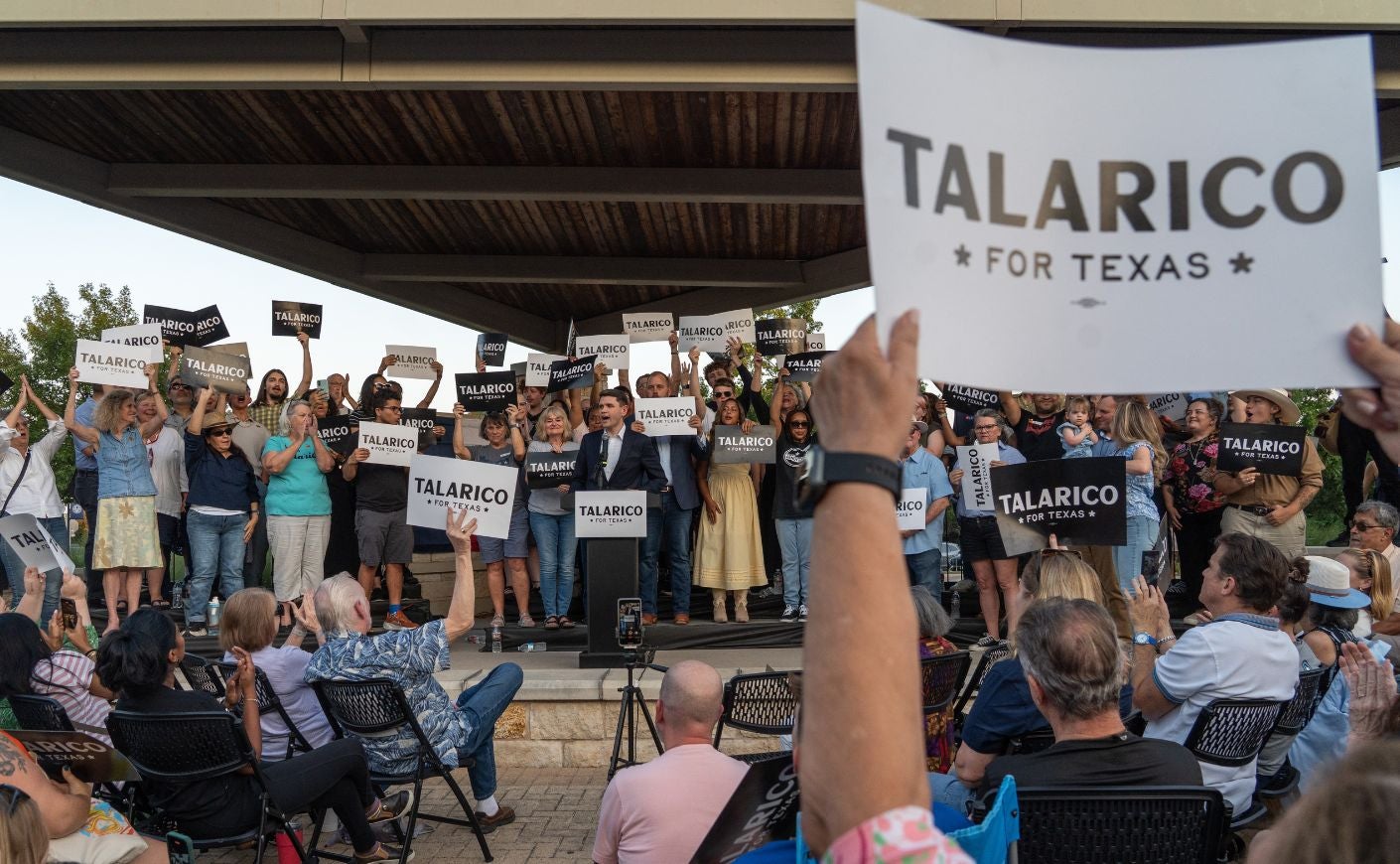
The party hasn't won a statewide election since the '90s — but now, many believe they may have found an unlikely candidate in a 37-year-old state representative and former public school teacher who has studied to become a pastor. James Talarico has emerged as one of the party's fastest-rising stars, building a massive online following and attracting national attention with an unusual focus: religious faith. His message has earned praise from former President Barack Obama, who joined him in May for a high-profile appearance in Austin that many Democrats viewed as a show of support.
Talarico's growing profile has also carried him well beyond the Lone Star State. Earlier this year, the now-canceled The Late Show with Stephen Colbert posted its interview with Talarico online rather than airing it on CBS amid concerns over federal equal-time rules. Now, Jimmy Kimmel Live! is taking a similar approach: Kimmel announced that his interview with Talarico will appear on YouTube rather than air on ABC.
As he prepares to challenge Republican Attorney General Ken Paxton, Talarico enters a race unlike those faced by many recent Texas Democrats. (While Paxton remains a hero to many conservatives, years of legal and ethical controversies have also made him one of the state's most polarizing political figures.) To understand the excitement surrounding Talarico, it helps to start with what makes him different from most Democrats.
Why Talarico isn’t your typical Democrat
One reason Talarico has generated so much buzz is that he doesn't fit the mold of a modern Democratic politician. As the party's base has become increasingly secular, many Democrats have moved away from overt religious rhetoric. But Talarico, a Presbyterian seminarian who has publicly discussed entering the ministry, has gone in the opposite direction. He frequently quotes scripture and invokes the teachings of Jesus, arguing that issues like healthcare, education, childcare, and poverty are opportunities to follow the biblical commandment to "love thy neighbor."
Talarico is a throwback to an older era of Democrats who leaned into their faith and talked about it pretty openly.

Talarico is interpreting that — and other — religious directives in strict terms: "I don't believe in a progressive or conservative Christianity; I believe in a biblical Christianity," he told The New York Times earlier this month. "My faith is rooted in Scripture and the teachings of Jesus Christ."
That approach has made him something of an anomaly within today's Democratic Party. "Talarico is a throwback to an older era of Democrats who leaned into their faith and talked about it pretty openly because it was just what you had to do to win," Ryan Burge, a political scientist who studies religion and politics in America, tells Katie Couric Media.
Talarico's blend of faith and populist politics is also what first propelled him into the spotlight. Some of his earliest viral moments focused on his criticism of billionaire GOP megadonors Tim Dunn and Farris Wilks, whom he accused of wielding outsized influence over Texas politics while advancing a Christian nationalist vision. Rather than condemning them solely on partisan grounds, Talarico framed his opposition in religious terms, arguing that their brand of politics is fundamentally at odds with Christian teachings.
He has since become one of the Democratic Party's most prominent critics of the religious right, frequently declaring that "there's nothing Christian about Christian nationalism" and challenging the notion that faith belongs exclusively to conservatives.
His message appears to be resonating: Talarico has built an online audience of more than 1.5 million TikTok followers and raised a record-breaking $27 million during the first quarter of 2026, helping transform a little-known state legislator into one of the country's most closely watched Democratic candidates. Recent polling suggests the appeal may extend beyond his online following, showing him running neck-and-neck with Paxton and performing particularly well among independent voters.
For some Democrats, the excitement goes beyond a single Senate race. "The myth of Republican invincibility in Texas will be shattered if Talarico wins," Mark P. Jones, a political scientist at Rice University, tells us.
Talarico's growing profile has also made him a target of Republicans eager to paint him as out of touch with Texas values. President Trump has repeatedly mocked the Democrat as a "vegan" who "can't get elected in Texas," while also attacking his views on religion, gender, and immigration. Talarico has denied the vegan label, joking that his campaign "basically runs on Texas barbecue."
Where Talarico's faith divides Christians
Talarico's faith-forward politics have won him admirers, but they've also made him a lightning rod within the Christian community itself.
Many of the same positions that have earned him praise from progressive Christians have drawn criticism from conservatives, who argue that he's stretching scripture to fit a political agenda.
In an interview with Joe Rogan last year, for example, Talarico argued that the New Testament account of an angel visiting Mary before the birth of Jesus points to a biblical basis for abortion rights. “The angel comes down and asks Mary if this is something she wants to do, and she says: 'If it is God’s will, let it be done,'” Talarico said. “To me, that is an affirmation in one of our most central stories that creation has to be done with consent. You cannot force someone to create.”
Talarico has also defended LGBTQ inclusion within Christianity and challenged traditional interpretations of scripture, including arguing that God should not be understood in strictly male terms. Those views have drawn fierce criticism from some conservative Christians. Jason Rapert, a former Arkansas state senator and president of the National Association of Christian Lawmakers, has called Talarico "a very dangerous person not only for the state of Texas, but for the United States of America," arguing that he is spreading "misinformation and falsehood" through what Rapert described as "apostate" views. Steve Toth, a conservative pastor who serves alongside Talarico in the Texas House, has gone even further, describing him as "a demonic presence in the world."
Even some observers sympathetic to Talarico's broader project caution against equating Christian values with specific policy prescriptions. Burge, who is also a former Baptist pastor, says he worries that Talarico sometimes goes too far in suggesting that Democratic policies are inherently Christian.
"That's where I worry about Talarico — when he acts as if everything in the Democratic Party falls in line with Christian principles," Burge tells us. "The Christian view is that everyone should have access to affordable, accessible healthcare. But how we get there is a matter of policy, not principles."
The challenge may be particularly acute in Texas. Jones notes that many Texas Christians do not share Talarico's views on issues such as abortion, LGBTQ inclusion, and biblical interpretation.
"Many of the things he says, and how he interprets the Bible and Jesus's teachings, are very different from how a majority of Christian Texans see them," says Jones. He argues that this disconnect could make Talarico's faith-centered message "more of a liability than an asset" with some voters, even as it energizes others.
The debate underscores a larger question hanging over Texas politics: Even if Talarico has found a message that resonates with some voters, is it enough to succeed where generations of Texas Democrats have failed?
Why Texas Democrats haven't broken through
For nearly three decades, Texas Democrats have been stuck in a political drought.
Back in 1994, Democrats still held several statewide offices even as Republican George W. Bush defeated incumbent Gov. Ann Richards. But since then, Republicans have won every statewide race, turning Texas into one of the GOP's most reliable strongholds.
For years, many Democrats believed that would eventually change. Texas was growing younger, more urban, and more diverse. Major metropolitan areas like Houston, Dallas, Austin, and San Antonio were booming, and (potentially blue-leaning) newcomers were arriving from across the country. The assumption was that the state's politics would eventually catch up with its demographics.
There were moments when that prediction appeared close to coming true. Wendy Davis's 2014 gubernatorial campaign generated national attention but ended in a decisive defeat. Four years later, Beto O'Rourke came closer than any Democrat in four decades, losing to Sen. Ted Cruz by less than three percentage points after raising record sums and drawing massive crowds. For many Democrats, it felt like a turning point.
Yet the long-awaited breakthrough never arrived. O'Rourke later lost bids for president and governor, while Republicans continued to dominate statewide elections.
Political scientists point to several reasons for this lack of Democratic progress. For one, Democratic votes remain concentrated in urban areas, while Republicans continue to run up large margins in rural Texas and smaller communities. Turnout patterns also tend to favor the GOP. And while Texas has changed demographically, those changes have not always translated into the electoral gains Democrats expected.
"Texas has been and continues to be a very conservative state," Jones says. Once Republicans gained power, much of the financial and institutional support that had once flowed to Democrats shifted to the GOP, creating a cycle in which Democrats struggle to raise money, recruit top-tier candidates, and convince voters they can win.
"Since Democratic candidates have a hard time raising money, the party has a tough time recruiting high-quality candidates to run for statewide office," he adds.
Jones also argues that Democrats have often misunderstood the state's demographic changes. While newcomers do continue to arrive from places like California, Illinois, and New York, they aren't uniformly Democratic. Republicans have also remained competitive among many Latino voters while maintaining overwhelming support in rural areas.
"A lot of Democrats have been waiting for demographics to deliver them victory for years," Jones says. "But demographics are not destiny."
Whether Talarico represents a genuine political realignment or simply the latest Democratic hope remains to be seen.
What is clear is that he is testing a theory that few Democrats have seriously attempted in modern Texas politics: that faith can be a political asset for the left rather than a liability. If he's right, he could reshape the future of the Texas Democratic Party. If he's wrong, he'll become the latest name on a growing list of Democrats who came close, but couldn't break the state's long Republican hold on power.
