






The term “cult” has become a catchall in today’s discourse, used to describe everything from extreme beliefs and blind loyalty to overzealous fandoms. In recent years, it’s increasingly been deployed as a political weapon — used to discredit opponents, frame ideological movements as dangerous or irrational, and suggest certain groups operate outside the bounds of normal political or social behavior.
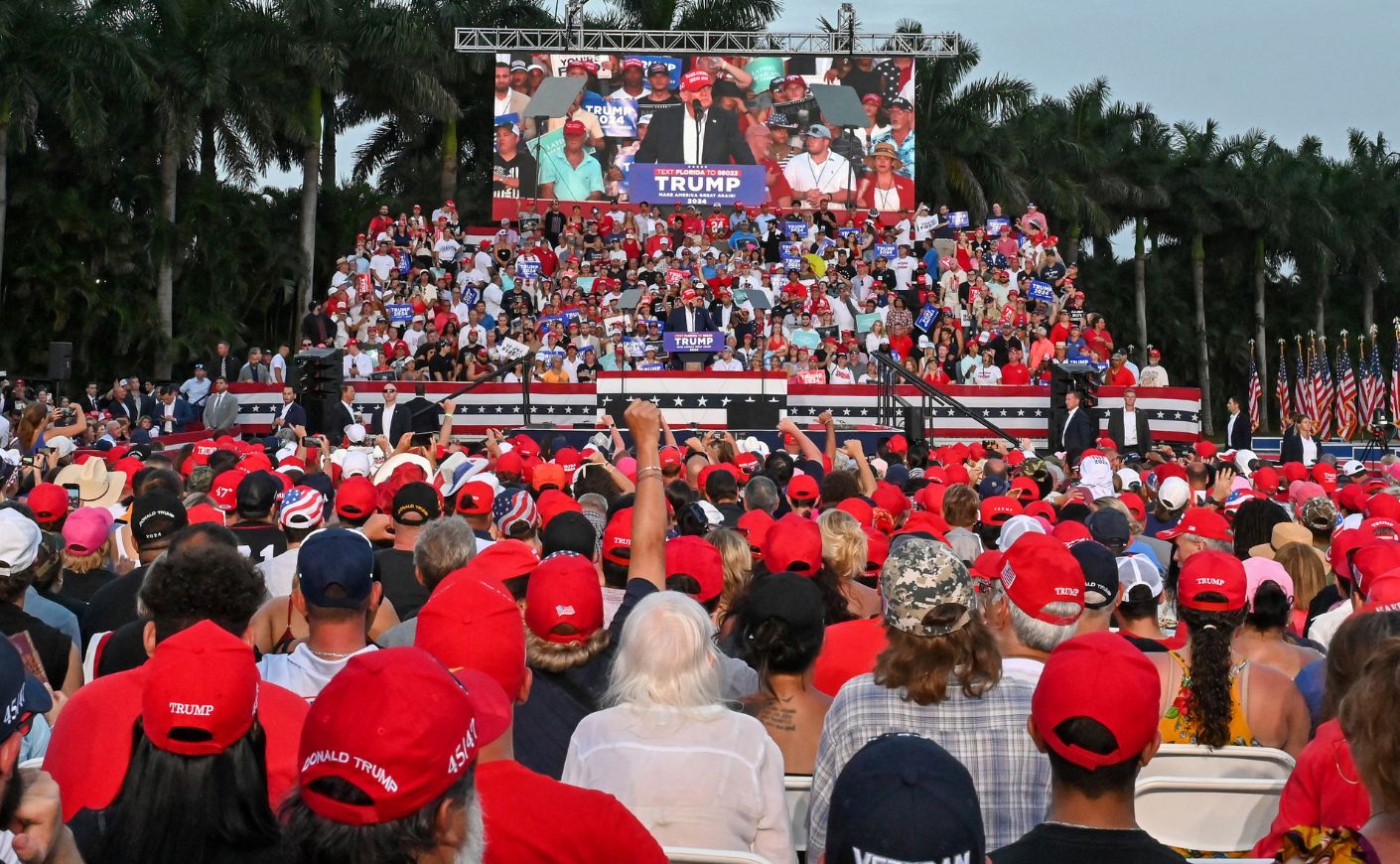
But for Harvard-trained organizational psychologist Daniella Mestyanek Young, the comparison isn’t just rhetorical — it can accurately describe the dynamics and behaviors within current political groups. She isn't afraid to say that the MAGA movement is a prime example.
Young would know. She grew up inside the extremist religious group known as Children of God — a controversial sect accused of widespread abuse — before being excommunicated at 15.
Today, she sees familiar manipulation techniques used in movements far beyond the NXIVMs and Branch Davidians that we've come to associate with the label.
“All cult experts are begging to be taken seriously when we call MAGA a cult,” she tells Katie Couric Media. “We’re not being hyperbolic here.” (Some researchers and political scientists caution that applying the term “cult” to large political movements can oversimplify complex coalitions — and risk turning an analytical framework into a partisan label.)
Young emphasizes that the point of using the term isn’t provocation — it’s about recognizing a set of dynamics that repeat across systems and moments of instability.
“When experts use the word ‘cult’ in this context, we’re describing patterns of behavior and control — not hurling an insult,” she says. “And those patterns are measurable.”
Here’s a closer look at how those dynamics take hold — and how they can reshape political behavior, public trust, and even democratic institutions.
What is a “cult,” really?
A cult is generally defined as a tightly knit group — often, though not exclusively, religious — marked by intense devotion to a specific person, ideology, or belief system.
Young, co-author of the book The Culting of America: What Makes a Cult and Why We Love Them, describes “high-control systems” as environments that shape not just behavior but also how people think, question, and interpret information. At their core, she argues, these systems are designed to direct loyalty and extract something in return — whether that’s labor, belief, or identity. The distinction isn’t so much about accuracy, she says, as it is about whether people are willing to engage.
That perspective isn’t theoretical; it’s based on her own experiences growing up in Children of God, a controversial religious group founded during the social upheaval of the Vietnam War era, when anti-establishment movements and distrust in traditional institutions were surging across the U.S. The group later became notorious for allegations of psychological control, isolation from outsiders, and widespread sexual abuse involving both adults and children.
She argues that Trump has united a wide range of conservative, populist, anti-establishment, and conspiracy-driven factions under a single political identity.
“MAGA follows the exact pattern of Children of God,” she says, pointing to the way such movements tend to emerge during periods of social upheaval and coalesce around a single leader. “Donald Trump has pulled these groups into a cult of personality — and done it pretty successfully.”
Young, who served as an intelligence officer in the U.S. Army, notes it's not just MAGA. “By definition, I think the American political system is culty,” she says, pointing to its two-party structure. “Anytime you have a binary process, you’re going to have an us-versus-them dynamic — one side is saving the world, the other is destroying it.”
When politics become culty
At their core, cults operate by shaping not just behavior, but how people interpret information and decide what to question.
“Brainwashing is quite simply the process of getting people to stop asking questions,” she explains. “It’s getting thoughts to stop themselves.”
That kind of dynamic doesn’t happen all at once. Instead, it builds gradually, reinforced through repetition, social pressure, and a narrowing sense of what information feels safe or acceptable. Over time, the boundaries around what can be questioned start to shrink.
“High-control groups don’t just tell you what to think — they shape how you think,” she says. “They define what’s acceptable to question, and what isn’t.”
Young argues that dynamic can become especially powerful when leaders encourage followers to distrust outside sources of information altogether. She pointed to Trump’s long-running attacks on the media and his repeated use of the phrase “fake news” to dismiss unfavorable coverage — rhetoric she says can make it easier for supporters to view criticism as inherently suspect rather than something to engage with on its merits.
While these systems can appear stable from the outside, Young says they’re often more fragile than they seem. In Trump’s orbit, that fragility has at times surfaced through public loyalty tests, internal feuds, and a steady stream of high-profile firings.
Cracks tend to form when leaders fail to deliver on core promises. She points to long-standing pledges — like the promised release of the Epstein files — which were delayed and ultimately made public in heavily redacted waves.
“The thing Trump’s been promising his people the whole time was, ‘drain the swamp,’” she says. “When that doesn’t happen, you start to see fractures.”
While most Trump voters still support the president, signs of frustration are beginning to emerge: A recent Reuters/Ipsos poll found Republican approval has slipped to 79 percent, down from 91 percent at the start of Trump’s second term.
Why this is concerning — and what you can do about it
Young points to a more subtle risk: the way people talk about this moment — and the fear that can come with it.
“There’s so much fear right now because it’s in the news every day,” she says, referring to the increasingly apocalyptic rhetoric circulating online and in political conversations. “But one of the things I’m really wary of is all of this language of like, ‘we’re cooked,’ ‘it’s over,’ ‘America’s done.’”
That framing, she argues, can obscure a more complicated reality. Despite their visibility, these movements are not all-powerful. “They have people in very, very important seats of power,” she says, but she argues, "they don’t have cultural dominance."
Young says the mindset that we're already "done for" can reinforce cult dynamics by making people less likely to act. And when people stop pushing back, systems face less pressure to change.
She reinforces that these movements usually fade slowly as internal fractures grow, leaders lose credibility, and younger voters begin to disengage from the ideology. “The way cults die is when they fail to keep or recruit the next generation,” she says. In political movements, that can mean declining enthusiasm among younger supporters, splintering factions, or an inability to expand beyond a loyal core base.
So what matters most isn’t just what a group believes — it’s how it handles uncertainty, and, as she puts it, “whether they feel allowed to question it.”
Ultimately, the outcome isn’t predetermined: It depends on what people do next, and whether they stay engaged over the long haul. “It is all of us figuring out what part we want to care about,” she says, “and then pushing back.”
