






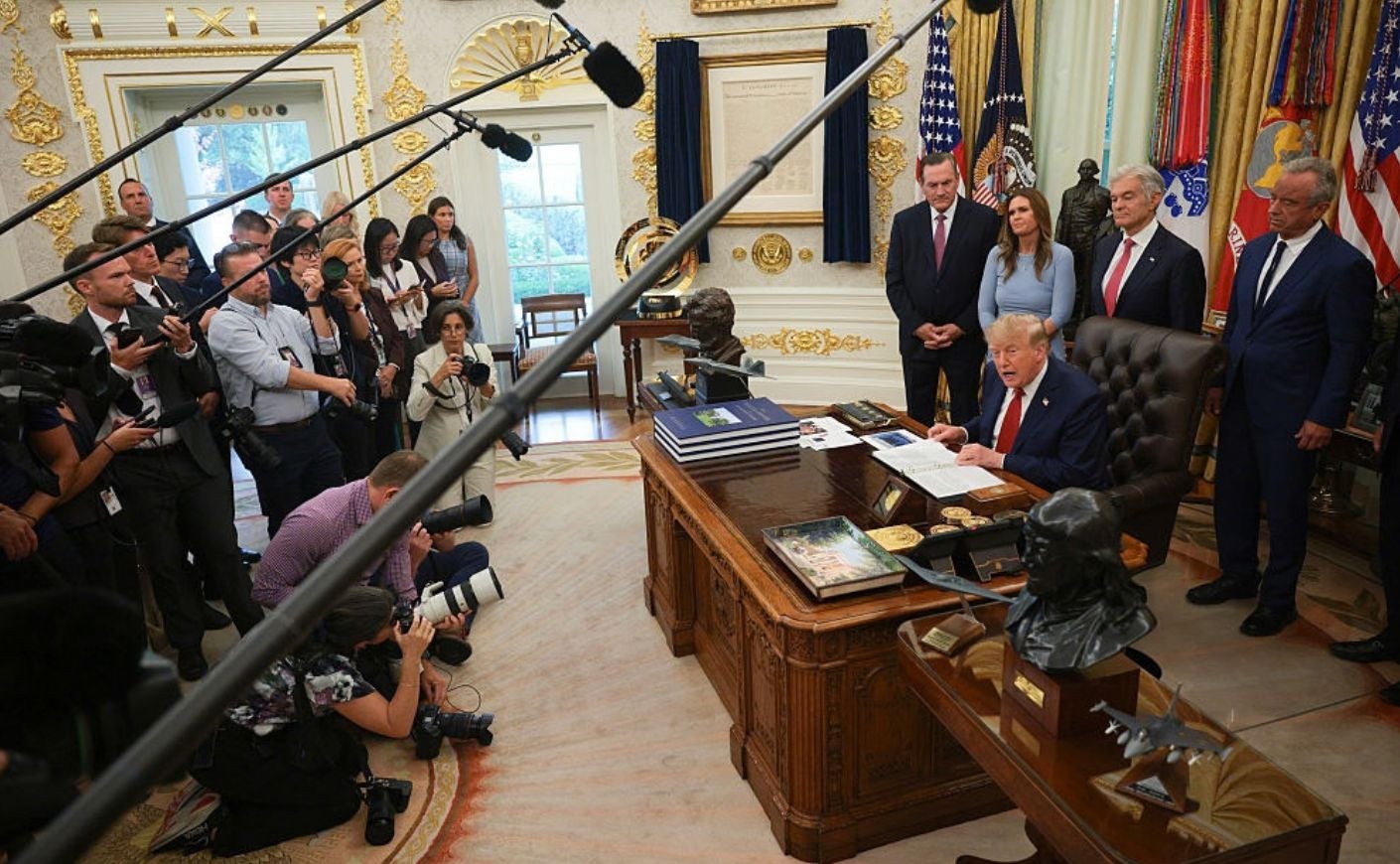
- The White House bans threaten press freedom and democratic checks; the issue is preserving a free press, not just CNN.
- Trump’s control over the press pool and access changes who asks questions, favoring friendly outlets over traditional reporters.
- Blocking outlets limits what the broader press can see and report, prompting rare solidarity among networks to defend pool norms.
CNN’s chief political correspondent Dana Bash has been reporting on presidents and politics for decades — and lately, she’s been thinking a lot about the institutions that underpin American democracy and what happens when they’re tested.
It’s a theme she explores in her new book, The Elections That Changed the World: Fifteen Pivotal Moments That Shaped How We Live. While the book is a retrospective, Bash can't ignore the latest in the history-making presidency playing out in real time: President Trump has barred CNN, MS NOW, and Politico from the White House, escalating an already contentious relationship with the journalists who cover his administration. The three news organizations have since sued the Trump administration, arguing that the ban violates their First Amendment rights.
For Bash — and many others in the industry — the move was “shocking and not surprising at the same time.” She acknowledges that a White House press pass is something journalists hold “very, very dear,” and says it shouldn’t be taken away simply because a president dislikes a news organization’s reporting.
“He doesn’t like coverage that is holding him accountable,” she tells Katie Couric Media.
“It’s not about CNN”
The stakes go well beyond which reporters are allowed through the White House gates.
“It’s not about CNN or Politico or MS NOW,” she says. “This country was founded on a free press in order to keep authority and leadership in check.”

Bash has covered national politics across multiple administrations, dating back to George W. Bush, when she served as CNN’s White House correspondent. The closest comparison she can think of came during Trump’s first term, when the White House revoked CNN correspondent Jim Acosta’s press credential following a contentious 2018 news conference. The network sued, and a federal judge ordered the administration to temporarily restore Acosta’s access. Days later, the White House fully reinstated his credential, and CNN subsequently dropped the lawsuit. Now, the latest case has landed before the same judge: U.S. District Judge Timothy Kelly, a Trump appointee who issued the 2018 ruling in Acosta’s favor.
Bash sees the current fight as part of a broader shift in how the White House deals with the press. She draws a distinction between Trump’s willingness to take questions and the way his administration has reshaped who gets access to ask them. In February 2025, the White House took control of the press pool from the White House Correspondents’ Association, which had managed the system for decades.
“He likes to talk about the fact that he’s the most transparent president because he takes questions all the time,” Bash says. “And that is true, and that is very much appreciated.”
What’s different, she says, is who gets into the room. The White House now has greater control over the pool, whose ranks have expanded to include people Trump knows “will talk about how wonderful he is.”
“That is really not the traditional way reporters handle any newsmakers,” Bash says.
Then there’s “Trump TV,” the president’s newly launched streaming service, which Bash sees as another example of the administration producing its own version of events rather than relying on independent news organizations.
“It’s not journalism,” she says. “It’s a giant press release in the form of a streaming service.”
What happens when reporters aren’t in the room
Bash says that the consequences of the ban aren’t theoretical — they’re already changing how CNN can cover the president.
When Trump meets with foreign leaders, for example, a small group of pool reporters would ordinarily be allowed into the room at the beginning of the meeting, giving them a chance to observe the interaction and ask questions on behalf of the broader press corps. The system is designed so that whichever network is assigned to cover the president that day is gathering news for everyone — not just itself.
“When I’m a pool reporter, I am not just asking questions for CNN,” Bash explains. “I’m asking questions on behalf of all of the television networks.” Right now, Bash emphasizes, that isn’t happening.
So barring one outlet can have consequences well beyond that outlet, limiting what the broader press corps can see, ask, and ultimately report to the public.
The ban has also produced an unusual show of solidarity among news organizations that are normally fierce competitors. After CNN was barred from fulfilling its scheduled television pool duties, ABC, CBS, NBC, and Fox News declined to step in — leaving the president without the usual independent network television coverage. Bash calls that response “heartening.”
But in some ways, she says, that cooperation is simply the pool system working as intended. There isn’t enough room for every reporter, camera crew, and photographer to follow the president everywhere he goes, so news organizations rely on one another to cover him for everyone.
And for that system to work, those competitors have to trust one another to hold the line. So far, Bash says, “the alliance is holding.”
