






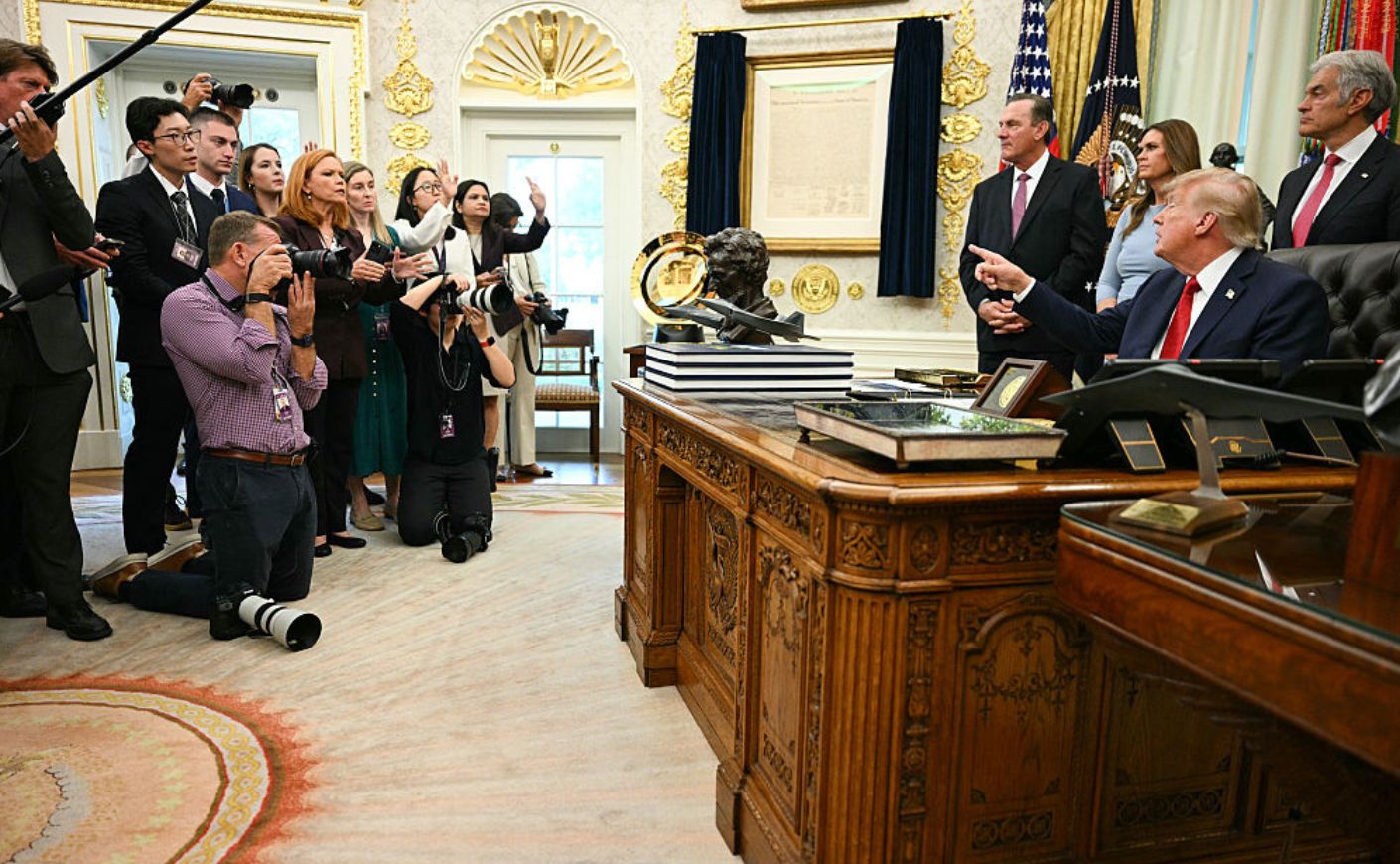
President Trump’s long-running battle with the press has just entered a new phase.
On Saturday, reporters from CNN, Politico, and MS NOW showed up to the White House only to be turned away, their press credentials confiscated or disabled. The move came one day after Trump announced he was banning all three organizations over unflattering coverage — and warned that other outlets could be next.
The decision has sparked an outcry across the media industry and raised a much bigger question: How far can a president go in deciding which news organizations get access to the White House?
“All outlets covering the White House have a stake in this case,” Bruce Brown, president of the Reporters Committee for Freedom of the Press, tells Katie Couric Media.
Here’s what we know about the ban, who could be next, and the legal fight that may be coming.
Why did Trump ban CNN, Politico, and MS NOW?
Trump announced the ban Friday on Truth Social, saying it was effective immediately and accusing CNN, Politico, and MS NOW of repeatedly reporting what he called “FAKE NEWS.”

“Media Outlets shouldn’t be able to constantly write or report FICTION and LIES when they’re covering the President of the United States, the Trump Administration, or the United States of America,” Trump wrote.
But the president didn’t point to a particular story that prompted the decision. When reporters asked him about the move later Friday, Trump said it was based on the outlets’ coverage over time, repeatedly accusing them of publishing negative and dishonest stories.
He also singled out Politico, pointing to roughly $8 million that federal agencies spent on subscriptions to the outlet during the Biden administration, spending that Trump cut after returning to office.
As for what the ban would actually entail, Trump suggested it would be sweeping. “I don’t want them here," he told reporters. "I would say the ban would go as far as you can.”
Trump also left open the possibility that the outlets could eventually regain access if he believed their coverage changed, saying, “if they could straighten themselves out,” he would like to have them back.
By Saturday, the ban had become a reality. Reporters from CNN, Politico, and MS NOW were turned away from the White House, with some saying their press credentials had been confiscated or disabled.
How CNN, Politico, and MS NOW Are Responding to Trump’s White House Ban
All three outlets have vowed to continue covering the Trump administration.
On Friday, before the ban went into effect, CNN called the move an “illegal assault” on its constitutional rights. And after its reporters were turned away, the network made clear it wasn’t backing down, saying in a statement that its "mission to report on the U.S. government will continue regardless of any attempts to restrict physical access to the White House and other government buildings, or any other attempts to impede our journalism."
Politico struck a similar note. In an email to the newsroom, editor-in-chief Jonathan Greenberger said the publication stands by “all reporters here covering the White House," adding that it will "vigorously defend our First Amendment rights."
MS NOW, meanwhile, signaled it could take the fight even further. The network vowed to take “any and all steps necessary to defend our First Amendment rights,” adding that “The White House belongs to the American people.”
So far, none of the three news organizations have formally announced a lawsuit.
Could other news outlets follow?
Trump has suggested he may not stop with CNN, Politico, and MS NOW.
“Other Fake News Media Outlets to follow,” he wrote in his initial post announcing the ban. When reporters pressed him on what that meant Friday, Trump singled out two of the country’s biggest newspapers, calling The New York Times “so fake” and The Washington Post “disgusting.” He stopped short, however, of explicitly saying he planned to ban either outlet from the White House.
Both newspapers have since pushed back — and they’re far from alone. The Times called Trump’s latest move “yet another retaliatory and unconstitutional threat” and said it “stands in support of the news organizations being unfairly targeted by the president.”
The Post, meanwhile, called White House access a “non-negotiable constitutional right” and described the move as “a clear form of intimidation meant to silence coverage.”
Other major news organizations have also rallied behind the three outlets, including some of their biggest competitors. Coming off its own legal battle with the Trump administration over White House access, The Associated Press said it stood with CNN, MS NOW, and Politico.
“No news organization — or person — should be retaliated against by the government over the words they use,” AP spokeswoman Lauren Easton said in a statement.
Even some conservative media figures have taken issue with Trump’s latest media restriction. Fox contributor Ari Fleischer said conservatives should challenge liberal reporters, not shut them out. “Argue and defeat them,” he said. “Don’t ban them. Or one day they’ll ban us.”
Another Fox contributor, Jonathan Turley, similarly warned that “barring disfavored media from the White House is a terrible precedent and practice.”
And Jacqui Heinrich, a Fox News anchor and the president of the White House Correspondents’ Association, said in part on X that First Amendment protections “do not depend on whether the president likes a news organization’s coverage.”
Could Trump’s ban hold up in court?
First Amendment experts say a legal challenge could be coming.
Bruce Brown, president of the Reporters Committee for Freedom of the Press, told Katie Couric Media that the affected outlets have “a very strong case that their rights have been violated” and predicted a lawsuit is “both likely and imminent” if their access isn’t restored.
Jameel Jaffer, executive director of the Knight First Amendment Institute at Columbia University, said in a statement that the First Amendment prohibits the president from punishing journalists because he dislikes their coverage. And if Trump intends to exclude the outlets from the White House press pool, Jaffer said the move is “doubly unconstitutional” because the pool is a “public forum” under the First Amendment, meaning journalists cannot be excluded based on their viewpoints.
There’s also precedent for White House press fights ending up in court. Last year, the Associated Press sued the Trump administration after the White House restricted its access to certain presidential events over the news agency’s decision to continue using “Gulf of Mexico” rather than Trump’s preferred “Gulf of America.” A federal judge initially ruled that the administration could not restrict the AP or other journalists based on their viewpoints, though an appeals court later paused parts of that ruling while the case continued.
During Trump’s first term, CNN correspondent Jim Acosta and Playboy correspondent Brian Karem also successfully challenged attempts to revoke or suspend their White House credentials. Federal judges ordered their passes be restored, but the decisions were made on due-process grounds rather than weighing in on the First Amendment concerns.
Those cases aren’t identical to what’s happening now. But they help explain why the latest ban is drawing legal scrutiny, particularly because Trump has explicitly tied the decision to coverage he dislikes.
Amy Kristin Sanders, the John and Ann Curley Chair in First Amendment at Penn State, warned that the implications could extend beyond this particular dispute. “If the courts are unwilling to stand up to the President's brazen attempts to limit critical reporting, it's not a stretch to believe other government leaders in the United States and abroad will follow suit,” she tells Katie Couric Media.
Trump, for his part, has suggested he’s prepared to test the issue in court again. When a reporter noted Friday that a judge had restored Acosta’s credentials, Trump responded: “Depends on the judge you get, to be honest with you.”
