






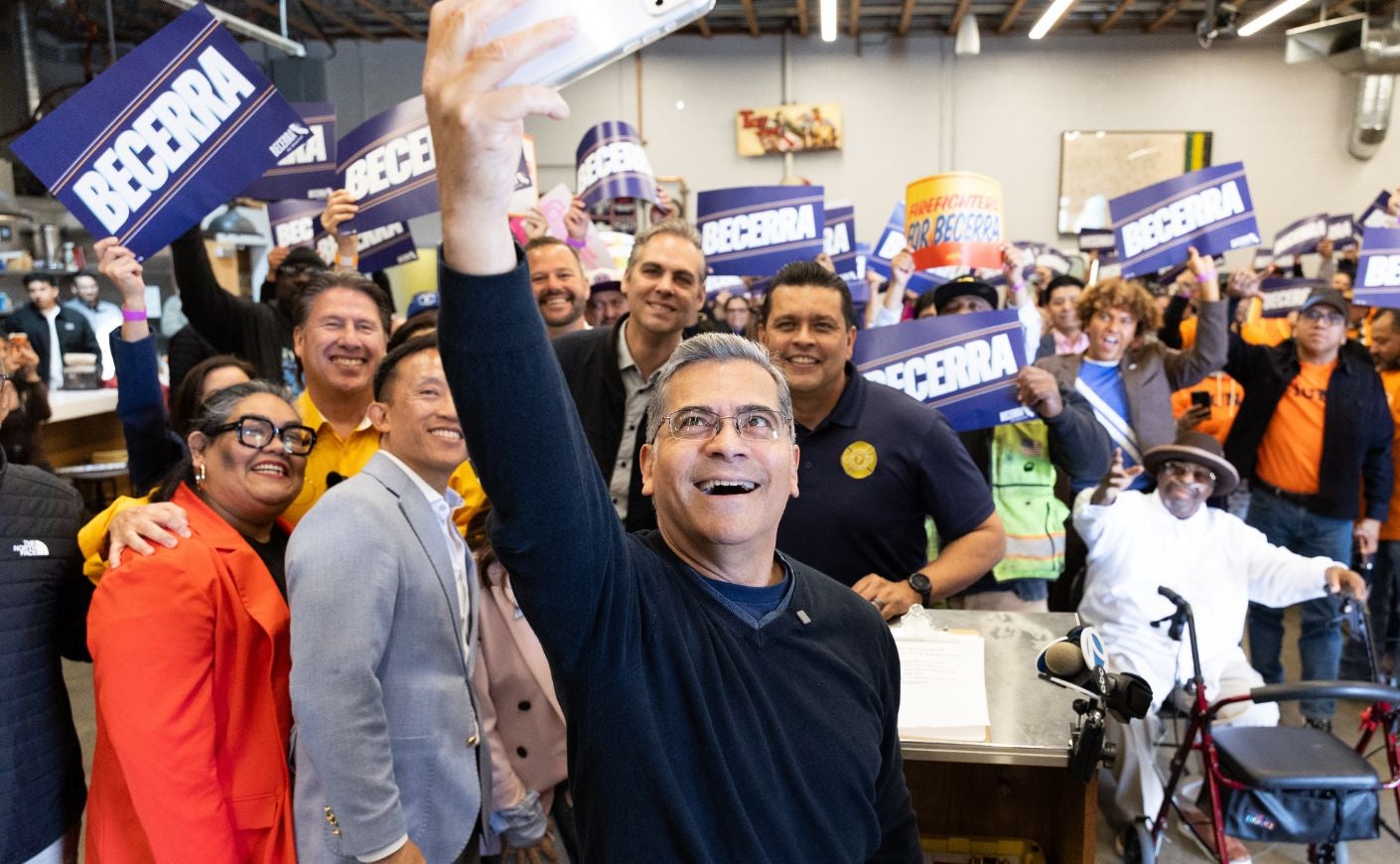
California's race to replace outgoing Gov. Gavin Newsom is already shaping up to be one of the most closely watched elections of 2026. The contest has drawn a crowded field of Democrats, a pair of high-profile Republicans, and growing national attention as both parties look for clues about the political future of the nation's most populous state.
But for all the attention, the race remains remarkably unsettled. No candidate has emerged as a clear frontrunner, and with voters heading to the polls Tuesday for primaries, there's still plenty of uncertainty about who will advance to the general election. California's vote-counting process can take days — sometimes weeks — meaning the final two candidates may not be revealed on election night.
We're explaining what's on the line, why the contest is so unpredictable, and who the candidates vying to replace Newsom are.
Why is California's governor's race so important?
California's next governor won't just lead the nation's most populous state — they'll inherit a position that has long served as one of the most influential platforms in Democratic politics.
The Golden State's influence extends well beyond its borders. Home to nearly 40 million people, a roughly $4 trillion economy, and 54 electoral votes, California is often a testing ground for policies that later shape national debates.
With Newsom ending his second and final term, the race comes at a pivotal moment for the Democratic Party, which is still searching for its identity after the 2024 election loss. California remains one of the party's strongest states, and strategists across both parties nationwide will be watching closely for clues about which messages resonate with voters. The election will also coincide with the state's first use of newly redrawn congressional districts, making California a key political battleground far beyond the governor's mansion.

The contest could also have implications for 2028. While several potential presidential contenders chose not to run, the eventual winner will instantly become a national Democratic figure — and a potential participant in the next presidential primary.
Why is it so unpredictable?
Part of the answer lies in who's not running.
Several high-profile Democrats who likely would have entered the race with strong name recognition and fundraising networks chose to sit it out, including former Vice President Kamala Harris, California Attorney General Rob Bonta, and Sen. Alex Padilla. Their absence left the field wide open, creating an unusually large group of candidates competing for many of the same voters.
California's "top-two" primary system — sometimes called a "jungle primary" — has only added to the uncertainty. Instead of holding separate Democratic and Republican primaries, all candidates appear on the same ballot, and the two top vote-getters advance to the general election regardless of party.
That means candidates aren't just competing against the opposing party — they're competing against everyone else in the race. With so many contenders vying for support, votes can splinter across the electorate, making it difficult for anyone to establish a clear lead.
Candidates include former Health and Human Services Secretary Xavier Becerra and former Rep. Katie Porter. At one point, former Rep. Eric Swalwell appeared poised to emerge as a frontrunner. But after dropping out in April following allegations of sexual assault and misconduct, the field was thrown open once again.
For much of the lead-up, Democrats feared that a congested field could split the vote and hand both general-election spots to Republicans Steve Hilton and Chad Bianco. But GOP consultant Rob Stutzman said voters have increasingly rallied behind the strongest Democratic contenders as the possibility of a GOP-versus-GOP matchup came into focus.
"So they may like Katie Porter or Matt Mahan the most, but what's most important to them is not to have a Republican governor," Stutzman told The Washington Post.
That shift has made a Democratic shutout less likely.
Where do the polls stand?
A new Emerson College survey released Saturday found Democrat and former Health and Human Services Secretary Xavier Becerra leading the field with 28 percent of the vote. Fellow Democrat Tom Steyer followed at 22 percent, while former Fox News host Steve Hilton, a Republican, trailed closely at 21 percent.
Another closely watched poll released a day earlier by the Berkeley Institute of Governmental Studies painted a slightly different picture, showing Becerra at 25 percent, Hilton at 21 percent, and Steyer at 19 percent.
Despite the minor differences between the polls, one thing is clear: Becerra, Steyer, and Hilton appear to have separated themselves from the rest of the pack.
But California's top-two primary system means even small shifts in turnout — or a surge of late-deciding voters — could reshape the outcome.
Who are the major contenders?
Former Health and Human Services Secretary Xavier Becerra
Former Health and Human Services Secretary Xavier Becerra is one of the most experienced candidates in the field. In addition to serving in President Biden's Cabinet, he previously served as California's attorney general and spent more than two decades in Congress.
After languishing in the single digits for months, Becerra has surged into the top tier of the race. Analysts attribute his rise to a combination of his extensive government experience and growing support among Latino voters, who make up roughly 30 percent of California's electorate. California Democratic consultant Danielle Cendejas told The Hill that enthusiasm among Latino voters has been a "driving force" behind his campaign.
Becerra has also cast himself as a steady hand in a moment of political uncertainty, citing his battles with the Trump administration as attorney general and his experience leading one of the federal government's largest agencies.
Former California Rep. Katie Porter
Former California Rep. Katie Porter built a national following through her combative congressional hearings and viral whiteboard presentations. Porter is positioning herself as a progressive fighter focused on affordability, consumer protection, and holding powerful interests accountable.
Porter is also betting that her national profile and grassroots fundraising network will help her break through in a race packed with well-known Democrats. Her campaign has emphasized her ability to communicate complex issues in accessible terms and energize Democratic voters frustrated with the political establishment.
At the same time, Porter has had to contend with criticism from some former staffers, who have alleged difficult working conditions in her office. Those concerns resurfaced last year when Politico published a video showing Porter berating a staffer during a 2021 event with the Biden administration. Porter has pushed back on criticism of her management style, but the allegations have continued to loom over her campaign.
Former Los Angeles Mayor Antonio Villaraigosa
As the former mayor of Los Angeles, Antonio Villaraigosa is running on his executive experience and record governing one of the country's largest cities. A longtime fixture in California politics, he previously served as speaker of the California State Assembly before becoming the first Latino mayor of Los Angeles in more than a century.
Villaraigosa has sought to present himself as a pragmatic Democrat focused on results rather than ideology, arguing that his experience managing a major city has equipped him to tackle issues such as housing affordability, homelessness, and public safety. Though he's polling low, he's hoping to tap into his longstanding relationships within California's political establishment and Latino communities.
Billionaire Tom Steyer
Billionaire investor and climate activist Tom Steyer is no stranger to politics. After spending millions backing Democratic causes and launching a 2020 presidential campaign, Steyer is now pitching himself as an outsider who can bring business experience and urgency to issues such as climate change, housing affordability, and economic inequality.
Despite skepticism about whether another wealthy self-funded candidate could gain traction, Steyer has emerged as one of the race's strongest contenders.
San Jose Mayor Matt Mahan
San Jose Mayor Matt Mahan is one of the race's younger candidates and has sought to carve out a more centrist lane. Mahan has focused heavily on housing affordability, homelessness, and improving government performance.
He has often argued that California's biggest challenges are not ideological but managerial, making government accountability and results a central theme of his campaign. That message has helped distinguish him from both the party's establishment and progressive wings.
Mahan has also garnered attention for advocating a tougher approach to homelessness than some fellow Democrats, including proposals that more closely tie public assistance to treatment and shelter participation.
Former Fox News host Steve Hilton
The former Fox News host Steve Hilton is one of the most prominent Republicans in the race. Born in the United Kingdom, the conservative commentator previously served as a senior adviser to former British Prime Minister David Cameron before moving to California and becoming a prominent conservative media personality.
He has centered his campaign on crime, homelessness, affordability, and criticism of California's Democratic leadership. Hilton has argued that California's high cost of living is driving residents and businesses out of the state, framing his campaign as an effort to reverse what he calls years of policy failures under one-party Democratic rule.
Riverside County Sheriff Chad Bianco
Riverside County Sheriff Chad Bianco has emerged as a favorite among some conservative voters. Running to Hilton's right, Bianco has built his campaign around public safety, immigration enforcement, and opposition to many of California's progressive policies.
A longtime law enforcement official, Bianco gained statewide attention during the Covid-19 pandemic for criticizing state lockdowns and refusing to enforce certain public health mandates. He has since become a vocal critic of California's Democratic leadership, arguing that the state's approach to crime, homelessness, and immigration has failed Californians.
His outspoken style and willingness to challenge state officials have made him a favorite among some conservative activists, but his hardline positions could also make it harder to expand his appeal in a heavily Democratic state.
