






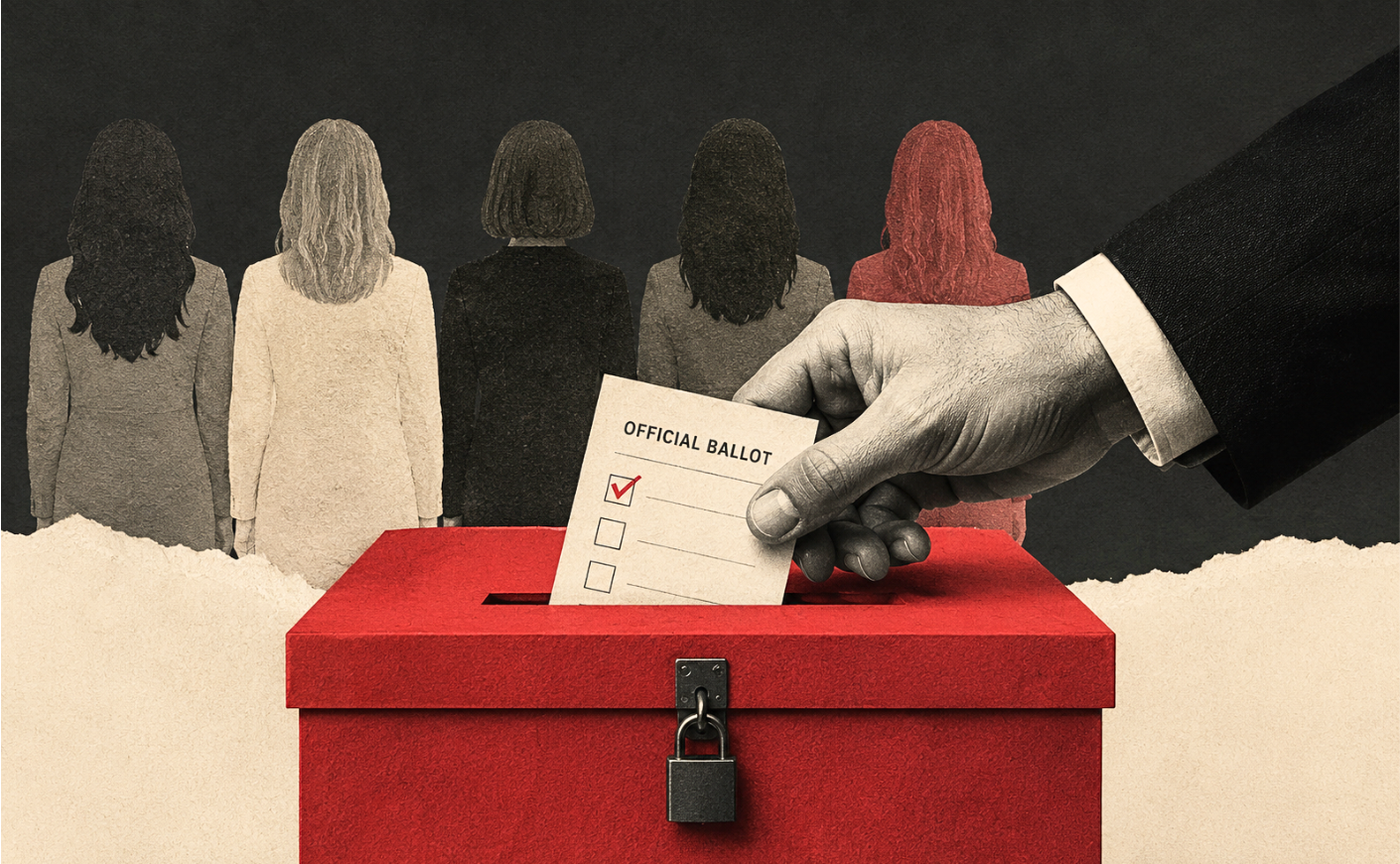
At a recent conference hosted by Turning Point USA, several conservative women were asked a question that would have seemed unimaginable to many Americans just a few years ago: Would they be willing to give up their right to vote? Some said yes.
The discussion centered on a concept known as "household voting," the idea that families — rather than individuals — should serve as the basic political unit in society, with a husband, father, or some kind of male figure casting a single vote on their behalf.
Once largely confined to a small corner of the religious right, the idea has gained visibility in recent years among some Christian nationalists and advocates of "biblical patriarchy," a belief system which teaches that men should lead their families, and that women should submit to their authority.
Here's what to know about household voting, where the idea comes from, and why some experts believe its growing visibility matters.
What is household voting?
In practice, household voting would mean that women would no longer cast their own ballots, despite having had the constitutional right to vote since the ratification of the Nineteenth Amendment in 1920.

There are some clear logistical issues with this premise. What about households without a husband — such as those headed by divorced women, widows, or women who have never married? Who, if anyone, would vote on their behalf? Even some supporters acknowledge those challenges, suggesting unmarried women could instead be represented by fathers, brothers, or uncles. But many proponents ultimately envision a society in which women are married — and only to men — leaving same-sex couples outside the family structure the proposal is built around.
Regardless, proponents of household voting often frame the concept as a return to a more traditional social order. They point to eras ranging from the 1950s to the late 19th century — or even 17th-century Puritanism — as models, arguing that society functioned better before the rise of feminism, no-fault divorce, legalized abortion, and other changes that expanded women's rights and independence.
Historian Beth Allison Barr disputes the idea that household voting would restore a lost American custom, arguing that the society its supporters envision never actually existed. Barr notes that political power was historically concentrated among a relatively small group of men. "The householder was the wealthy white man who had the vote," says Barr, author of The Making of Biblical Womanhood: How the Subjugation of Women Became Gospel Truth. "So it was more about class privilege and racial privilege."
Where did household voting come from?
Household voting is closely tied to biblical patriarchy, a belief system that holds that men should lead their families, and that women should submit to that authority. Under that framework, the husband serves as the family's representative in both the home and public life.
"The household vote concept is really part of the foundations of a Christian society," says Kristin Kobes Du Mez, says the historian and author of Live Laugh Love: The Secret History of White Christian Women and the World They Made. "Individualism is the antithesis of a well-ordered Christian society."
Though its roots go back much further, biblical patriarchy gained new momentum in evangelical circles in the 1990s and early 2000s through Doug Phillips, the founder of Vision Forum Ministries and a leading advocate of household voting. The movement increased its visibility in recent years. Today, one of its most influential voices is Doug Wilson, the Idaho pastor who helped shape the denomination that Pete Hegseth attends and has argued that the U.S. should be governed according to Christian principles.
Tia Levings — whose bestselling memoir, A Well-Trained Wife: My Escape From Christian Patriarchy, recounts her years in a marriage shaped by those beliefs — says supporters often frame household voting as a way to promote harmony. Women are often told that surrendering political authority will strengthen their marriages and reduce conflict. "The primary sales point is that the man already makes all the decisions for the family. Why wouldn't he also represent you in politics and cast your vote?" she says.
But Levings argues that household voting is part of a broader effort to concentrate authority in the hands of men. "When you give up your voice, you give up your rights," she adds.
Why are people talking about household voting now?
In recent years, ideas once largely confined to patriarchal religious communities have increasingly entered mainstream political conversations.
Du Mez says that the shift reflects an attempt to move once-fringe views into popular political discourse. "These ideas are being platformed more brazenly and more unapologetically, and moving from a kind of quiet subculture into the mainstream," she tells us.
Defense Secretary Pete Hegseth has echoed similar beliefs, including sharing a clip last summer of pastors in his ultraconservative denomination arguing that women should be barred from voting.
The discussion has also emerged amid broader debates over voting rights and women's political participation. Some point to the SAVE Act, a Republican-backed proposal that would require documentary proof of citizenship to register to vote in federal elections. Voting-rights advocates have raised concerns that the measure could create additional hurdles for some married women whose birth certificates do not match their current legal names.
For Levings, the discussion underscores how such beliefs can spread even without changes to the law. She argues that cultural and religious pressure can encourage women to voluntarily cede authority to their husbands.
"When proponents of these ideas aren't able to legislate these changes, they will get women to self-subjugate," she says.
