






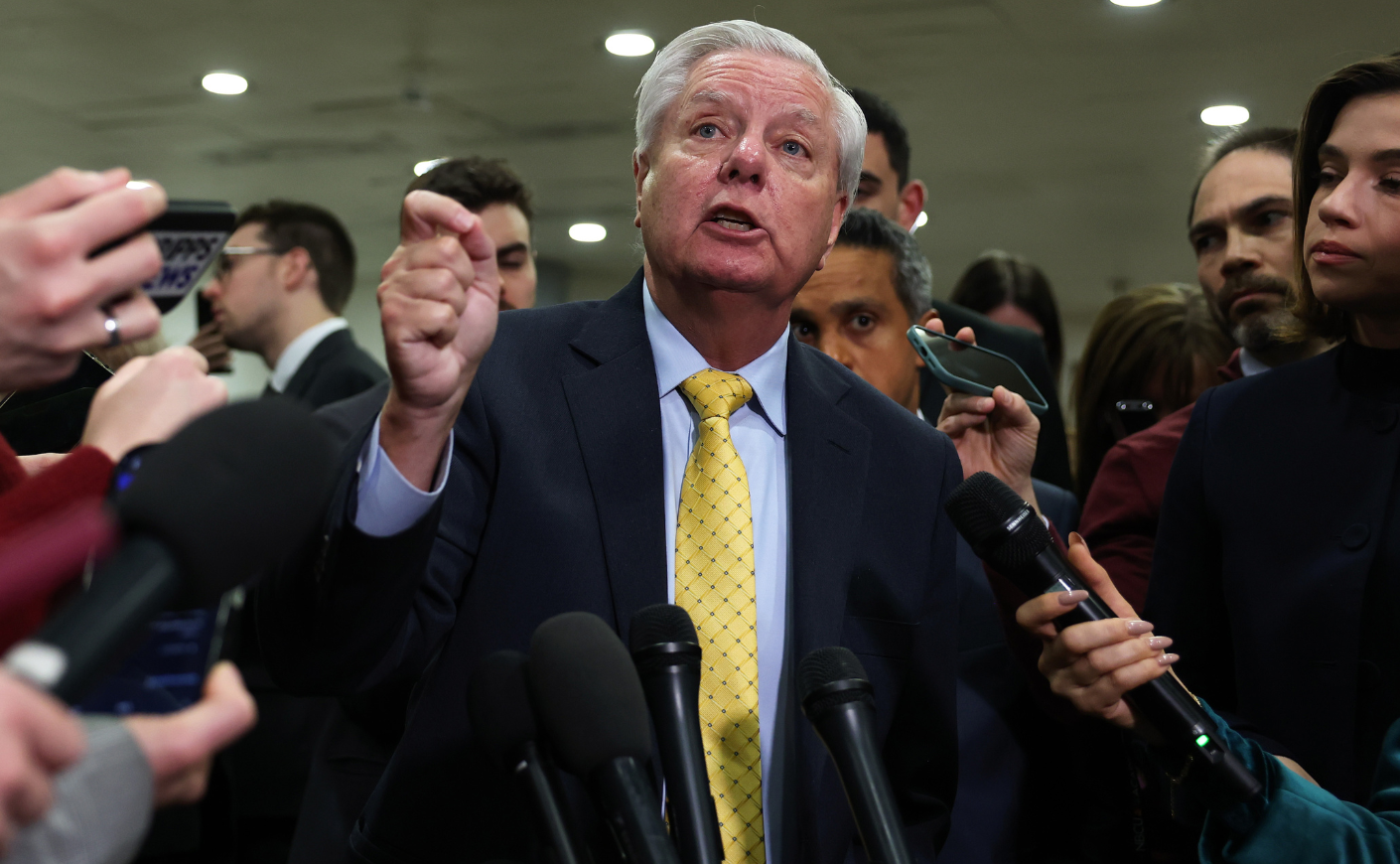
Lindsey Graham, an influential Republican senator from South Carolina, died on Saturday of a "brief and sudden illness," his office said in a statement. He was 71.
Graham, a former Air Force lawyer who served in Congress for three decades, had recently returned from a trip to Ukraine and was scheduled to appear on Meet the Press over the weekend. President Trump, who made an appearance on the show on Sunday, said he had recently spoken to Graham and that he "sounded a little bit tired, but perfect." He ordered flags be flown at half-staff until Saturday evening to honor the late senator, according to the Associated Press.
Graham's office said Sunday that the preliminary cause of death was "aortic dissection due to arteriosclerotic cardiovascular disease," or a rupture to his aorta, NBC reports.
Graham, who strongly advocated for American military intervention abroad, advised Trump on foreign affairs, working with him closely on issues like the Iran war and U.S. relations with Russia. However, he was not initially a fan of the president, referring to Trump as a "demagogue" during his 2016 campaign and voting instead for Evan McMullin, an independent candidate.
Graham led two powerful committees during his career. From 2019 to 2021, he chaired the Senate Judiciary Committee, overseeing the confirmation of Amy Coney Barrett to the Supreme Court and confirming more than 200 federal judges. As head of the Senate Budget Committee since January 2025, he helped Republicans pass major tax and immigration legislation without support from Democrats by way of a legislative procedure known as reconciliation.
On social media Sunday, Trump called Graham "one of the greatest people and Senators I have ever known." Israeli Prime Minister Benjamin Netanyahu wrote, "Israel has lost one of its greatest friends. America has lost a great patriot. I have lost a beloved friend."

Who will replace Lindsey Graham?
Under South Carolina law, Republican Gov. Henry McMaster can appoint a temporary replacement for Graham to finish out his term. Trump said Monday that he would like to see Graham's sister, Darline Graham Nordone, serve out the rest of his term and that he made the recommendation to McMaster, who's expected to name a replacement later today. "This would be a fabulous tribute to Lindsey, who loved her dearly," Trump said.
The late senator took legal guardianship of Nordone when he was 22 and she was 13, after the death of their parents. Nordone has actively supported Graham throughout his political career and has consistently attended his political events, CBS reports.
Sen. Tim Scott, Graham's counterpart in the Senate, initially said that he wasn't sure who McMaster would pick, but that "there are at least one or two Congress members" he expected to see on the shortlist. But since Trump's endorsement, Scott has said that Nordone would be a "wonderful placeholder."
Last month, Graham had beaten five challengers to win the Republican primary and was expected to win a fifth term in November. A special election will be held in August to determine who will replace the longtime senator on the ballot, the New York Times reports. If no one secures a majority, a runoff will be held between the top two candidates.
South Carolina Rep. Nancy Mace is reportedly considering running for his seat and is expected to conduct polling this week to see how she'd fare in a primary, per The Hill. Mace placed fifth in a Republican primary for governor last month and was set to leave Congress in January. But after news of Graham's death broke, she posted a clip from The Godfather Part III, writing: "Just when I thought I was out... they pull me back in..."
Lt. Gov. Pamela Evette, who also ran unsuccessfully for governor and was endorsed by President Trump, is another potential candidate, NBC reports. Mark Lynch, a businessman who came in second in his primary against Graham with 29 percent of the vote, has not said whether he will run again; neither has third-place finisher Thomas Keith Dismukes, a motivational speaker.
The winner of the special election will face Annie Andrews, MD, a Democrat and pediatrician, in the general election in November. She paid tribute to Graham on social media Sunday, writing, "I hope that South Carolinians will join me in setting partisanship aside and offering gratitude to Senator Lindsey Graham for his service to the great state of South Carolina."
How will this affect legislative issues?
As chair of the Senate Budget Committee, Graham was in the early stages of trying to muscle through Trump's voter ID bill via a reconciliation process, CNN reports. The SAVE America Act doesn't have the votes to pass, frustrating Trump, who's pushed conservatives to eliminate the filibuster and has refused to sign other bipartisan bills. Trump said that Graham was confident the SAVE Act would pass the Senate and called his death a "big blow" to the bill.
Graham had also recently secured a major victory in his bipartisan push for a new round of sanctions against Russia. The bill has gained renewed support in the wake of his death, with Sen. Jeanne Shaheen, the leading Democrat on the Senate Foreign Relations Committee, writing, “There can be no more fitting memorial to Lindsey, his legacy or the causes he fought for than to pass this legislation and realize his long-held dream of an independent and secure Ukraine."
