






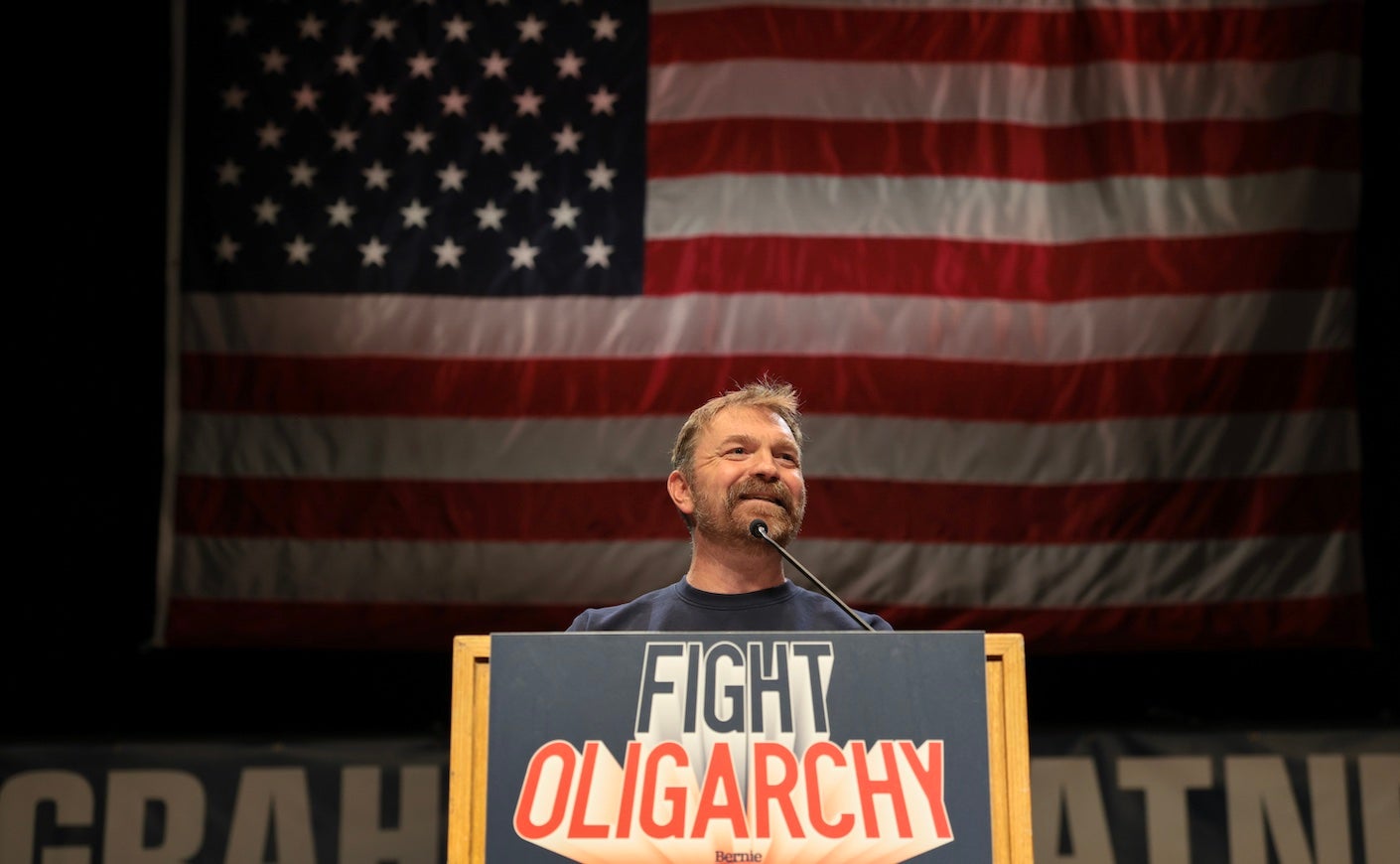
- Former Marine Graham Platner emerged as Democrats' top recruit to challenge Sen. Susan Collins in Maine.
- Multiple scandals: abuse allegations, a sexual assault accusation, explicit sexting reports, offensive online posts, and a tattoo resembling a Nazi symbol.
- Platner denies nonconsensual wrongdoing, apologized for past comments, and says he is reflecting on the campaign's future.
- Top Democrats including Schumer and Gillibrand urged immediate withdrawal and the DSCC will not invest if he stays on the ballot.
- Race remains unsettled: Platner leads primary and keeps progressive support, yet allegations could sway independent and moderate women voters in general election.
Graham Platner was supposed to be one of the Democrats' brightest Senate recruits of the 2026 cycle. The Marine veteran and oyster farmer quickly emerged as a rising political star in Maine, fueling hopes that the party could unseat Republican Sen. Susan Collins and help reclaim control of the Senate.
But as Platner prepares to become his party's nominee, a growing list of controversies has cast uncertainty over what was once viewed as their most promising opportunity.
In recent months, Platner's campaign has been rocked by scandal after scandal: abuse allegations from former girlfriends, reports that he exchanged sexually explicit messages with multiple women early in his marriage, and resurfaced social media posts and questions surrounding a tattoo that resembled a Nazi symbol. Now, a former partner publicly accused him of sexual assault, an allegation he's denied.
In a video statement, Platner acknowledged the political impact of the accusation and said he was taking time to "reflect on the best path forward" for his campaign while maintaining his innocence.
Senior Democrats, however, say it's time he stepped aside.
Senate Democratic leader Chuck Schumer and Democratic Senatorial Campaign Committee chair Kirsten Gillibrand released a joint statement saying Platner should “immediately withdraw”.

“The allegations reported today are incredibly disturbing – violence, abuse and sexual assault are absolutely unacceptable,” they said. “The DSCC will not invest in the Maine Senate race if Platner remains on the ballot.”
While Platner's political future remains uncertain, here's a closer look at the scandals surrounding him and what they could mean for one of the country's most closely watched Senate races.
What controversies are hanging over Platner's campaign?
Sexual assault allegations
On July 6, Jenny Racicot publicly accused Platner of sexually assaulting her during a 2021 encounter. In an interview with Politico, the Maine Democrat, who said she dated Platner on and off between 2019 and 2021, alleged that he entered her home uninvited while intoxicated and forced her to have sex despite her repeated objections. According to the outlet, Racicot's account was supported by contemporaneous text messages, emails with her therapist, and interviews with people she said she confided in shortly after the alleged assault. Racicot said she was initially reluctant to come forward, explaining that she felt torn "between supporting his politics, but not supporting him as a person."
Racicot had previously been among several former partners who spoke to The New York Times about Platner's behavior. She told the newspaper that he arrived at her home intoxicated in 2021 after she had asked him not to come over. Racicot declined to provide additional details at the time but said she ended contact afterward and described his behavior as "reckless" and "unsettling."
Another former partner, Lyndsey Fifield, a Virginia conservative who worked on Republican campaigns and dated Platner from roughly 2013 to 2015, alleged that he regularly grabbed her hard enough to leave marks. On one occasion, he forced her into a bedroom and held the door shut while telling her to remain there until she was "calm." She also said he frequently talked about killing people he viewed as threats and made repeated comments about rape as an expression of power.
Other women interviewed by the publication described Platner as a safe and caring partner and disputed allegations that he had been abusive.
Speaking on MSNBC in June after the NYT report was published, Platner said he "absolutely" took responsibility for parts of his past, describing the periods after his combat tours in Iraq (2003–2007) and Afghanistan (2010–2011) as "very dark" times marked by heavy drinking, untreated PTSD, and being a "bad boyfriend." He strongly denied allegations that he had physically intimidated or been violent toward former partners, calling those claims "simply not true" and politically motivated.
After Politico published Racicot's account, Platner issued a video statement categorically denying that any non-consensual encounter had occurred, calling "any accusation of non-consensual behavior" false.
The sexting scandal
Platner has come under fire over reports that he exchanged sexually explicit messages with multiple women early in his marriage, though the contents of those messages have not been made public.
Both The Wall Street Journal and The New York Times reported that his wife, Amy Gertner, alerted campaign aides to the messages in 2025 after discovering them, concerned they could become a political liability as his Senate campaign was taking shape.
According to these reports, Gertner disclosed the messages ahead of a major campaign rally featuring Democratic Sen. Bernie Sanders. Campaign aides ultimately concluded the issue was a private matter that the couple was addressing through marriage counseling, and the event proceeded as planned.
Platner's former political director, Genevieve McDonald, said Gertner told her that he had exchanged sexual messages with as many as a dozen women. A current campaign official disputed that figure, telling the Times the number was closer to six and that the communications ended before Platner launched his Senate campaign. McDonald later argued that the Senate is "not a training ground for redemption" but a place for leaders with "moral clarity and integrity."
In a statement to The Wall Street Journal, released through the campaign, Gertner said she believed she was confiding in a trusted friend and defended her marriage, noting that she and Platner had worked through the issue with counseling and honest conversations. “We did the hard work that marriage requires,” she said. Platner, meanwhile, accused the media of trying “to rip” their marriage apart.
Controversial online activity
Platner's campaign was also shaken by the resurfacing of deleted Reddit comments he wrote between 2009 and 2021.
In some of the remarks, he argued that rural white Americans are either racist or stupid and used anti-LGBTQ+ slurs. Other comments from 2013 drew scrutiny for his views on sexual assault in the military. In one exchange, Platner wrote that women should "take responsibility for themselves" and avoid getting drunk to prevent situations that could lead to assault, comments critics said amounted to victim blaming.
The resurfaced material also included a 2019 comment about Army veteran Teddy Daniels, who was wounded during a firefight in Afghanistan and later received a Purple Heart. Platner referred to Daniels as a "dumb motherf****r" who "didn't deserve to live."
His potential opponent, Maine Republican Sen. Susan Collins, called the comments "appalling." Following the backlash, Platner issued a public apology, saying he was ashamed of the remarks and that they did not reflect who he is today.
Platner's tattoo
Platner also drew criticism over a skull-and-crossbones tattoo on his chest that closely resembled the Nazi Totenkopf, a symbol used by the SS, Adolf Hitler's paramilitary force.
The controversy intensified after former girlfriend Fifield told The New York Times that Platner was aware of the tattoo's connection to the Nazi Totenkopf and had referred to it as "my Totenkopf" years before the issue became public.
Platner has denied that claim and said he did not learn of the symbol's Nazi association until reporters raised questions about it during the campaign. He said he got the tattoo while drinking in Croatia in 2007 as a young Marine, choosing the design from a wall in a tattoo parlor without knowing its historical meaning. He has also said military doctors reviewed the tattoo during his service and never identified it as a hate symbol.
Shortly after the tattoo drew widespread criticism, including from the Anti-Defamation League, Platner had it completely covered with a new design in late 2025.
Can Platner survive the fallout?
It's still unclear whether the allegations surrounding Platner will significantly damage his Senate bid. Mark Brewer, a member of the Democratic National Committee and longtime Maine political consultant, says these reports, which are generating extensive media attention, are "not helping" his chances.
At the same time, Brewer noted that misconduct claims may not carry the same political weight they once did. "It's probably safe to say that allegations of sexual misconduct are not instantly disqualifying in the way that they may have been two or three decades ago," he tells Katie Couric Media.
Still, some observers argue the allegations could pose a particular challenge among independent and moderate women — a key voting bloc in Maine. Strategist Ken Altshuler noted that Collins has historically relied on support from women to win statewide races, narrowly carrying female voters by three points in 2020. Recent polling suggests Platner may have an opening with those voters, but Altshuler said the accusations could jeopardize his ability to win over the swing voters who became disillusioned with Collin after her vote to confirm Supreme Court Justice Brett Kavanaugh.
"The allegations are exactly the kind of issue that could undermine the independent swing female voters who were absolutely essential to Graham Platner beating Susan Collins," Altshuler said. "Without them, Graham Platner will not beat Susan Collins."
Yet the stories do not appear to have fundamentally altered the race — at least not yet. Platner remains the overwhelming favorite to win the Democratic primary, and supporters have continued to pack campaign events, underscoring the divide between voters who view him as a flawed but compelling candidate and critics who see him as an electoral liability.
Despite the mounting scrutiny, Platner has retained significant support among his populist and progressive base. High-profile allies, including Vermont Sen. Bernie Sanders and Califbornia Rep. Ro Khanna, have continued to back him, often framing his past as part of a redemption story involving a combat veteran struggling with the lasting effects of war. Critics — including some Democrats — argue that his history could make him an electoral liability in a race the party can ill afford to lose.
Brewer argued that one of the biggest risks for Platner is that the allegations could shape how voters view a candidate who remains relatively unknown to many Mainers.
"You always want to define yourself if you can," Brewer said. "But I'm sure that Collins and her supporters are going to be trying very hard to define Platner in their terms to those voters."
Whether the allegations ultimately change the trajectory of the race may depend on how Maine voters weigh them against broader concerns such as the economy, abortion rights, and the national political environment. With months remaining until Election Day, strategists say the bigger test may come once Collins and outside groups begin spending heavily to define Platner to voters who are only now learning about him.
