






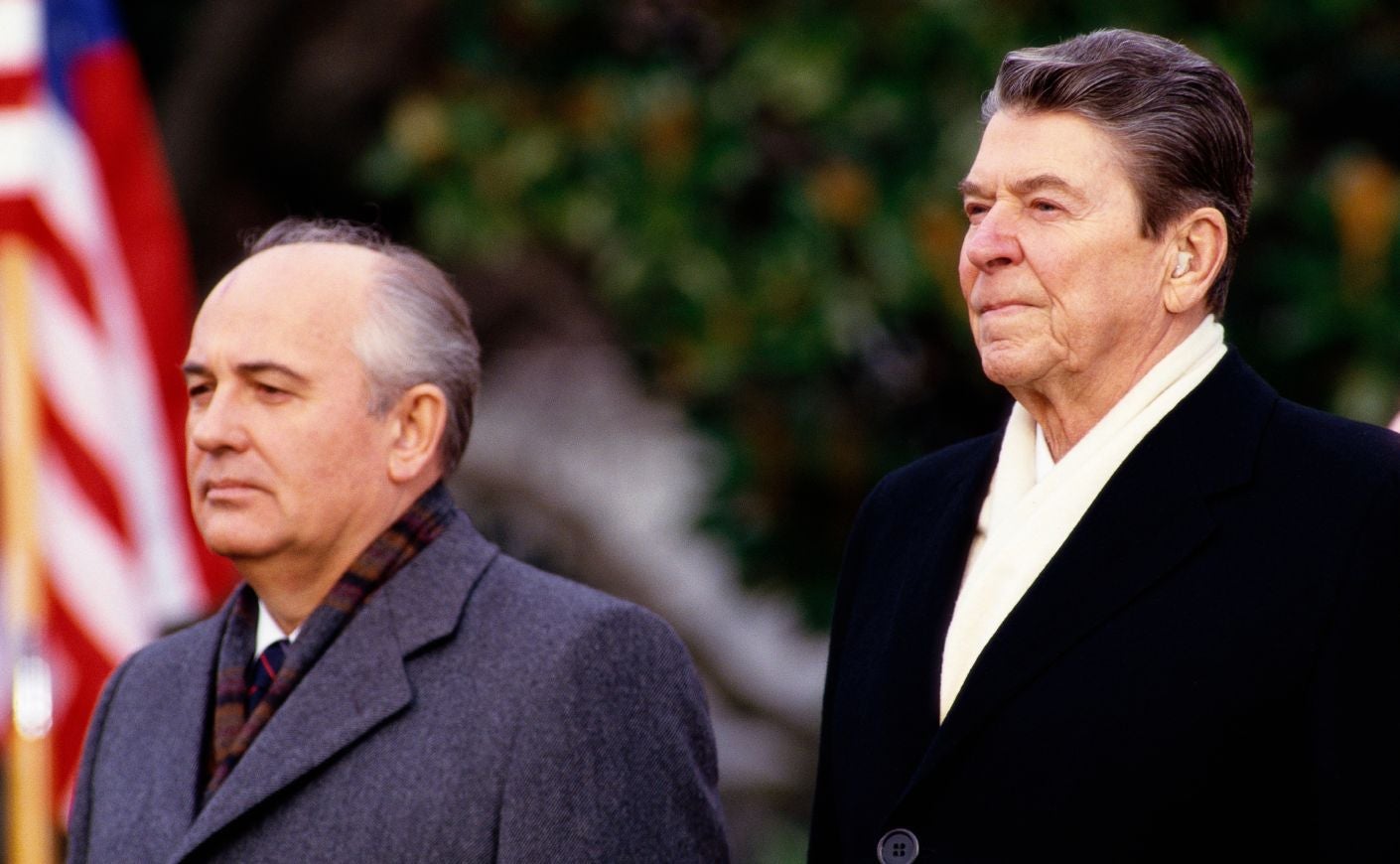
A pivotal Cold War meeting that helped reshape the nuclear arms race is getting renewed attention.
President Ronald Reagan's arms control director, Ken Adelman, was among the few officials with a front-row seat to history at the 1986 Reykjavík Summit, where Reagan and Soviet leader Mikhail Gorbachev laid the groundwork for landmark arms control agreements. Adelman has chronicled the historic negotiations in his upcoming book, The Brink of War. Those same historic events have separately been turned into a feature film starring Jeff Daniels and Jared Harris as Reagan and Gorbachev, respectively. In a full-circle moment, Adelman also finds himself portrayed on screen.
Adelman sat down with us to discuss why the summit still matters nearly 40 years later, what current leaders can learn from it, and the nuclear risks we still face today.
Katie Couric Media: You open the book by arguing we're once again living under the threat of nuclear conflict. Are we closer to a nuclear crisis today than most Americans realize?
Ken Adelman: Yes. More so than many Americans realize.
The "nuclear sword of Damocles," as President Kennedy described it, comes and goes. Right now it's coming back because of the situations involving Iran, Taiwan, and Ukraine. Those are all deeply concerning.
So where would we be today if that meeting hadn't happened? How did it change the nuclear landscape?
First, it began the deep reductions in nuclear weapons between the United States and the Soviet Union, now Russia. Today, the world's nuclear arsenals are roughly 20 percent of what they were during the Cold War.

At the same time, other countries have developed nuclear capabilities, and there's growing concern about unstable regimes — or even breakaway groups — obtaining nuclear weapons.
Second, President Reagan pushed the importance of defensive systems rather than relying solely on offensive weapons. Strategic Defense Initiative (SDI) dominated much of the 10 and a half hours of negotiations at Reykjavík. Looking back 40 years, defensive systems — and now drones — have become among the defining military innovations of our time. Reagan was well ahead of the curve.
Third, Reykjavík accelerated reforms inside the Soviet Union. Those reforms ultimately contributed to the collapse of the Soviet system, the Eastern Bloc, and the legitimacy of communism itself.
Those three developments all trace back, in one way or another, to Reykjavik.
You were in the room during those historic negotiations. What's the biggest misconception Americans have about what happened over those 48 hours?
The biggest misconceptions are that people either don't know it happened or don't realize how consequential it became. Reykjavík set in motion trends that changed the course of history.
That's one reason I'm excited about the film adaptation of The Brink of War. It's opening in theaters on August 14, and I hope it reminds people that this summit happened and that it mattered enormously.
Speaking of the film, were you involved in the filmmaking process?
Not really. For about 10 years, I worked with Michael Douglas on a film adaptation of my earlier book, Reagan at Reykjavík, but that project never got off the ground.
Then, out of the blue, Angel Studios announced this film starring Jeff Daniels, J.K. Simmons, and Jared Harris. My wife and I were able to see a private screening, and I thought it was terrific.
Seeing that movie inspired me to substantially revise my book. I changed the title to match the film, cut back on some of the technical arms-control details, and focused much more on the stories, personalities, humor, and suspense. I wanted people who knew nothing about Reykjavík to pick it up and think, "This is a great story."
Reykjavík was widely viewed as a failure at the time, but history remembers it very differently. What does that teach us about judging diplomacy in the moment?
That's what makes it such a compelling story.
We only had about 10 days' notice before the summit. It was essentially a "come as you are" meeting. We expected very little to happen.
The U.S. ambassador to Iceland was actually told the president would be staying at his residence, then informed there wasn't enough room for him, so he'd have to leave. He stormed off and wasn't seen again during the summit.
Everything about it suggested this would be a brief ceremonial meeting. Instead, it became one of the most consequential diplomatic gatherings of the Cold War.
When the summit ended, the headlines declared it a failure: "Reagan fails." "SDI kills the summit." "Arms control is dead."
A year later, the United States and the Soviet Union signed the INF [Intermediate-Range Nuclear Forces] Treaty, eliminating an entire class of nuclear weapons. As the Soviet Union unraveled and missile defense became increasingly important, it became clear that Reykjavik had been far more consequential than anyone realized at the time.
We thought, “holy cow, this is one of the most significant historical meetings in history."
You've worked alongside some of the biggest names in American foreign policy, including Reagan and Donald Rumsfeld. What did you learn from them about negotiating with adversaries?
First, it was incredibly humbling just to be there.
Outside the conference room stood two military officers — one American and one Soviet — each carrying the nuclear launch codes for their country. They stood about 10 feet apart for the entire summit. That's probably the most unforgettable image I have from Reykjavik.
As for negotiations, Reagan taught me two enduring lessons. First, know exactly where you want to go. Reagan had a very clear objective. He didn't need constant advice because he'd already decided what success looked like. Second, have the courage to stay the course.
Finally, what do you hope readers take away from The Brink of War?
I hope they come away thinking, "What a great story."
It’s about one of the most important diplomatic moments of the Cold War. But it's also funny, suspenseful, personality-driven, and surprisingly entertaining.
History doesn't have to be dry. Sometimes it's the best thriller you'll ever read.
This interview has been edited and condensed for length and clarity.
