





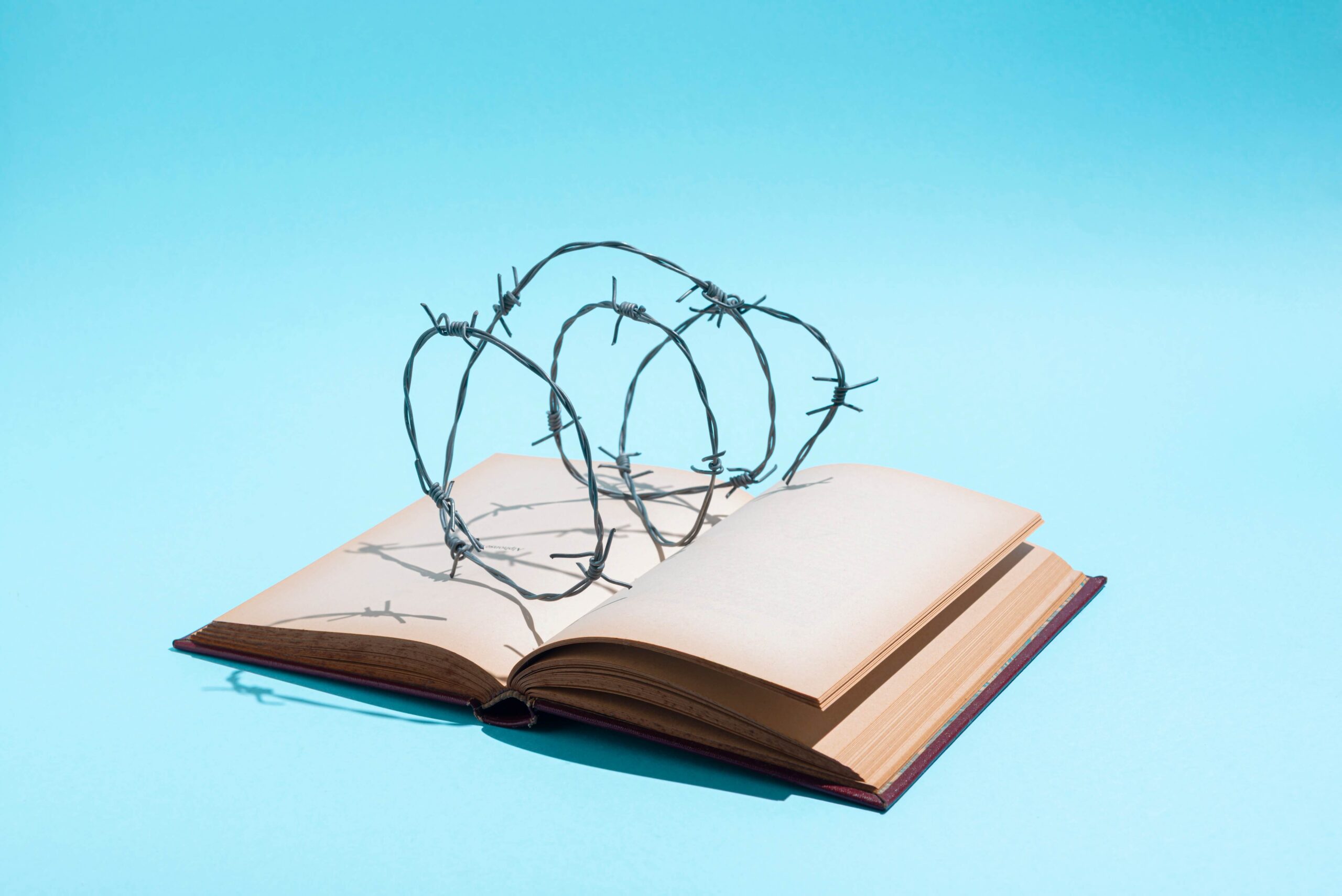
There are so many matters of concern these days. It's difficult to rank order the challenges we face — as a society and as a world community. There are existential threats all around us: the arms race throughout the world, wars, hunger, the effect of a warming climate, the rise of authoritarianism, and the threat of pandemic. And while all of these carry with them great risk, none of them is really an “either/or” problem of our own making. There are, however, problems that we create out of fear and intolerance, issues that we can resolve through reasonable resolution. My candidate for an issue that encapsulates the ignorance, fear, intolerance, and social engineering of our time, is the banning of books. One need not look very far to find a better example of the dumbing-down of America, the impact of over-parenting, and the attack on the free flow of information and education than stripping library shelves of literature and ideas.
The sordid history of book banning
It was Heinrich Heine, the prescient German poet who wrote in 1820: “…where they burn books, they will ultimately burn people as well.”
In 1933, Heine’s words took on a ghoulish meaning when many Germans, including students from one of Germany’s most distinguished universities, gathered to burn over 20,000 books in what is now Bebelplatz. The fact that this happened in front of Humboldt University, one of Germany’s most distinguished institutions of higher learning, imbues the event with even greater meaning. What happened in the decade to come is no secret, as Germany, a center of art, literature, culture, and liberal democracy in Europe, descended into the Nazi killing machine. And, just as Heine predicted, the burning of books later culminated in the burning of people.
I’m not suggesting that the spate of book banning happening in America is leading us toward anything like the Holocaust. But the motivations that led to the book burning and later inhumanities in what once was among the most educated and open societies at the time have their echoes in the parent groups and school boards acting with determination and resolve to spare our youth from reading books deemed too provocative, too profane, too tolerant, or simply too politically objectionable. Those seeking restrictions on what is available in the marketplace of ideas apparently must feel that their intellectual arguments are not enough to prevail. Instead, they will do the next best thing. They will ensure that words and ideas of those with whom they disagree, whom they often label as pursuing an “agenda” to pollute the minds of children (and even adults), must be purged from schools and libraries. The advocates for banning books don’t even trust educators to curate the experience for students, as they are also working to ensure that books whose subject matter is deemed objectionable can no longer be assigned reading in classrooms.
While it might strike some as the government’s duty to ensure that children are protected from ideas and narratives that differ from their parents’, they ultimately may find that cloistering their children in bubbles of limited intellectual rigor will backfire on them. Indeed, they may be surprised to learn this already is happening, as their precious little ones, whose upbringing they wish to curate, are on their laptops, finding stories, information, images, and videos that are far more objectionable.
Although Heine’s warning resulted in a denouement that even Heine likely did not anticipate, one can also look at his fear of the burning of people metaphorically. Each time a book is banned, there is, by definition, a further eroding of the First Amendment’s guarantee of freedom of speech. What's playing out in school boards, library advisory councils, and municipal governments is but one front in the war to limit the availability of objectionable material in our broader community. Each time there's a restriction on a book, it is as if we are, bit by bit, burning the rights the Founders struggled so mightily to ensure for future generations.
Book bans in the modern age
Sometimes the banning of books takes on an almost humorous absurdity. A few years ago, an assistant principal at a Mississippi school was fired because he “showed a lack of professionalism and impaired judgment” when he read a book entitled I Need a New Butt! to second-grade students. The termination letter said, “The topics described in this book were inappropriate.” The basic premise of the book is that the protagonist needed a new butt because his had a crack.
Needless to say, the students found this book quite hysterical, and who wouldn’t at that age? Bodies and bodily functions play well in elementary school. In any case, the assistant principal pointed out the obvious, incredulous at his firing: “It’s a silly book. I’m a firm believer that…if kids see that books can be funny and silly, they’ll hang around long enough to see all the other cool things that books can be.”
PEN America has identified nearly 6,870 instances of censorship covering nearly 4,000 books. They noted that the top banned books focus on themes of race, LGBTQ+ issues, and sexual content. Counted among the top banned books nationally are A Clockwork Orange, Wicked, the Judy Blume books, most of Stephen King’s oeuvre, Anne Frank’s Diary of a Young Girl, George Orwell’s Animal Farm, Aldous Huxley, Kurt Vonnegut, the Harry Potter books, R.L. Stine’s Goosebumps books, Isabel Allende, Faulkner, Steinbeck, Upton Sinclair’s The Jungle — the list goes on and on.
Many of the book bans described above come predominantly from the right, particularly on religious and political grounds. But the left isn't without its own culpability in limiting speech. One such example is the banning of The Adventures of Huckleberry Finn, by Mark Twain, considered by many to be the greatest American novel ever penned. No less a writer than Ernest Hemingway noted that "All modern American literature comes from…Huckleberry Finn.” He described it as "the best book we've had." Another book on the chopping block is To Kill a Mockingbird, the iconic story adapted for the screen in the famous Gregory Peck film.
Objections to both of these books include criticism that Black characters are not fully realized and that the books romanticize the idea of a “white savior.” There are concerns about use of the “N-word” (used derogatorily in the South in which both stories take place), and that the portrayal of Black characters causes harm to students of color. It would seem that children already understand the offensiveness of this word, should understand the impact of slavery and Jim Crow, and need not be reminded each and every time words or historical racism are invoked. To deny children of these two classics is to deny them meaningful expositions on America and what it means to be an American.
I keep coming back to the question, “What are people so afraid of?” People of varying ideologies seem hell-bent on limiting what it is that we can read. Either they contain subjects deemed too sensitive for children, are too critical of our society, show a darker side of history, or use words that might offend (even if uttered in historical context). Some material is banned simply because it is written by people with impermissible flaws in their character.
Parent groups and school boards spend inordinate amounts of time poring over titles (I seriously doubt how many of these books actually are read by the authorities imposing restrictions), leaving more important tasks unaddressed. School boards should be focused on the necessity of producing a literate, math-proficient, critical-thinking, employable generation of scholars and citizens. They should not be concerned about what these well-educated children are reading or what lessons they may be learning from prior generations, and how they dealt with their challenges. Books can help students determine who they are, inform them about where they come from, and perhaps stimulate their minds to imagine what they can be.
A fear of free-thinking children?
But here’s the thing: The banning of books isn’t just fear of the books, the ideas they present, or the uncomfortable situations they might present. The banning of the books necessarily includes the fear of one’s own children. We live in a world where parents increasingly are insinuating themselves into the lives of their children, curating activities and friends, drafting their kids’ college essays, and limiting play they consider too hazardous. In addition to this “helicopter parenting,” these people live in fear that the children can’t process the information or the circumstances presented in the books or that they might be “brainwashed” during the formative years. Apparently, parents believe children cannot distinguish right from wrong. Or do they fear their children may be more welcoming to the stranger, or that they might feel empathy for different people in different times and circumstances? But in banning books, parents are also preventing their children from learning one of the most important skills for being better consumers of information and better citizens — the ability to think critically.
Someday, these kids — unequipped with the diversity of ideas, insights into people different from themselves, and lacking critical judgment — may find the fundamental truths they have been restricted from hearing, heretofore unchallenged or tested, proven false. The ultimate irony is that this very restriction of exposure to that which is different may drive them away from their parents in the end. If they are exposed later in life to new ideas and great books, they may find themselves resenting the restrictions placed upon them by their parents and perhaps rebel more than their parents thought possible. Or worse…they may grow up to be just like their parents and seek validation only from those most similar to them. And these children may react with fear of that which is different, perpetuating a climate of denial of that which is different. Some of them, no doubt, will replicate their parents’ closed-mindedness, resisting complexity and nuance. If they can’t journey to uncomfortable places and meet people different from themselves in books, they might become closed to new ideas and find themselves victims of confirmation bias in the media and on their bookshelves. My father, who was a pediatrician, used to say that if you wanted children to start behaving like adults, you start treating them like adults. If you want adults to behave like children, treat them like children. I always thought his admonition was a warning and a prescription — not a prediction of the future.
The latest legal challenge
Buried in the morass of troubling news stories is a case recently decided by the Fifth Circuit that should send chills down the spine of any enlightened democrat (small “d”). And it applies not only to children, but to everyone. In the case of Little v. Llano County, the plaintiff challenged the county’s removal of 17 books from the public library. They were viewed as “obscene” and “pornographic.” Among the books are those that talk about “butts and farts” and books by Maurice Sendak and Isabel Wilkerson. The library board, charged with such matters, was disbanded.
The court found that a government entity that removes books from a library based on content does not violate the First Amendment. Choosing books or removing them, for ideological reasons or otherwise, was held to be government expression and not public speech (and, therefore, not protected by the First Amendment). Because the Supreme Court declined a hearing of an appeal, the ruling stands in the Fifth Circuit.
This is what the American Library Association said when the Supreme Court declined to hear the case:
"By declining to review the Fifth Circuit’s decision, the Supreme Court has empowered state and local governments to limit what materials people can access in their libraries. As a result, millions of library users now face a diminished right to read and explore information free from government interference. The ruling threatens to transform government libraries into centers for indoctrination instead of protecting them as hubs of open inquiry.
"The Fifth Circuit’s decision disregards the ethical principles of librarianship, which require that library collections be curated without favoring any political party, ideology, or viewpoint. Public libraries have historically served as inclusive institutions committed to offering a broad range of ideas and perspectives. Efforts to remove books based on ideological objections erode these principles and violate the constitutional rights of all community members."
If the First Amendment doesn’t apply to government speech, like the choosing of books for libraries, doesn’t this render unto each local government the ability to shape all that our children and we can read? Or what we can read? Of what value is the First Amendment if the government is granted the privilege of determining what information is to be made available to the people?
The last word goes to the Sage of Monticello himself: "I know no safe depository of the ultimate powers of the society but the people themselves: and if we think them not enlightened enough to exercise their controul [sic] with a wholesome discretion, the remedy is not to take it from them, but to inform their discretion by education.”
Jefferson nails it: It is incumbent upon us to be educated and our children to be educated. In a world filled with challenges, the sooner one confronts concepts in the magical world of books, the better prepared one will be for the ideas and challenges we face every day. They are children today; they will be our leaders tomorrow.
When he isn’t writing his column Thinking Things Through, Glenn Sonnenberg heads a real estate investment company and serves on several nonprofit boards. A graduate of the University of Southern California, Mr. Sonnenberg also received his J.D. from USC. He began his career as an attorney specializing in real estate and finance. Follow him on Substack here.
