



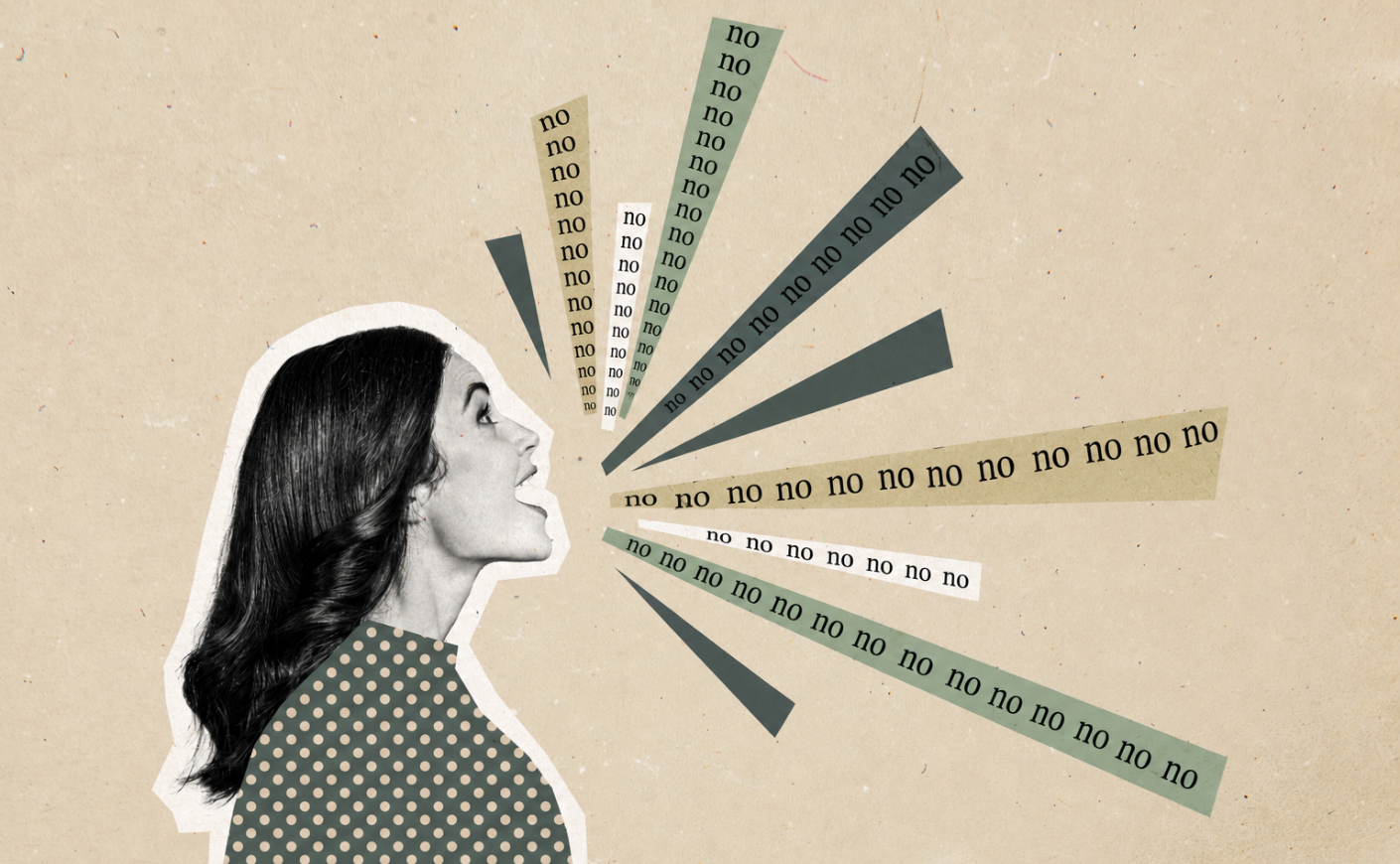
I have a hard time saying “no” to people. In personal relationships, I often become so worried about alienating the other person that I keep my mouth shut when faced with bad behavior. Unreasonable requests in the workplace have also (historically) been difficult for me to push back on. It wasn’t always this way. When I was young, as in, really young, I felt freer to assert boundaries around what I wanted, and what I didn’t, and to take my own needs into account when deciding whether to agree to others’ requests or expectations. In other words, I put myself first.
Things changed as I got older. Around age 10 or 11, I became more cautious about putting myself first, and by extension, saying “no” to others’ demands. I was less likely to raise my hand in school settings — this, just a few years after a teacher deemed me “bossy” in her classroom. (I had initially taken this as a compliment.) I became more tolerant, in a way, of toxic social dynamics in the social groups around me. This isn’t because I became nicer to others, but because I became more acquiescent and submissive — and, in the process, more neglectful of myself.
This happens to so many of us. I wish it didn’t, but, in most every girl’s life there comes a moment — the beginning of an era, really — when all the years of being taught to be warm and accommodating start to eat away at her true sense of self. By the time we hit early adolescence, many of us become more diminished versions of ourselves, more heedful and less headstrong in how we respond to the world. Less likely to say “no.”
I’m the author of a new book called The Power of No. I was inspired to write it after I delivered a commencement address at an all-girls’ private school, Emma Willard. Administrators at the school, aware of my background as a writer and thinker around gender politics and female empowerment, had invited me to speak to the graduating class.
I was flattered by the invitation, and intimidated. Certainly, I thought, the seniors had spent much of their lives hearing encouragement to seize the day. About saying “yes” to things. I wasn’t in disagreement with that message. But I wanted to communicate to them that while it's important for young women to lean into opportunities, it’s equally important to become comfortable with saying “no.”
Much to my relief, the speech was well-received, and eventually became an article in The Atlantic magazine. That article, in turn, became a book. It was a tough one to write — I wanted to encourage readers to say “no” more often and acknowledge the difficulty in doing so, but I had to be careful and intentional in my approach. It was important that I not be too strident or too prescriptive. It was important that I explore the subject of “no,” not simply issue edicts about it. It was important that the book felt inviting — maybe even a little bit fun at times.
Researching The Power of No was as much an attempt to inspire and educate myself as it was to do the same for others. I learned — or relearned — a lot in writing it, speaking to child development experts and sociologists and activists and politicians and scientists and self-defense instructors and famous people and not-so-famous people. I learned through my reporting that girls begin to become cautious about saying “no” — actively discouraged from doing it — as early as age 6 or 7, and that this can have lifelong consequences to our sense of self, competence, and mental health. (Maybe we accede to ill treatment coming from others; maybe we don’t speak up in circumstances that go against our ethics or morals.) I learned different ways of saying “no” and the importance of taking a pause before saying “yes.” I learned that I’d said “yes” way too much. I learned that “no” is indeed a complete sentence.
What I also learned is that, to say “no" — and to push through the discomfort of displeasing others — we have to take stock of the times we didn’t stay true to ourselves. How many minutes, hours, or years had I lost to unfulfilling relationships, lopsided friendships, or toxic work situations because I’d been afraid to say “no”? What might my life have looked like if I’d felt more empowered to refuse? Perhaps I wouldn’t have tried to repair a broken marriage that ate away at my self-respect. Maybe I’d have pushed back more against bosses who exhibited toxic or undermining behavior. Maybe a lot of things would have been different.
It’s easy, of course, to say that “no is a complete sentence,” even if it’s true. But a lot of The Power of No is about literal power: Who holds it, who doesn’t. An individual’s ability or willingness to say “no” has a lot to do with how the world identifies her, or how she identifies herself. People with economic privilege might find it easier to say “no,” as might people with certain racial or sexual identities. The “power” of “no,” after all, depends in part on who gets to say it, and who doesn’t. One woman who interviewed me about the book observed that The Power of No has an element of melancholy because it acknowledges our regrets even as it operates as a rallying cry.
It turns out that saying “no” begets more noes. (It’s never too late for “no!”) That doesn’t mean that it becomes easy — just that it gets easier. The world doesn’t end. You don’t lose the love of all your friends or family members. And when you say “no” you’re modeling that possibility for those around you — at home and at work — especially younger women and girls. You teach them that the assertion of boundaries is not just allowed, but encouraged.
Writing about “no” helps those of us who labor to build boundaries — and there are so many of us! — and to feel more seen. The response to the book has been overwhelmingly encouraging so far. Readers have shared their strategies for saying “no,” told stories about successful noes they’ve issued, and recalled moments when they wished they’d issued them at all. Women have given the book to daughters and granddaughters, or shared it among themselves. (There’s something about getting older that makes “no” a lot easier for some women, but that’s a subject for a different essay.)
At its most basic, knowing what we don’t want, or who we don’t want to be, is about knowing what, and who, we do want to become. In that sense, the power of “no” is the power to listen to our intuition and trust our own inner voices. And if we don’t know what we want quite yet? That’s OK, too. Reminding ourselves that “no” is an option — and a legitimate one at that — is a revolution in and of itself.
Anna Holmes is a writer living in Los Angeles and a contributor to such publications as The Atlantic, The New Yorker and the New York Times. The Power of No, is her third, and most personal, book; you can find her on Instagram and Substack.