





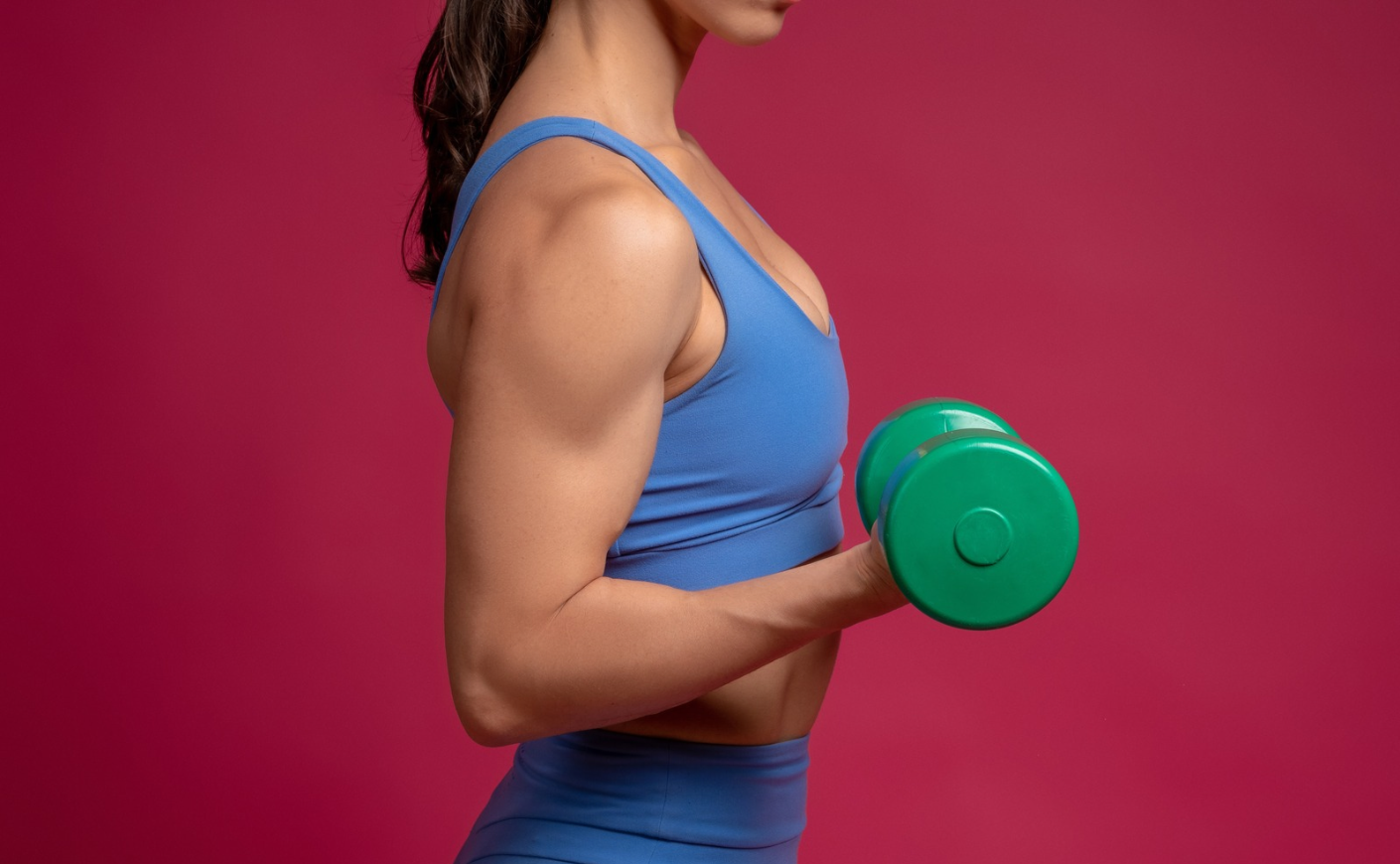
Why are defined arms such a universal fitness goal? It's simple: Of all our major muscle groups, our arms are on display more than anything else. Long before anyone notices your abs, legs, or glutes, your arms are out there taking center stage.
Whether you’re aiming to fill out a t-shirt or look your best in a sleeveless dress, a defined set of arms serves as a visual badge of honor — a proof-of-work stamp for the time you invest in training.
But the benefits go far beyond aesthetics. Strong arms serve massive real-world applications. They carry our heaviest everyday loads, from stuffed grocery bags to luggage to toddlers. They handle the physical demands of manual work around the house. And in critical moments, they are our ultimate line of defense to brace against a sudden fall.
Whether your focus is visual definition or pure physical capability, building strong arms is a non-negotiable. As an experienced personal trainer who's developed a strength-training routine for Katie, I'm here to tell you that you can seriously beef up your arms on your own, without professional help. Here's what you need to know.
Setting the record straight on arm training
Before diving into the exercises, let’s clear up two persistent myths surrounding arm training with a couple of fundamental truths:
1. "Toned" is a result of muscle mass and body fat
Achieving that coveted "toned" look comes down to a simple two-part equation: How much muscle have you built, and is your body fat percentage low enough to show it? Direct arm work cannot "spot-reduce" fat from your triceps or biceps. High volume and endless reps won't reveal shape if your body fat remains too high to expose the underlying muscle structure.
2. High reps aren't enough — you must train for tension
The idea that lightweight, ultra-high-rep sets are the secret recipe for defined arms is a myth. Definition requires muscle size, and muscle growth demands a meaningful training stimulus: mechanical tension.
You know you're applying sufficient mechanical tension when you encounter forced deceleration near the end of a set — meaning that you're pushing or pulling with maximum intent, but the weight naturally slows down due to muscular fatigue. These grueling, slow-moving reps at the tail end of a set are what trigger real adaptation. Choose a load that brings you to this level of fatigue within eight to 12 reps, with the final two to three reps requiring total effort.
Five go-to movements for complete arm development
The following exercises offer the ultimate balance of execution ease, direct target-muscle tension, long-term progression potential, and secondary stability benefits.
1. Seated Incline Bicep Curl
Target: Biceps brachii (long head)
Mechanics: Position an incline bench to roughly 45 to 60 degrees. Sit back, letting your arms hang straight down behind your torso, and curl without allowing your shoulders or elbows to drift forward.
The payoff: Sitting against a back pad eliminates momentum and prevents body sway. Positioning the shoulders in extension places the long head of the bicep under a deep stretch, unlocking a far greater range of motion than standard standing curls. Keeping your shoulder blades set back and down builds isometric strength across the trapezius and postural stabilizers.
2. Standing Cable Hammer Curl
Target: Brachialis and brachioradialis (forearms and outer arm)
Mechanics: Attach a rope or single handle to a low pulley. Keeping your palms facing inward (neutral grip) and elbows locked at your sides, curl the weight upward.
The payoff: Unlike dumbbells, cables deliver constant, uninterrupted tension throughout the entire range of motion — especially at the fully lengthened position. The neutral grip heavily targets the brachialis (the muscle sitting underneath the bicep and separates the outer arm) while offering a wrist-friendly angle for anyone dealing with joint discomfort.
3. Dumbbell Lateral Raise
Target: Medial (lateral) deltoid
Mechanics: Stand with a slight forward lean at the hips. Raise the dumbbells out to your sides in the scapular plane (roughly 30 degrees forward of your torso), sweeping the weights outward toward the walls rather than straight up.
The payoff: The medial deltoid provides that rounded, capped shoulder line that instantly visually widens the upper body and frames the arms. Because the side delt receives minimal stimulus from compound pressing or pulling, isolated lateral raises are essential. Working within the scapular plane keeps the shoulder joint centered, protecting the rotator cuff while maximizing side-delt muscle recruitment.
4. Single-Arm Tricep Cable Pushdown
Target: Triceps brachii (lateral and medial heads)
Mechanics: Set a cable pulley high and attach a knotted rope or a single handle. Face the stack, align your shoulder directly with the cable line, and push straight down until your arm reaches full extension beside your hip.
The payoff: Unilateral training exposes and corrects left-to-right strength imbalances. Training one arm at a time lets you align your shoulder, elbow, and cable path perfectly, drastically reducing joint strain. Clearing your hip at the bottom of the movement unlocks a peak tricep contraction that isn't possible with a rigid straight bar or standard rope.
5. Staggered-Stance Cable Overhead Tricep Extension
Target: Triceps brachii (long head)
Mechanics: Attach a rope to a mid-to-high pulley, face away from the anchor, and take a staggered (foot-forward) stance. Lean slightly forward, keep your elbows fixed near your ears, and extend your forearms overhead.
The payoff: The long head of the tricep crosses the shoulder joint, meaning it achieves its deepest stretch — and greatest growth potential — when trained overhead. Cables ensure continuous tension at the most vulnerable lengthened position, where dumbbells typically lose resistance. The staggered stance creates a wide, powerful base of support that allows you to handle heavier loads while demanding active core and hip engagement to maintain a stable torso.
Daniel Stransky is a personal trainer and nutrition coach based in New York City.
