






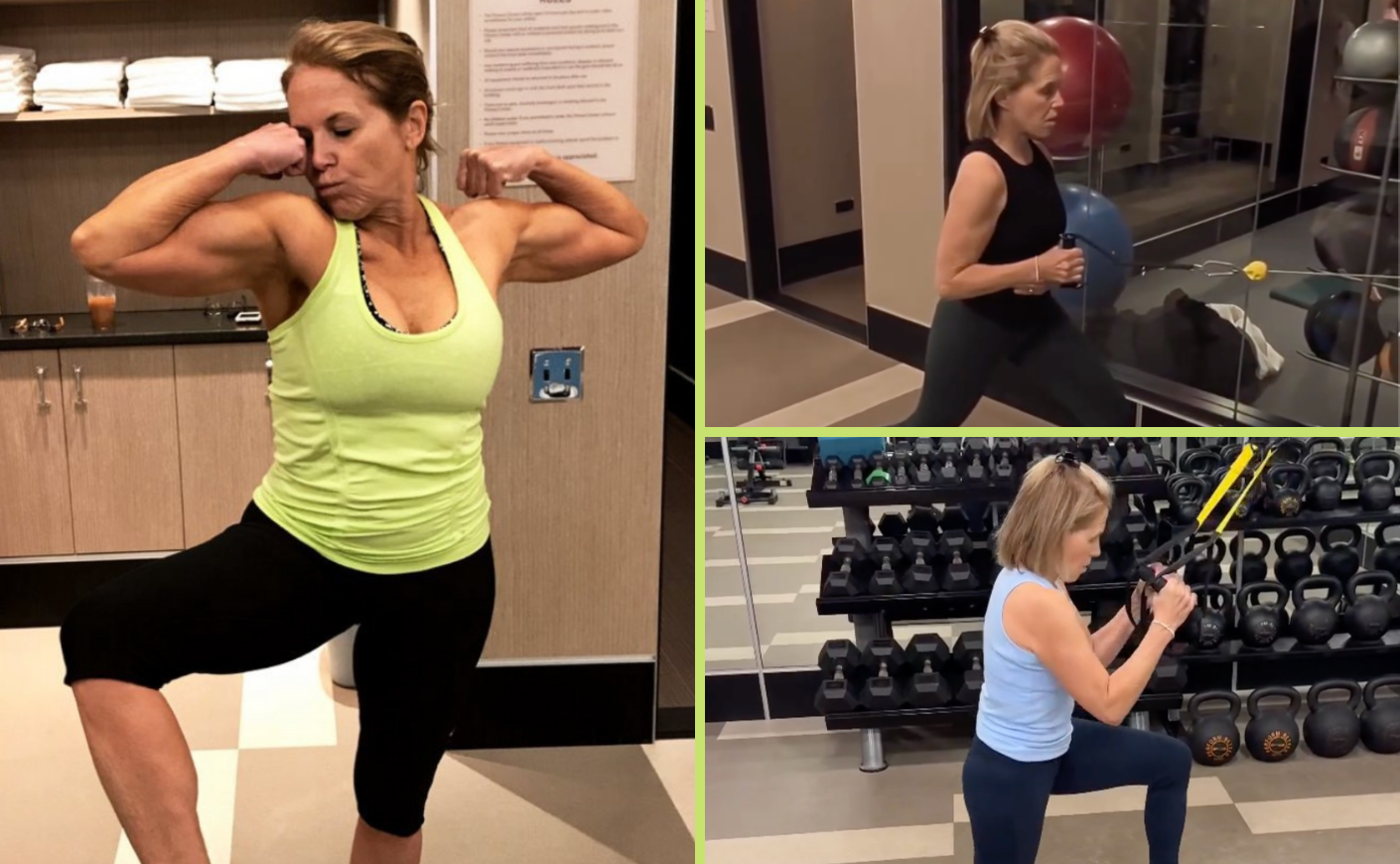
This year, Katie’s been laser focused on her health. As she approaches a big birthday, she’s doubling down on building muscle, maintaining her bone density, and getting stronger — and that means hitting the gym.
About six months ago, she began working with Daniel Stransky, a personal trainer who’s now got her pumping some serious iron. And, according to him, she’s already making excellent progress.
We spoke to Stransky about the workout routines he’s crafted specifically for Katie, the exercises he thinks all women could benefit from, and his advice to help get you started on your own strength training journey.
What are some of Katie’s fitness goals?
Daniel Stransky: When we started training together, her main concerns were her bone density, mobility, and strength. All of those things are a crucial part of remaining independent and healthy as you reach those more advanced years.
What’s a typical workout like for Katie?
We usually start out with some movement prep. For Katie, we’re trying to do more t-spine mobilization, because she has some stiffness in her upper back. So we’ll have her start by arching her back over a foam roller to open up the ribcage and expand the spine. Then, we’ll usually go into some hip mobility movements, like the 90/90 hip flip and a glute bridge with an adductor hold.

From there, we’ll do a succession of three types of exercises: a big push, a big pull, and a leg exercise. So we might do a cable chest press, where she’s standing with one foot forward and pushing the cables out in front of her. Then, we’ll move into a tall kneeling lat pull down, where she’s kneeling with one knee up and will pull the cable down toward her. And then, we’ll go into a stationary lunge. She initially was using a suspension band to perform those but has now progressed to doing them with dumbbells.
Another one of Katie’s goals is to improve her cardiovascular health, so we’ll usually do a cardio circuit on the stationary bike. I’ll have her do 30 seconds at a slower speed and then 15 seconds at high intensity, and she’ll do several reps of that. After a little break, she’ll do another round of push, pull, legs. So let’s say she’ll do a seated dumbbell shoulder press, a set of overhead triceps extension, and a dumbbell RDL, which offsets the lunge because it works the hamstrings.
Katie has osteopenia. How have you tailored her workouts to optimize bone density?
What we’ve been doing is loading her appendicular skeleton, which refers to her arms and legs. She’s holding heavy weights and lifting heavy, and that provides stimulus to those bones that’s going to encourage bone mineral density to increase.
The other thing is that building strength gives her the security of knowing that if she gets bumped, she’s not going to fall — and if she does fall, she can get up off of the floor. So we’re working on her stability and balance, pushing her limits to prevent falls, too.
How heavy is she lifting right now?
She’s not lifting anything super heavy right now. With the cable chest press, for instance, she’s pressing 15 pounds on each side. For a chest press, she’s using 15-pound dumbbells. The last session we did, she was lunging with an eight-pound weight in one of her hands. We’re still early in her training, and I’d say she has a long runway.
What progress has Katie made since you started working with her?
We’ve seen the most progress in her ability to move through the hips and bear weight into her legs and knees. When we started, she had some pain in her knees when we were doing things like lunges. We’ve eased her into those moves by using a modified range of motion, so that her muscles adapt over time. Now, she’s able to lunge without any pain, her hips are feeling better, and she’s able to move more fluidly.
One of the reasons why Katie’s seeing such great results is that she’s really locked in on form and execution. These exercises are designed to build strength and resilience, but only if they’re performed well. She’s a great student and she cares a lot about getting it right.
When you think about all of your clients, what are some of the challenges women have with strength training as they age?
Many of them have an aversion to training with heavier weights or at a higher intensity out of fear that they might get bulky, or build too much muscle. That’s never the case.
But I think the biggest impediment is that many of them start late, so they’re a bit behind the eight ball. When you haven’t done strength training for a long period of time in your life, you don’t have the coordination and proprioception — the ability to know where your body is in space — to execute exercises at a high level. So with a lot of my clients, it’s about teaching the nuances of certain movements. But I’d say many of my clients who make the most progress are older women, because they’re so open to learning.
Are there any exercises you think are particularly important for those clients?
The easy answer is the glute bridge and lunges. Building strong legs has a huge impact when it comes to balance and stability.
This interview has been edited and condensed.
