







For people living with aggressive blood cancers, a revolutionary form of personalized immunotherapy has reshaped what's possible. This groundbreaking approach is called CAR T therapy, and treats certain blood cancers by genetically modifying T cells — white blood cells crucial to the immune system — to recognize and kill cancer cells. Traditional CAR T therapy is autologous, meaning a patient’s own T cells are extracted, modified to attack cancer cells, and then reinfused into the patient’s bloodstream. But while this form of CAR T can be lifesaving for some, it has remained frustratingly out of reach for many patients.
First approved in 2017 for children with leukemia and adults with non-Hodgkin lymphoma, autologous CAR T therapy has since expanded to treat adults with other blood cancers, such as multiple myeloma. Despite remarkable results, the treatment process for today’s approved autologous CAR T therapies is constrained by a multitude of barriers, including complex access logistics and a manufacturing process that can take weeks.
John M. Burke, MD, a blood cancer specialist at the Rocky Mountain Cancer Center in Aurora, Colorado, has seen firsthand the challenges this time-intensive and location-specific treatment can present: “Very few centers can administer autologous CAR T, so patients who do not live near an existing CAR T center may have to travel a long way to receive it,” he explains. “Patients may not want to travel or have the means to travel, but the treatment is complex and requires specialized care.”
For the roughly 85 percent of eligible patients who have not been able to access autologous CAR T,* a next-generation approach could reduce some of those barriers. Known as allogeneic, or off-the-shelf, CAR T, this approach uses healthy donor cells rather than a patient’s own cells, allowing doses to be manufactured in large batches and stored until they are needed. By simplifying the process, off-the-shelf CAR T could make treatment more practical for community-based oncology centers — where the majority of patients receive their care today — and more accessible to a greater number of patients.
For oncologists working in communities outside major cities, this shift could be significant. Bringing off-the-shelf CAR T into community settings could help reduce long-standing barriers, including treatment delays, travel time and costs. And for patients whose cancer has returned or has not responded to initial therapy, those barriers are not just inconvenient — they can affect whether treatment is available in time to make a difference.
That urgency to expand access to CAR T is especially clear for patients with diffuse large B-cell lymphoma, or DLBCL, a fast-growing, aggressive form of non-Hodgkin lymphoma. Nearly one in three patients with DLBCL relapse within a year of initial treatment with chemoimmunotherapy, the current standard of care. For these patients, CAR T is one of the most promising options, and an off-the-shelf product could make it available faster than ever before. But what if doctors could identify the patients most likely to relapse — and proactively treat them with CAR T — before their cancer reappears on scans?

That is the idea behind the ALPHA3 study, an ongoing clinical trial testing whether an investigational off-the-shelf CAR T product (cemcabtagene asegedleucel, or cema-cel) can be used to treat patients with DLBCL who have responded to initial treatment but remain at high risk of relapse. Identifying who is most at risk involves testing patients for signs of minimal residual disease (MRD) using a highly sensitive blood test that can detect circulating tumor DNA — small amounts of cancer that remain in the blood — after completing initial treatment. Patients with MRD may be in remission by standard tests, but the presence of MRD may signal a higher risk that their cancer may return. The approach reflects a potential one-two punch: identify the patients most likely to relapse and treat them earlier with off-the-shelf CAR T while the cancer may be easier to control.
Dr. Burke has high hopes that ALPHA3 could help bring CAR T to patients earlier and closer to home: “Collecting the cells needed to create an autologous CAR T product and then manufacturing them takes time. Some patients’ cancers progress too quickly for them to get to the autologous CAR T treatment, while others are never even offered it. The ability to identify DLBCL patients at highest risk of relapse would allow physicians to offer off-the-shelf CAR T to patients at very high risk of relapse and, in theory, increase the cure rate.”
The ALPHA3 study focuses on patients whose cancer is not yet visible on scans but can still be detected through MRD testing. Initial findings are encouraging: nearly 60% of patients treated with cema-cel had no detectable cancer DNA in their blood after treatment, compared with about 17% in patients who did not receive cema-cel.
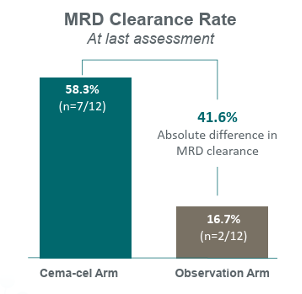
While these findings are still early, they suggest that identifying and treating high-risk patients before cancer can be seen on scans may help keep it from returning.
ALPHA3 is also providing early insight into the potential for community delivery. Roughly one-third of patient screenings and cema-cel infusions took place at community cancer centers, including some that had never offered CAR T therapy before. Most patients received treatment without a hospital stay, and researchers have not reported any serious treatment-related side effects or hospitalizations.
These early findings suggest that off-the-shelf CAR T may be practical at both major academic centers and community settings closer to where patients live. If confirmed as the study completes, this could mark an important shift — from a highly specialized therapy available primarily at major medical centers to one that could reach more patients, in more settings, and potentially help keep their cancer from returning.
For more information about the ALPHA3 trial or to find a trial site location, visit ALPHA3trial.com
*Shadman, Liu, et al, ASH 2025 FACT, Foundation for the Accreditation of Cellular Therapy.
