






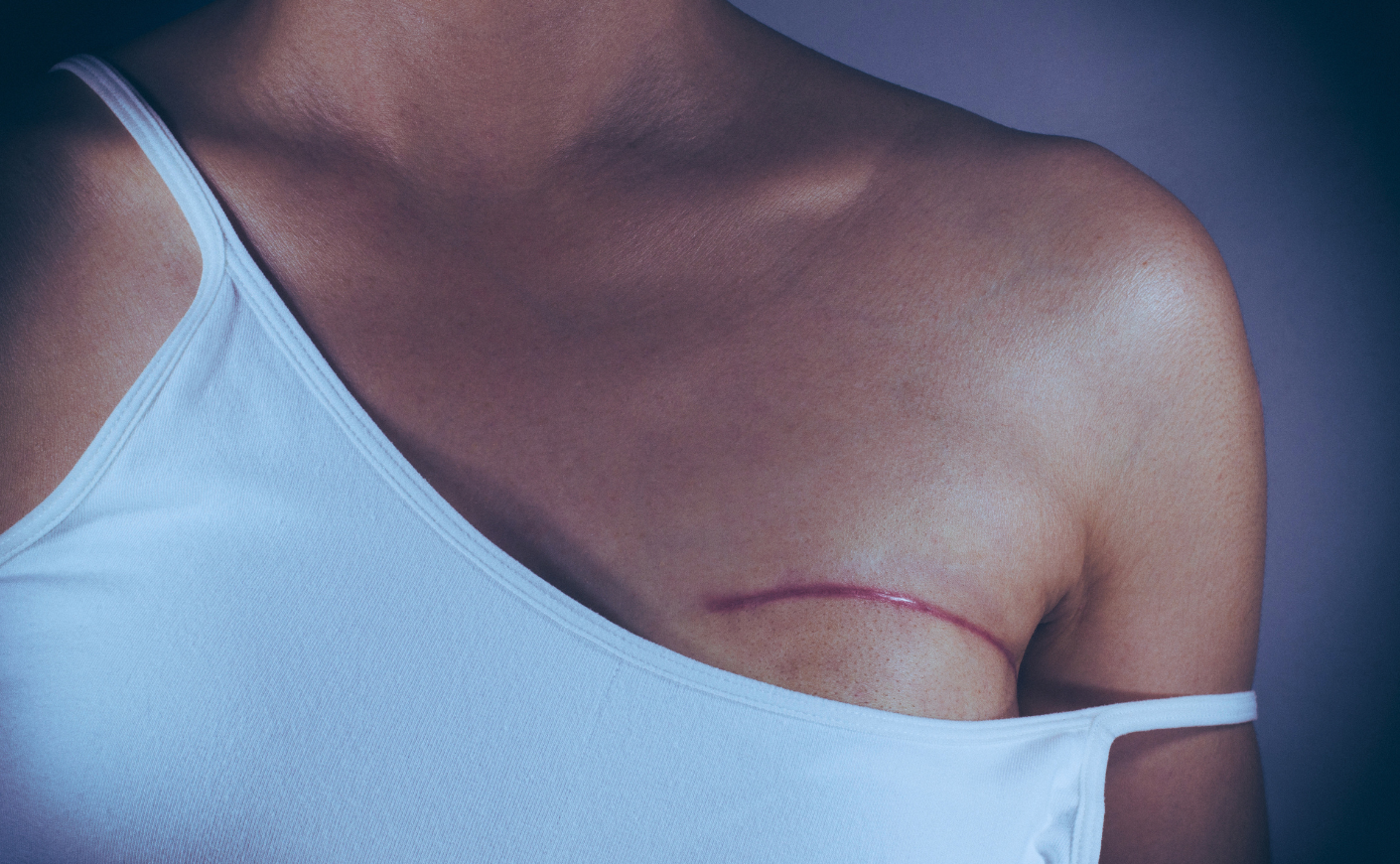
You don't think about losing a nipple until someone tells you you might. And then suddenly, you can't imagine life without it.
No one is prepared for breast cancer. Not the diagnosis. Not the treatment. And certainly not the things you lose quietly along the way. The parts of your body you never thought to say goodbye to.
In October 2023, at 38 years old, I was diagnosed with Stage III breast cancer. The treatment plan seemed straightforward enough. First, I would undergo chemotherapy — a series of powerful drugs designed to shrink the cancer before surgery. Then I would have a lumpectomy to remove the remaining tumor. Radiation would likely follow. After that, I hoped I could begin putting my life back together.
For the next five months, my life revolved around treatment. I counted every infusion, every appointment, every side effect. Like most patients, I was focused on reaching the finish line.
On March 15, 2024, I rang the bell signaling the end of chemotherapy. One week later, on March 22, I sat in my surgeon's office for the MRI review that would determine the next step. I expected confirmation of the plan I had been carrying in my mind for months: lumpectomy. Instead, I heard a different word: mastectomy.
The MRI showed that while chemotherapy had done its job, there were still cancer cells sitting too close to my nipple. Leaving part of my breast would compromise the clean margins needed to safely remove the cancer.

My surgeon explained that he would try to preserve the nipple if possible, but he wasn't optimistic.
I remember immediately dissociating, and then I realized cancer wasn't just changing my body. It was constantly reshaping my expectations of my life and future. Every time I thought I understood what was coming next, this disease rewrote the plan.
I sat there trying to absorb the fact that I had spent months believing I was heading toward a simple (in comparison) lumpectomy, only to find myself facing the complete removal of my right breast.
The nipple became the symbol of that shock. Not because it was the most important thing, but because it was the thing that made the loss feel tangible. Suddenly, I wasn't just removing cancer, or some skin or tissue. Now I was losing a full part of my body that I had lived with for 38 years — nipple and all. Something I had never imagined being without — or mourning.
I had never had surgery before, and now I was preparing for one that felt overwhelmingly significant.
I left the appointment and, within 24 hours, booked a flight to the Caribbean. I needed to escape my life for a little while and be somewhere no one knew my health status. I had no appointments; no MyChart notifications; and no conversations about margins, reconstruction, or the future of my body.
I spent those days alone with myself, with God, and with my body.
I thanked her. I apologized to her. I grieved for her.
Most of all, I mourned something that hadn't happened yet. That may sound strange, but anticipatory grief is its own kind of heartbreak. Sometimes the loss begins long before anything is gone.
I found myself sitting with questions I had never expected to ask:
If I were lucky enough to become a mother someday, would I breastfeed from only one breast?
Would a future partner understand?
Would I have to explain my body?
Would I want to?
The body I got back wasn't what I was used to, but it would be the body that carried me forward, to the other side of cancer and beyond.
It became bigger than the cancer, and bigger than my breast. Now I was grieving the future I expected and understood.
A month later, I underwent a unilateral mastectomy of my right breast with immediate placement of a tissue expander.
When the bandages finally came off, I braced myself. My reconstructed breast was flat. The expander sat empty beneath the skin. The nipple was obviously gone. I expected immediate devastation and tears. I expected grief to crash over me. Instead, I felt surprisingly calm. An unexpected observation came to me: Part of me was gone. Part of me had been rebuilt. And somehow, I was still me.
The body I got back wasn't what I was used to, but it would be the body that carried me forward, to the other side of cancer and beyond.
When I looked closer, I realized something else. The scar looked far better than I had imagined. Before surgery, I had spent hours looking at photos online, preparing myself for worst-case scenarios. Instead, I felt immense gratitude. My surgeons had done beautiful work. The cancer was out. The hardest part was behind me.
I was one step closer to finishing treatment. Over the following weeks, I returned for regular expander fills. Saline was added gradually to stretch the skin and create space for the future implant. Physically, this part was easier than chemotherapy. Emotionally, it was strange.
My left breast remained exactly as she had always been. Meanwhile, the right side slowly grew week by week. For the first time in my life, I stuffed one side of my bra. Something I had never done as a teenager. Something I never imagined doing as an adult. I tried not to let it bother me.
Most days it didn't. But I am human. And some days it did.
When reconstruction was complete, I was presented with another choice: a nipple tattoo. Many women choose this option and have beautiful results. I considered it but something in me resisted. Maybe it was the permanence. Maybe it was fear. What if I didn't like it? What if it didn't feel like me?
After everything my body had survived, I couldn't force another decision onto it. So I chose not to.
Two years later, another option found me: custom prosthetic nipples.
The choice to wear the nipple or not would be a reminder that I was back in control of my breasts.
I remember staring at the photographs online, zooming in and looking again. They looked real. Not close. Not convincing. Real.
Something inside me exhaled — because it wasn't really about the nipple. It was about bodily autonomy and the control cancer had taken from me: The ability to decide how I wanted my body to look and feel. I liked the idea of being able to wear the fake nipple when I wanted to and leave it off when I wasn't in the mood.
This decision to get it allowed me to reclaim some control cancer took away, and every day after that, the choice to wear the nipple or not would be a reminder that I was back in control of my breasts. Cancer doctors and patients often talk about survivorship as if the hard part ends when treatment does, but survival leaves you learning how to live in the body you're given back.
I've learned that feeling whole doesn't always mean returning to who you were before.
Kia Lee is a breast cancer survivor, author, speaker, and survivorship coach.
