






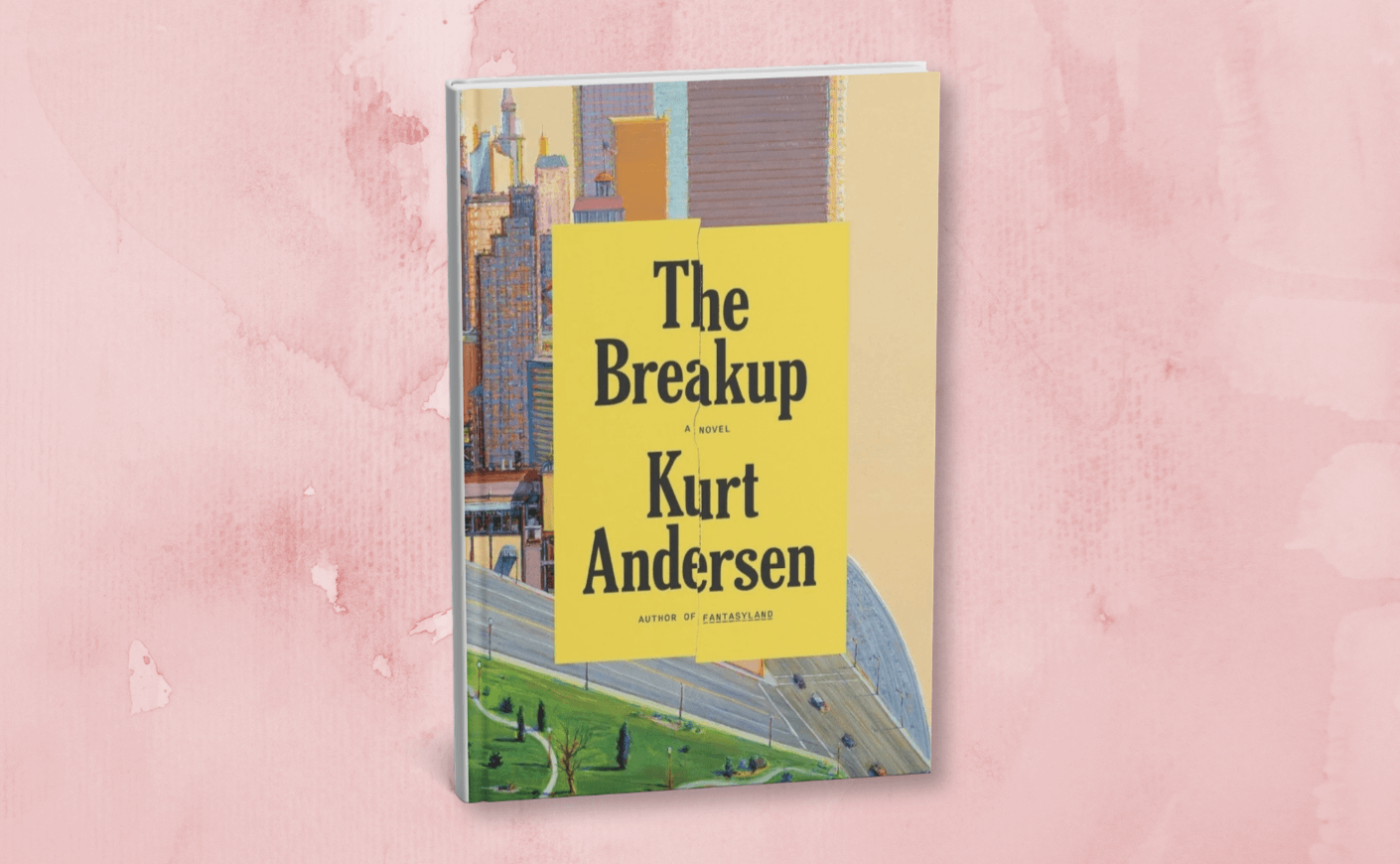
What would it actually look like if America broke up? Not metaphorically, not because we all stopped speaking to relatives over politics, but literally: two countries, born from a second civil war. That's the unsettling premise of Kurt Andersen's new novel, The Breakup. But despite the big idea at its center, Andersen isn't primarily interested in presidents, battlefields, or the mechanics of dividing a nation. Instead, he tells the story through Natalie and Asher, a longtime married couple whose relationship is coming apart just as the country they've known is doing the same.
If anyone has spent enough time thinking about how America got here to imagine where it might be headed, it's Andersen. The author and longtime cultural commentator previously tackled the country's recent history in Fantasyland and Evil Geniuses, and this time he wanted, as he puts it, "heart and humor" — and the freedom to invent. We talked to him about why he deliberately resisted writing a dystopian AI novel, the problem with obsessing over politically loaded language, what happens when even enormous collective traumas begin to fade, and why he didn't want either half of his divided couple — or his divided America — to simply "win" the argument.
Did you always know you wanted Natalie and Asher's relationship to be the emotional center of the novel, or did that emerge as you were writing?
Yes, always, from the very start. As soon as I started thinking hard about a novel set in the future, and making its main backdrop the breakup of the United States, I decided it would be about a couple and their family and friends.
The future you've imagined feels surprisingly plausible because it's built from dozens of small, recognizable technological changes that feel like an extension of trends we already recognize. Were there future technologies or political developments you deliberately pulled back on, because they felt too wild/speculative?
The big one is how I decided to treat AI. In my future, it's absolutely pervasive, sometimes invisibly. And there are robots all over the place. But I decided from the start not to make it a book about the possible "OMG" consequences of AI for ill or good, because I didn't want this to be a tech-focused sci-fi book. My friend John Heilemann told me it reminds him of the great recent TV series Andor, which is a Star Wars show, but it's really about a few people and their relationships and politics, not so much about the robots and starships and death star. Like it, The Breakup is for grownups.
Natalie spends a lot of time wrestling with language: what to call the conflict, how words shape memory, even whether certain labels make violence seem more or less legitimate. Were you making a broader point about how vocabulary influences the way we understand history and ourselves?
Well, she's a poet, so naturally she does that — and that's one place where Natalie and I fully agree. Focusing the political discourse so much on whether one should or shouldn't use this word or that word is mostly a waste of time and energy, a distraction. Because it's easy and superficial and good for trolling, suited to social media posts, unlike actually wading into the complicated substance and nuances of an issue.
Neither Natalie nor Asher is written as a caricature. Even when readers strongly disagree with one of them, it's easy to understand how each arrived at their worldview. Was it important to you that readers don't see one character "win" the argument?
Absolutely, 100%. There's only one character I'd consider a villain, and she's a secondary character and not all that villainous: Elon Musk's widow and now the girlfriend of Asher's trillionaire German boss.
There's an undercurrent throughout the novel about the "half-life" of trauma: how societies eventually normalize even extraordinary events. How have you observed this happening in real life, too?
Sure, in my own life all the time — like everybody, no? In smaller ways, like getting over unhappiness about professional disappointments or fallings-out with friends or breaking up with a boyfriend or girlfriend. And with larger things, like when parents or siblings die: the pain eventually subsides. Sometimes over days, sometimes months, sometimes many years. And at the macro long-term cultural level, you see it in often sad or disturbing ways, especially after you reach a certain age, and younger people seem more and more unfamiliar with important pieces of history — like the fairer economy we had just 50 years ago, like American life before so many awful childhood diseases were eliminated, and like Nazism or why we created NATO.
You've written nonfiction about American politics and culture, but this novel lets you explore some similar ideas through fiction. What did writing a novel allow you to say that you don't think you could have said as effectively in an essay or a work of nonfiction?
I started writing novels 30 years ago, and published four of them before The Breakup. Then in the last decade, I wrote two big American histories, Fantasyland and Evil Geniuses, which between them said pretty much everything I have to say in serious long-form nonfiction. That's the reason I wrote a work of fiction about the future instead of a speculative non-fiction book, which wouldn't interest me much as a writer or a reader. I wanted readers to feel immersed in my imaginary but realistic and plausible version of a future, to get a sense of this radically transformed country through the lives and eyes and voices of two individual people who they really get to know. I wanted heart and humor.
