






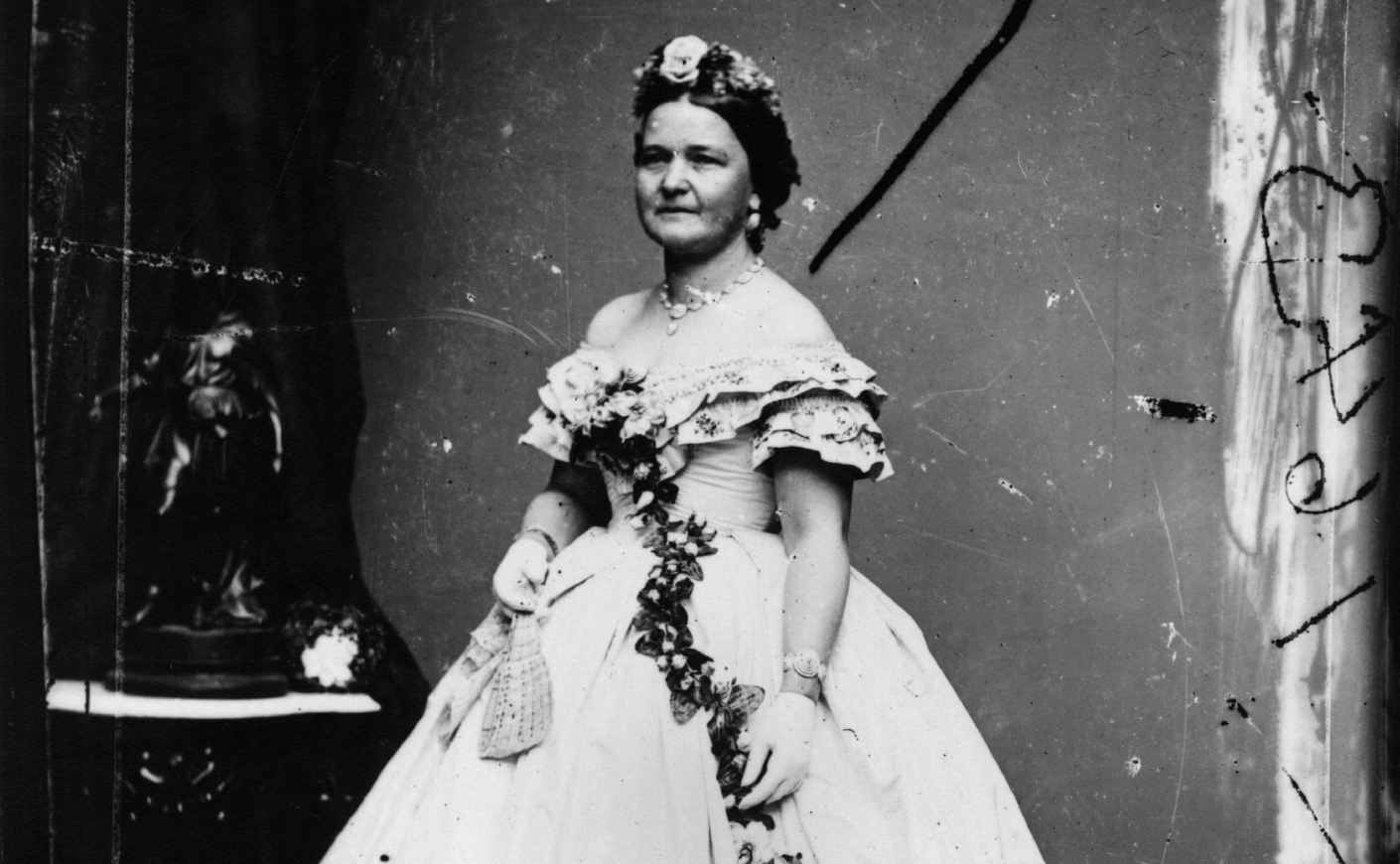
Abraham Lincoln is one of the most iconic characters in the story of America, and yet his wife, Mary Todd Lincoln, has been largely misunderstood by history. The things you're most likely to know about her have to do with the money she spent, the mental health struggles she endured, and the "madness" she's been labeled with time and time again. But this complex first lady was much more than that — and a fascinating new book reveals the truth about her consequential life.
In An Inconvenient Widow: The Torment, Trial, and Triumph of Mary Todd Lincoln, journalist Lois Romano peels back the curtain on a woman who, despite being fiercely ambitious and sharply political, was vilified by the people (mostly men, of course) who ultimately defined her legacy in the eyes of the public. Lincoln played a crucial role in her husband's rise to greatness, yet she's been reduced instead to being portrayed as a "hysterical" and "unstable" woman.
With Mary Todd Lincoln back in the cultural zeitgeist, thanks to the runaway success of the acclaimed Broadway hit Oh, Mary!, Romano's book couldn't come at a better time. We talked with her about what Lincoln's life was really like, her dynamic with the 16th president, and why the peaks and valleys of her biography feel so connected to modern culture.
You paint a more loving and intellectually equal portrait of Mary and Abraham Lincoln’s marriage than many readers may expect. What convinced you that Mary was not just Lincoln’s wife, but one of his most important political and intellectual partners?
Lois Romano: The deeper I went into the research, the clearer it became that Mary Todd Lincoln was a consequential figure. She was exceptionally well educated for a woman of her era, deeply interested in politics, and came from a prominent Kentucky family immersed in the issues dividing the nation. Long before Abraham Lincoln became president, Mary recognized his political gifts and believed in his future with a certainty that even he sometimes lacked. He would not have been president without her.
What struck me most was how often contemporaries underestimated her influence simply because she was a woman. Mary followed political developments closely, understood the personalities and rivalries shaping Lincoln’s world, and offered candid opinions that he valued. Their marriage was not always easy. Both were complicated people. But they were intellectually compatible and emotionally connected in ways historians have not fully acknowledged.
I also came to see that many of the traditional portrayals of Mary were filtered through men who either disliked her personally, were jealous of her relationship with Lincoln, or viewed ambitious women with suspicion. Once I looked beyond those accounts and examined letters, newspaper coverage, and the political context of the time, a much fuller picture emerged. Mary was not merely a witness to Lincoln’s presidency; she was an active participant in the political and emotional life that surrounded it.

The relationship between Mary and her son Robert is heartbreaking. Do you think modern readers — especially women caring for aging parents or navigating complicated family dynamics — will see that story differently than earlier generations did?
I tend to think modern readers will have more sympathy for Mary’s plight. I challenge the accepted narrative that Robert was simply the dutiful son rescuing an irrational mother. His letters show that many of his actions were self-serving. Mary was eccentric and sometimes erratic after Lincoln was killed, and Robert found it difficult to accept her as she was: a woman in pain trying to get through life. Her shopping habits and visits to spiritualists embarrassed him. He saw her as an inconvenience, someone who interfered with his life. Rather than protect her dignity, he orchestrated a surprise insanity trial, testified against her, and helped strip her of autonomy. To critics, his actions suggest not only concern, but impatience, paternalism, and a willingness to sacrifice his mother’s freedom for order, control, and respectability.
Even when she managed to extricate herself from his control, evidence shows he resisted her return to full independence. He continued to favor supervision and control over her finances, even as public sympathy shifted toward Mary.
What makes the story so tragic is that both Mary and Robert felt betrayed by the other. Mary believed her son had stripped her of her dignity and independence. Robert believed he was trying to save his mother from spiraling further.
You write about grief as a force that shaped Mary’s personality and mental health. After losing three children and then witnessing her husband’s assassination, do you think history confused profound trauma with “madness”?
Absolutely. Mary Todd Lincoln endured an almost unimaginable grief. She lost three of her four sons, including Willie Lincoln, during the White House years, and then witnessed the assassination of her husband beside her at Ford’s Theatre. Those experiences would destabilize almost anyone.
Yet in the nineteenth century, there was very little understanding of trauma, depression, anxiety, or complicated grief — especially in women. Behaviors that today might be recognized as symptoms of anxiety or emotional distress were often labeled hysteria, instability, or insanity. Mary became an easy target because she was already controversial: outspoken, emotional, politically engaged, and often unpopular in Washington society.
One of the central questions I explore in the book is why Abraham Lincoln’s melancholy became part of his mystique and greatness, while Mary’s suffering was used to diminish and discredit her. There was a deeply gendered double standard at work. That does not mean Mary was easy or entirely stable in her later years, but it does mean her pain deserves to be understood in human terms rather than reduced to caricature.
Mary’s anxiety about money and image feels very modern. Why do you think her spending and shopping habits became such a cultural obsession, both then and now?
Mary understood political imagery before modern media culture existed. As First Lady during the Civil War, she believed the White House needed to project strength, legitimacy, and sophistication at a moment when the nation itself was fractured. But her spending habits also reflected deeper insecurities — about status, belonging, and public acceptance.
What fascinated me was how disproportionately obsessed the public became with her shopping. Male politicians of the era were engaged in corruption, patronage, and wartime profiteering on a massive scale, yet Mary buying dresses or redecorating the White House became a national scandal. Other first ladies shopped and modernized the White House, but Mary was vilified. Her spending was treated not simply as extravagance, but as evidence of vanity and moral failure.
Modern audiences will recognize that dynamic immediately because women in public life are still judged through a lens that fixates on appearance and likability. She was scrutinized not only for what she did, but for how visibly she occupied power and privilege as a woman.
William Herndon emerges as someone who helped cement an unflattering version of Mary in the public imagination. Why do you think his account became accepted as fact for so long?
Herndon was enormously influential because he positioned himself as the authentic interpreter of Abraham Lincoln after the assassination. He had worked with Lincoln for years, and many Americans were hungry for stories that would help explain the man who had become almost mythic after his death.
But Herndon despised Mary Todd Lincoln, and his portrayal of her was shaped by personal bias, jealousy, and bitterness. Mary saw him as beneath Lincoln and a political liability. He was loud, indiscreet, and a drunkard. She wasn’t wrong. Lincoln once had to bail him out of jail after a bender. Consequently, she refused to invite him to dinner at their home. This incensed Herndon and made him feel small. He portrayed Mary as irrational, manipulative, and emotionally unstable, and because so few historians challenged those characterizations for decades, his account hardened into accepted truth.
What is remarkable is how durable those narratives became. Once a woman is labeled “difficult” or “unstable,” history often repeats the label without interrogating who benefited from it or why it stuck. More recent scholarship has begun to revisit Mary with greater empathy and nuance, but Herndon’s shadow remained long and powerful.
Your book arrives at a moment when Mary Lincoln is suddenly back in the cultural conversation. Why do you think audiences are newly drawn to “difficult” or complicated women like Mary right now?
I think we are living through a broader cultural reconsideration of women who were dismissed or misunderstood by history. Readers today are increasingly skeptical of simplistic narratives, especially about women who challenged expectations, occupied public power, or made people uncomfortable.
Mary Todd Lincoln was brilliant, ambitious, emotionally volatile, politically perceptive, deeply loving, and sometimes self-destructive. In other words, she was profoundly human. Modern audiences are far more willing to accept complexity rather than demand perfection.
There is also a growing recognition that many women who were once dismissed as “crazy,” “difficult,” or “too emotional” were responding to extraordinary pressures, grief, isolation, and scrutiny. Mary’s story speaks directly to contemporary conversations about mental health, misogyny, public image, and the costs of political life.
What I hope readers ultimately see is not simply a reevaluation of Mary Lincoln, but a reminder of how history itself is shaped — who gets remembered sympathetically, who gets caricatured, and who gets to tell the story.
