






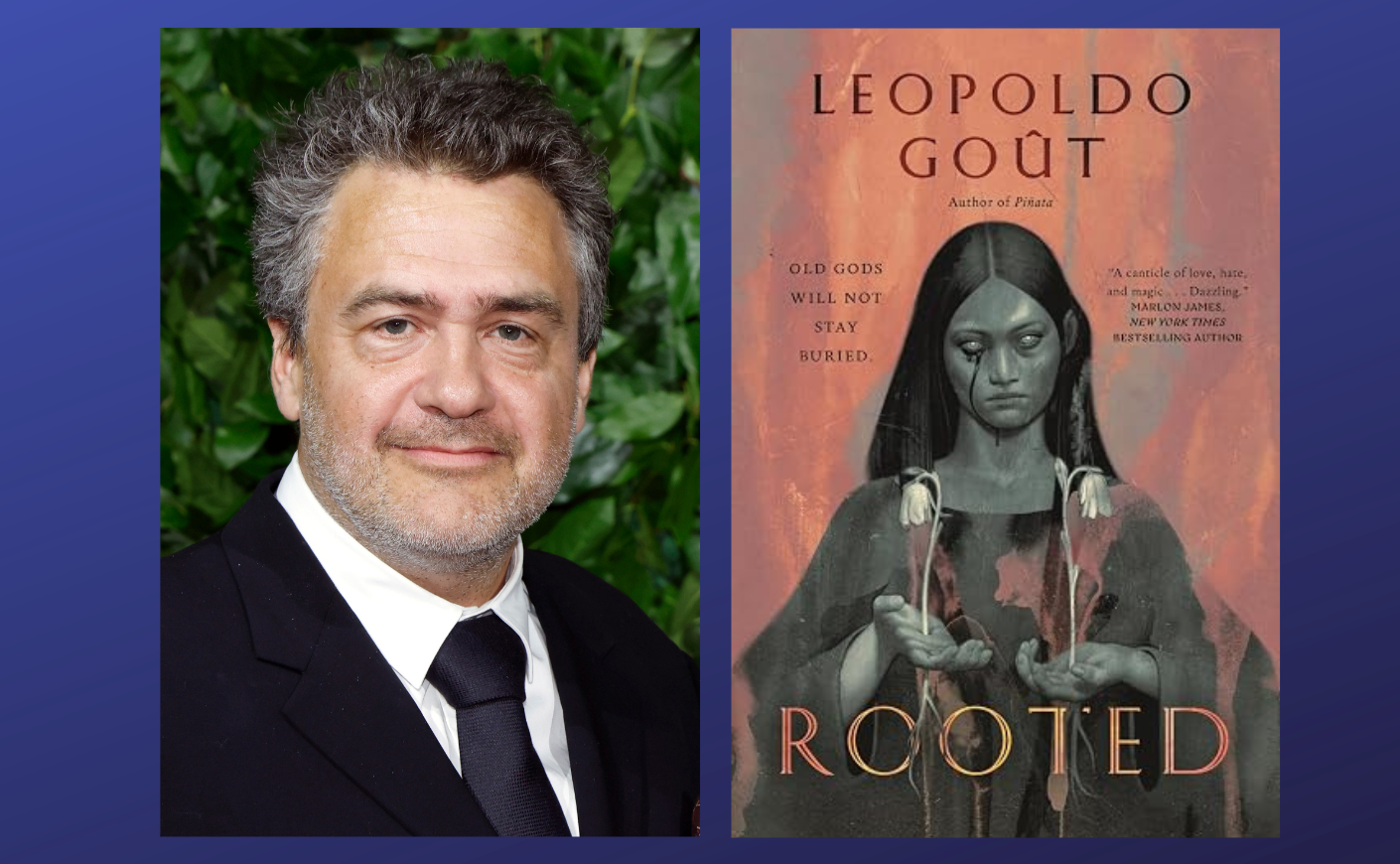
Leopoldo Gout is an artist, filmmaker, and author whose work often explores culture, identity, and the forces that shape us. He’s also a friend of Katie and John, who were intrigued when they heard about his new novel, Rooted. And we can absolutely see why: The supernatural thriller draws on Gout’s Mexican upbringing, family history, and lifelong fascination with art and mythology to explore cultural theft, the repatriation of Indigenous artifacts, generational trauma, ancient belief systems, and the complicated meaning of home.
Itching to learn more, we spoke with Gout about the deeply personal experiences behind the book, why horror can reveal truths other genres can’t, and what he hopes readers carry with them long after the final page.
Katie Couric Media: Rooted uses supernatural horror to explore the legacy of colonialism and cultural theft. Why did that feel like the right genre for telling this story?
Leopoldo Gout: That genre really opened up for me as a young artist in Mexico City, when I watched George Romero's original Night of the Living Dead at the Cineteca Nacional. I was young, political, and full of rage, and I realized that a cheap black-and-white zombie movie was talking about racism in America more honestly than most of what was being written about it. The only man who survives the night is a Black man, and at dawn he's shot by the posse that came to rescue him. It blew my mind open. A genre can carry an argument a country won't have out loud because it arrives dressed as a monster movie.
There's also the simple fact that I'm Mexican. I grew up visiting the people we'd lost on the Day of the Dead, setting a table and having dinner with them once a year. Death isn't a hooded stranger. She's a woman in a wide hat covered in flowers, and we make her out of sugar and hand her to children to eat. The dead aren't an intrusion in my fiction. They're guests, and they expect a place setting.
Aurora returns to Mexico after helping recover artifacts that were taken from the country, but she also begins uncovering things about her own past that her family kept from her. How did you see those two kinds of homecoming as connected?
In London, I studied sculpture on a scholarship and practically lived in the British Museum with a sketchbook. When I returned to the Museo Nacional de Antropología in Mexico City, I saw what I'd grown up walking past with new eyes. For the first time, I understood how astonishing it was.
Then I moved to the United States and had my children here. When you belong to two countries, the things you miss about your own can get louder rather than quieter.

Both journeys in the book turn on provenance: Every artifact in Aurora's shipment carries a paper trail written by the people who took it. Then she opens the box under her mother's bed and discovers that her own paperwork doesn't match the life she remembers.
That's what I most want people to notice. It isn't really the objects Aurora is trying to bring home. The crates represent a part of herself that was taken, buried, and cataloged under someone else's story. She can't get it back by filing correctly. She has to dig.
Aurora eventually learns that the women in her family have hidden important parts of their history — and of her own identity — in an effort to protect her. What interested you about the idea of generational trauma, and that love and protection can also cause harm?
At its heart, this is a book about a witch and everything that word has been made to carry. That's the subversion I was after. Here, the witches are the protection. Teresa sells her house. Maria renounces every practice she was raised in and leaves the country, the language, and the gods behind so Aurora will be safe from her own gift. They don't just hide Aurora from the world — they hide the world from Aurora, and then they hide Aurora from herself.
People say a mother gives up a little of her life to make you. In this book, that isn't a saying; it's the mechanism. The magic obeys one law: Everything comes at a cost. Tenderness and violence stop being opposites.
At the center of the novel is Xipe Totec, an Aztec god associated with death, rebirth, and renewal. How did you approach writing about an important figure from Mesoamerican mythology while making it work as horror?
Xipe Totec is traditionally depicted with a young, smooth face that looks out through the mouth and eye holes of an older man's skin, while the dead man's hands hang loose beside the living hands of the god. The sculptor is holding two states of being in one object, in the same clay, at the same moment. I saw my first one at the Museo Nacional de Antropología, and it never left my mind.
So I stayed accurate and let the sources do the work. The book's real horror turned out not to be God at all. It's the iron box. It's what happens when a living thing is turned into an object, welded shut, and shipped across an ocean to become a conversation piece. Whatever comes out of that box isn't furious because it's demonic. It's furious because of what was done to it.
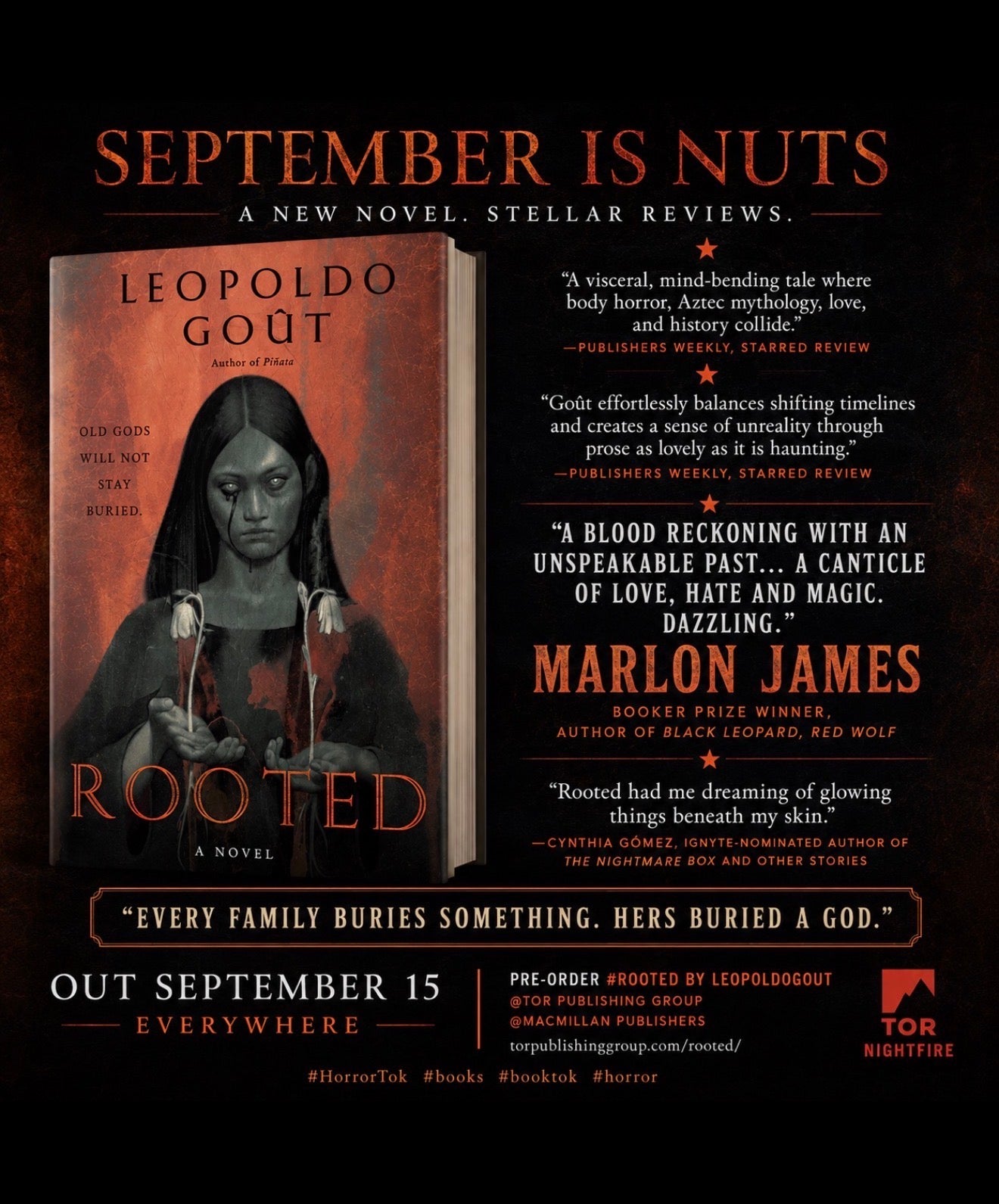
Aurora is a rational, highly educated lawyer, but she finds herself confronting forces that don't fit neatly into her understanding of the world. Were you interested in challenging the idea that science and ancient belief have to be opposites?
The greatest gift my late mother gave me was curiosity, and one conviction underneath it: There is a world, and there are also other worlds, and all of them are worth being curious about. My mother read scientific books seriously and constantly, and she was also the astrologer and healer for everyone who knew her. She never apologized to either camp. I didn't experience that as a contradiction. I experienced it as my mother.
There's a Nahua idea at the center of the book: teotl, an Aztec term, is described as energy in continuous motion, generating and regenerating, permeating and shaping everything like a flowing river. Aurora's grandmother teaches her to feel it as glowing roots beneath the soil moving nourishment from a strong plant to a struggling one; a forest ecologist would call that a mycorrhizal network. Same forest, two vocabularies, and only one gets called superstition.
Beyond the scares, Rooted says so much about identity, family, and the histories we inherit. What do you hope readers are thinking about when they finish it?
I'd love it if people put the book down and called their mother and asked what she's been carrying all these years and never mentioned. Every family I know has a box under a bed, and in a surprising number of cases it's a literal box. Aurora's mantra as a frightened child is, if you can't see it, it's not there. She spends 30 years training her eyes to skip one corner of one room, and the novel argues that this doesn't work. Not with grief, not with a family's secrets, not with a country's history.
The book stands on one sentence: Nothing stays buried. Not a city. Not a language. Not a family's hidden gifts. And not the dead, who in Mexico are simply relatives who moved a little further away.
