


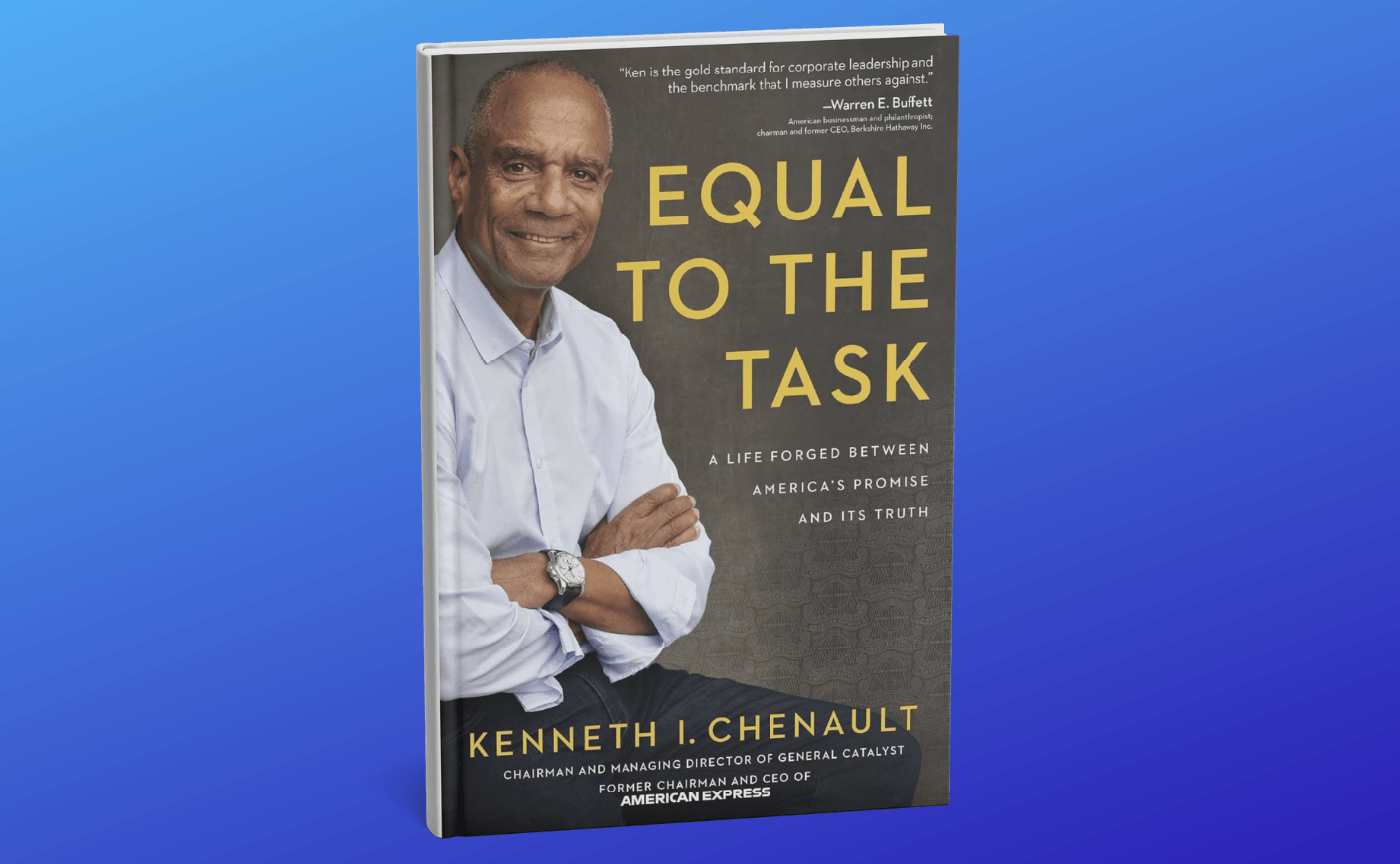
I just finished reading an advance copy of Ken Chenault’s inspiring memoir, Equal to the Task, which is being released on Tuesday, November 3 — Election Day. If you’re someone skeptical of America’s leaders and looking for inspiration, I suggest you pick up a copy.
What a story — and what a ride it’s been for Chenault. Born in 1951, three years before the Supreme Court’s landmark decision in Brown v. Board of Education, which ruled that separating children in public schools on the basis of race was unconstitutional, Chenault was raised by loving parents (his father was a dentist and his mom a dental assistant) in Hempstead, NY, a blue-collar village an hour outside of Manhattan on Long Island’s south shore.
Talented — if somewhat of an academic underachiever in high school (though a standout basketball talent who was recruited to a D1 program) — Chenault ultimately makes his way to Bowdoin College in 1970.
He arrives in Brunswick, Maine, a small coastal town about 25 miles northeast of Portland, at a time of social unrest against the backdrop of civil rights protests and the Vietnam War. While Chenault has deftly navigated other white-majority environments growing up, he’s keenly interested in his own racial origins and the civil rights movement. One of his early influences was hearing Martin Luther King Jr. address a local audience near his hometown just two weeks before the civil rights leader’s assassination. In that speech, King delivered a powerful line that he would again deliver in his final speech in Memphis: “I may not be there with you, but you will get to the promised land.” Chenault writes that MLK’s “vision of a brighter, more equitable America provided a guiding sense of purpose, a North Star for my young mind to orient toward.”
In college, he’s beginning to deliver on the promise others have seen in him. He’s invited to participate in a small discussion group formed by Nelson Rockefeller, New York’s governor. The group meets monthly or so to advise the governor on the most important issues facing the nation. It’s an early exposure to political and private sector leaders. Chenault is the youngest person in the room advising the governor and exchanging ideas with a select group of highly accomplished people.
For his senior thesis, Chenault chooses to explore black student experiences at Bowdoin — a research project that leads him to reach out to past black graduates of the college to learn about their experiences (it’s a mixed bag). During college, we see Chenault becoming grounded, focused and disciplined. While he is able to excel in a small, elite, and predominantly white college environment, he continues to try to understand racial tensions and — as his subsequent career unfolds — look for opportunities to make a difference. His ability to achieve in highly competitive environments where he's in the minority is a through line from Bowdoin, to Harvard Law School, to Bain Consulting and ultimately his tenure leading American Express (37 years, including 17 years as CEO until his retirement in early 2018).

When Chenault arrives at American Express in 1981, he doesn't encounter a single black person in senior management. He writes, “I hadn’t set out to be a pioneer but it was starkly clear that I was one.”
A theme that emerges throughout Chenault’s rise to the top of American business is the support he receives from people around him who saw outsized potential and encouraged him to realize it. Readers observe how family, community and mentors recognize Chenault's extraordinary talents throughout his young and early professional life, often pushing him early on. His parents raise him to be aware that (in his father’s words) he is “equal to the task” and that he can do anything he sets his mind toward. As part of a private school admission interview in the early 1950s, Chenault’s mother was asked what she wanted for her children. As recounted by the headmaster years later, Anne Chenault responded without hesitation: “I want my children to be happy. I want them to be confident. I want them to be caring. And I want them to be able to become whoever they want to be. If they want to become president of the United States, I’d like them to feel they could do that.”
In high school, college, law school and in his early professional career, Chenault attracts seasoned mentors who take an interest in him and his success. His supporters as he enters his business career include Lou Gerstner, president of American Express until leaving for RJR Nabisco in 1989, and Harvey Golub, CEO from 1993 until 2001 (when Chenault replaces him).
Chenault also had support and mentoring well before his appointment as CEO, from board members including Henry Kissinger, Vernon Jordan and Warren Buffett. Let’s just say that Chenault had prominent leaders in his corner who saw something exceptional in him.
His supporters identified qualities in Chenault that suggested he was uniquely qualified to lead. As a society, Chenault thinks we “over-index on intelligence and success” and, in his words, “we don’t give equal billing to character and values.” He had both of the latter as a kid in Hempstead and never lost sight of them as he made his way forward in the most competitive environments and boardrooms.
The greatest tests of leaders come in challenging times, and Chenault’s memoir shows how he responded to these moments with determination and character. One example? Chenault had been CEO for less than one year when the American Express headquarters at the World Financial Center (directly across from the World Trade Center) was severely damaged in the 9/11 attack. Eleven employees died immediately, testing Chenault’s leadership in a way that few CEOs can imagine. One of his first actions was to meet with families of all the victims. Chenault also rented out Madison Square Garden and invited all American Express employees to gather together just nine days after the attack. Chenault addressed those in attendance, almost 5,000 employees, without written comments, speaking from the heart and pledging his support for rebuilding the city and re-establishing the company’s New York headquarters. At a recent dinner in NYC commemorating the 25th anniversary of the terrorist attack, Mike Bloomberg recognized Chenault's contribution to rebuilding lower Manhattan. Bloomberg told the audience that he called Ken after his election as mayor, and asked him to stay in New York. According to Bloomberg, Chenault responded by saying, “We’re not going anywhere. How can we help?”
It’s impossible to read this memoir and not wonder: Why didn’t Chenault run for public office? What a treasure his leadership would have been if he were governor, a senator or, yes, president. But what also emerges is Chenault’s recognition of how much can be done from a position of corporate leadership. Chenault explicitly rejects the notion that the sole responsibility of business is to earn profits for its shareholders. Of course, businesses need to satisfy shareholders, creditors and other constituents. But for Chenault, the role of American business is far more ambitious — and it calls on leaders of character and values to do as much as possible to make communities stronger, not just enrich investors. In so doing, businesses are a central part of making American democracy succeed. Is it a coincidence that this book is being released on Election Day in America?
In Equal to the Task, Chenault shows how much each of us can do from our own positions of leadership. It’s a lesson worth learning.
