






On the cusp of America’s 250th, I believe that our nation is in transition. Every new crisis hits us with speed and force, causing massive contractions of freedom and safety — authoritarian violence, white nationalist rage, climate catastrophes, technological upheaval, genocide, and war. Each one brings searing pain. Each one seems like it might lead to the death of us. On the deadliest days, we can taste the ash in our mouths.
But if we dare lift our gaze and look again in the darkness, we may see what is struggling to be born: a multiracial America that is safe and whole, green and free — where you see my child as yours, and I see yours as mine.
When have you seen the promise of America? I saw it in Los Angeles, where neighbors chose to see no stranger and sheltered one another in the wake of apocalyptic fires. I saw it in the streets of Minneapolis, where neighbors risked themselves for immigrant families, showing up with whistles when they had guns. I see it anytime people who have no obvious reason to love one another come together to grieve, care for each other, and fight for humanity. I believe revolutionary love is the call of our times.
“The future is dark. What if this darkness is not the darkness of the tomb, but the darkness of the womb?” I asked in my 2016 Watch Night Address. “What if our America is not dead, but a country that is waiting to be born? What if the story of America is one long labor? What if all of our grandfathers and grandmothers standing behind us now — those who survived occupation and genocide, slavery and Jim Crow, detentions and political assault — were whispering in our ears, 'You are brave'? What if this is our nation’s greatest transition? The midwife says: Breathe and push!”
May we labor together for the America that is waiting to be born. If the last 250 years were defined by a declaration of independence, may we declare our interdependence to shape the next 250 years. What does it look like for you to be braver with your love than ever before?
The following 25 books show me how to labor with revolutionary love — love for others, our opponents, and ourselves.

Love for others
Seeing no stranger begins in wonder — to be able to look at anyone and say: You are a part of me I do not yet know. We are thrown into systems built to make us strangers to one another. These books show us how to build deep solidarity: how to lead with wonder, be brave with our grief, and fight for a future that leaves no one outside our circle of care.
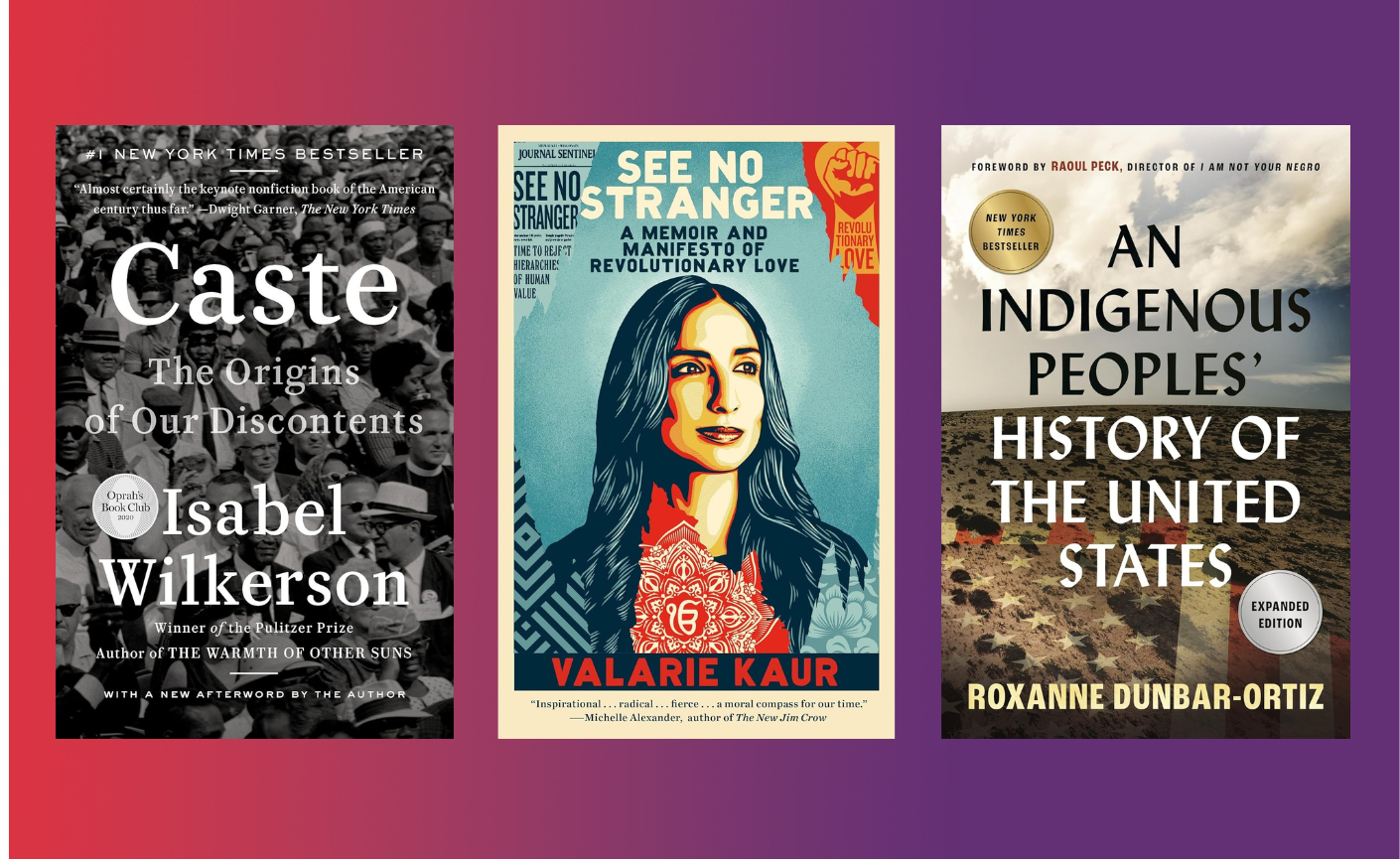
1. Caste by Isabel Wilkerson: Once we understand caste as the hidden architecture of America’s racial hierarchy, we discover the tools to dismantle it. In her tour de force, Wilkerson inspires us to interrogate how we have been shaped by systems we did not choose — and who we might become without them.
2. See No Stranger: A Memoir and Manifesto of Revolutionary Love by Valarie Kaur: As a Sikh American woman in post-9/11 America, I spent 20 years organizing around hate; I will spend the rest of my life organizing around love. I wrote this book to reclaim love as our birthright — and invite you to join me. It's a primer in the movement to reclaim love as a force for justice, healing, and transformation in America.
3. An Indigenous People's History of the United States by Roxanne Dunbar-Ortiz: This essential chronicle of the original stewards of this land empowers us to tell the truth about the genocide and erasure of Indigenous people and honor their enduring presence. To wonder about the stranger is to begin here, with the people who were never strangers to this land. The next 250 years must begin with Indigenous people’s history and wisdom.
4. American Indigenous Democracy: A Call for Interdependence by Jose Barreirro, Oren Lyons, John Mohawk, Katsi Cook, Baratunde Thurston, and other contributing authors: Learn how the Haudensaunee Confederacy practiced democracy on Turtle Island long before this land became the United States, and endures to this day. In this stunning new release, Elders, leaders, and scholars like Baratunde Thurston calls us “to citizen” as an act of love and points us to Indigenous wisdom to restore our relationships with our neighbors and the living world.
5. A People's History of the United States by Howard Zinn: These are the suppressed stories — of factory workers, dissenters, immigrants, and dreamers — that establish the foundation of our next 250 years of interdependence. When we wonder about the people that history forgot, we begin to build a "we" large enough to hold all of us.
6. The New Jim Crow by Michelle Alexander: In each era of America’s history, racism was never abolished; it transmuted and took new forms. The new Jim Crow is a system of mass incarceration that buries Black and brown bodies alive for the illusion of “security.” Once we see racist systems for what they are, we can not only abolish them, but imagine something new in their place.
7. How to Be an Antiracist by Ibram X. Kendi: An earth-shaking reckoning that shows us how to confront and uproot our own biases so that we can see no stranger. Kendi calls us to become anti-racists, active co-conspirators in building a multiracial America. Antiracism is the bridge; beloved community is the destination.
8. The Sum of Us by Heather McGhee: Through her riveting journey across America, McGhee reveals that our fates are inextricably linked — and shows us the "solidarity dividend" waiting for us when we finally choose to invest in one another. Freedom and dignity for Black, brown, and Indigenous people leads to liberation for all.
9. All We Can Save by Ayanna Elizabeth Johnson & Katharine K. Wilkinson: A visionary anthology of diverse voices on how to expand our "we" to include the earth and all who depend on her. Our grief becomes collective, our wonder becomes action, and saving what we love becomes an act of liberation that leaves nothing behind — land, water, sky, and all living beings.
10. Under a Future Sky by Brynn Saito: A shimmering book of poems that teaches us to love the ancestors who live within us — stitching together fragmented histories into a bridge of healing for the generations to come. In Saito's lines, we find language for longing that, when named, draws us into wonder, again and again.
Love for opponents
How do we fight for humanity without becoming what we are fighting against? These books show us how to tend the wound — they give us safe containers for rage, embolden us to listen to opponents with moral clarity, and inspire us to imagine a future that leaves no one behind.
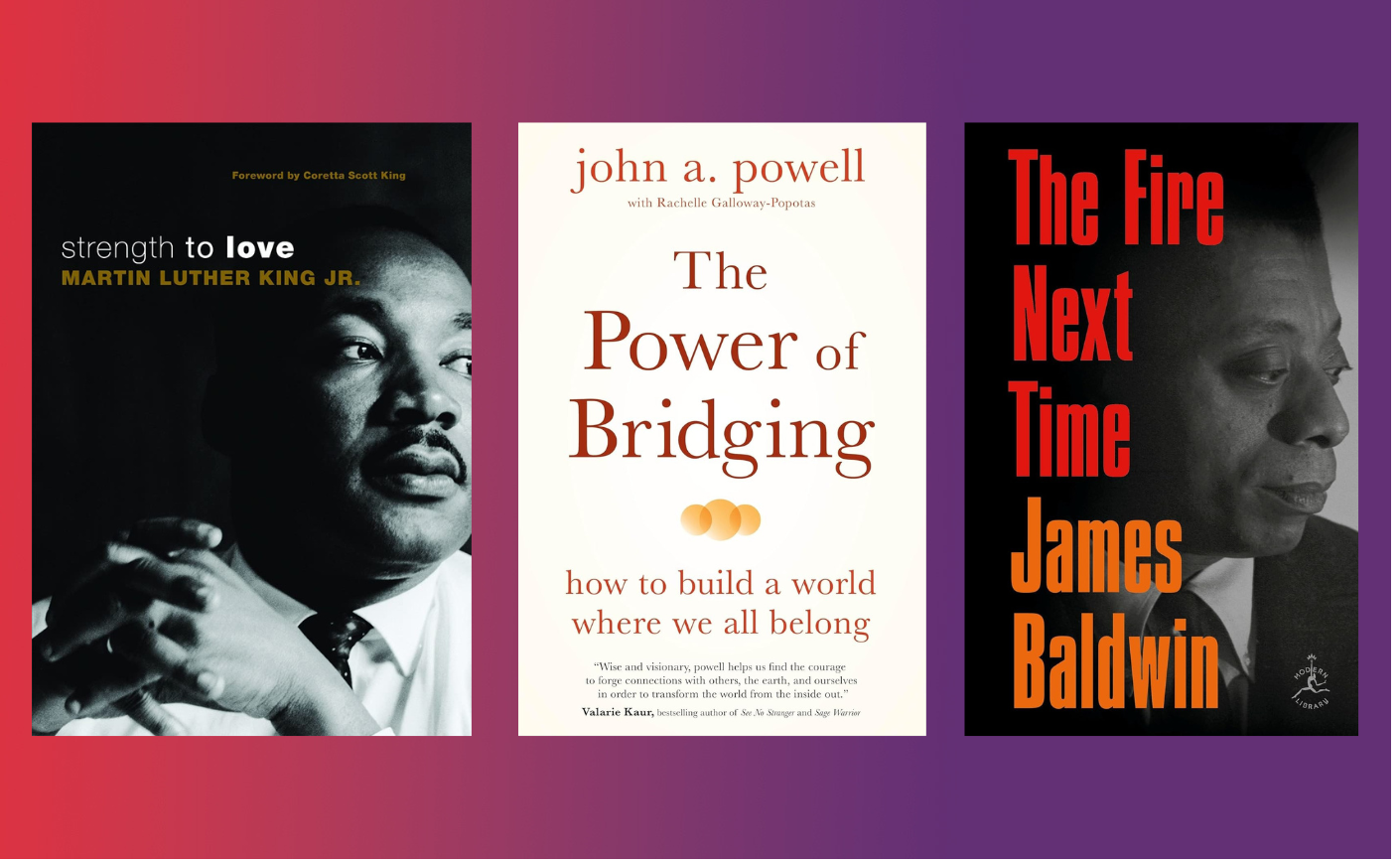
11. Strength to Love by Martin Luther King Jr.: Only love can transform an opponent, save the soul of our nation, and birth a future of reconciliation. Dr. King’s classic text embodies the love that he lived and breathes into us now. Love is not weakness, but the hardest and most disciplined labor of our lives.
12. The Power of Bridging by john a. powell: A new essential handbook for our time, Powell offers us the "technology" of bridging — the practice of choosing connection over othering — so that our movements leave no one behind. He gives us concrete tools for moving people from the margins of our "we" toward its center.
13. The Fire Next Time by James Baldwin: Baldwin's fierce and prophetic prose holds the mirror up to America with such unflinching love that we have no choice but to look. He envisions the nation we might one day become, if we become revolutionary with our love.
14. Healing the Heart of Democracy by Parker Palmer: A beloved Quaker elder and teacher, Palmer teaches us to hold the tensions of democracy within our hearts — turning conflict into a creative labor for the common good. A heart broken open by grief and rage can become the very organ capable of holding our opponents’ humanity without losing our own.
15. Just Mercy by Bryan Stevenson: Tending the wound requires us to get proximate to suffering — and that proximity is where we find the power to demand a justice that heals. A legendary social reformer, Stevenson’s stories teach us that mercy is not a sentiment but a practice — one that transforms both the giver and the receiver.
16. The Cruelty Is the Point by Adam Serwer: Serwer equips us to name the cruelty that drives authoritarian violence in America today. Naming the truth of what is happening with moral clarity is itself an act of love — for ourselves and for the world we are trying to protect.
17. On Tyranny by Timothy Snyder: Essential lessons from history that remind us that loving our opponents means protecting the democratic guardrails that keep us all safe and free. The labor of tending the wound is also the labor of refusing to let our institutions become instruments of brutality.
Love for ourselves
In all of our labors — making a life, raising a family, building a movement — we can draw on the wisdom of the midwife: Breathe and push! Breathe to draw energy, joy, and pleasure into our bodies. Push through fear and pain to become our best selves. As we stand at the threshold of the next 250 years, we will need to summon our deepest wisdom to transition — to undertake the fiery, life-giving labor of moving from the world we inherit into the world we choose to birth. These books are medicine for that labor.
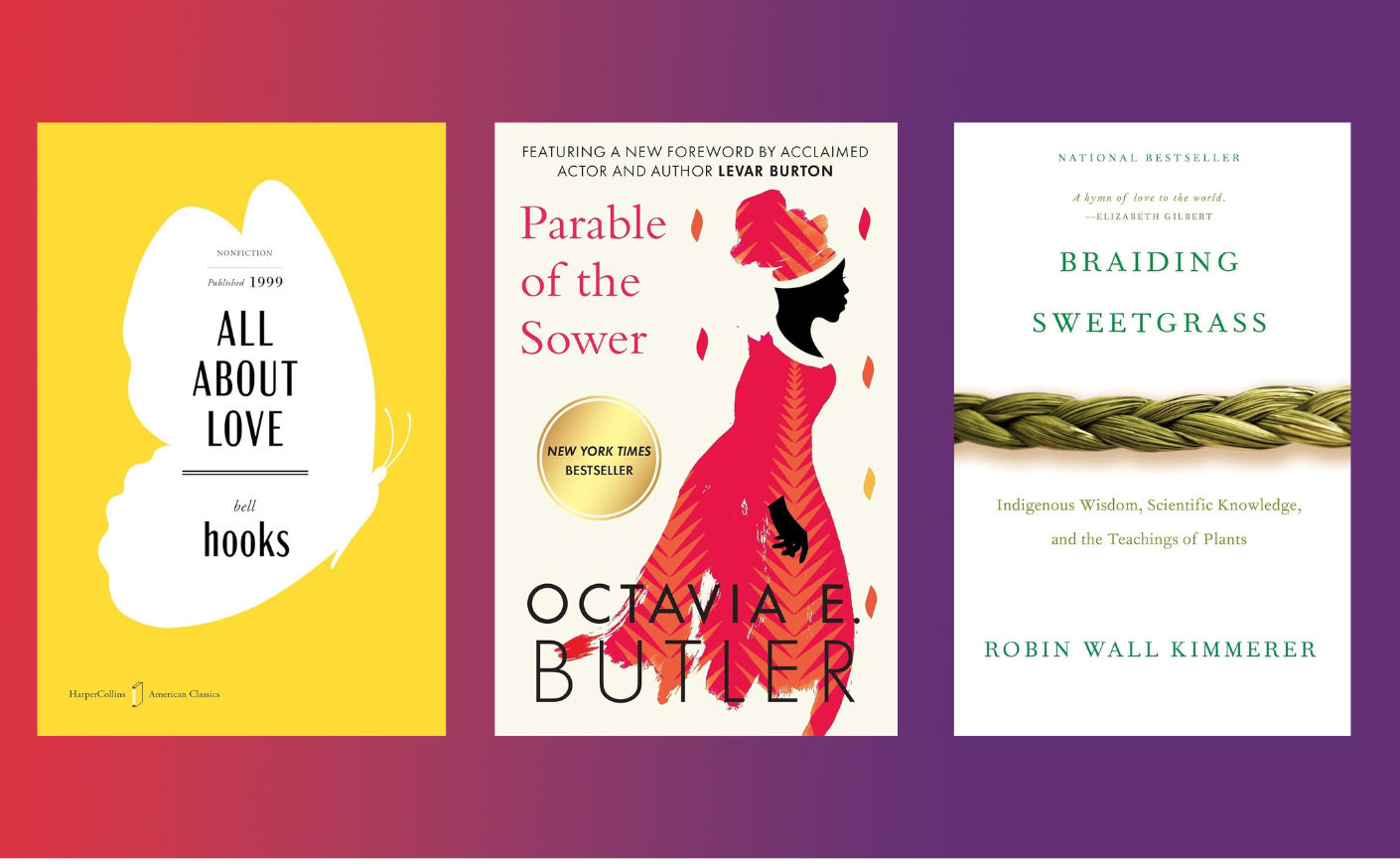
18. All About Love by bell hooks: The classic text on redefining love as action. Learning to love ourselves is not indulgence, but the most radical and necessary act of liberation: The more we love all parts of ourselves, the more we are able to love all parts of the world around us into collective liberation.
19. Parable of the Sower by Octavia E. Butler: A Black futurist now seen as prophetic, Butler foretold the fires and horrors of our current era in her visionary science fiction classic. She imagines a young Black woman who refuses to surrender to despair and creates her own cosmovision: God is change, change is the only constant, we can shape change. Her story has the magic to catalyze agency in the darkest times.
20. Braiding Sweetgrass by Robin Wall Kimmerer: A classic volume on Indigenous wisdom as medicine for our souls. Loving ourselves is remembering our place in the sacred web of the Earth, grounding our spirits for the labor ahead. Kimmerer teaches us that when we receive the gifts of the living world with gratitude, we are replenished for the giving.
21. My Grandmother's Hands by Resmaa Menakem: Trauma lives in the body. Menakem hands us healing practices to settle our nervous systems and metabolize generational trauma, preparing our bodies for the labor of birthing a new America.
22. Black Earth Wisdom by Leah Penniman: Let us return to the soil, reconnecting with the land to sustain our bodies and spirits for the work of transformation. Inspired by Black ancestors who labored on the land, Penniman shows us that healing ourselves and healing the Earth are one continuous act of love.
23. When the Light of the World Was Subdued, Our Songs Came Through (edited by Joy Harjo): These are songs of the Indigenous peoples of this land — wisdom carried across generations, through darkness and displacement, and offered now to us as medicine for this moment. As we mark 250 years, Harjo reminds us that these songs were here long before America was named — and that the joy, resistance, and memory woven into them are exactly what we need to carry us into the next 250 years. Singing together is how we remember who we are, and who we are still becoming.
24. Freedom is a Constant Struggle by Angela Davis: A legendary freedom fighter, Davis invites us to find peace in the long arc of history, embracing our role in a movement far larger than any single moment. Loving ourselves means releasing the weight of urgency long enough to be replenished by the wisdom of those who came before us.
25. Emergent Strategy by adrienne maree brown: A midwife for our times, brown shows us that small acts of care and connection are the fractals that eventually transform the entire world. The way we treat ourselves and each other in this moment is a blueprint for the future waiting to be born. (And a bonus title: her irresistible anthology Pleasure Activism.)
Valarie Kaur is a civil rights activist, lawyer, filmmaker, founder of the Revolutionary Love Project, and #1 LA Times bestselling author of See No Stranger. Her latest book, Sage Warrior, is a spiritual handbook for modern times rooted in 200 years of Sikh wisdom — for activists, burnt-out Americans, and anyone ready to put Revolutionary Love into action during hard times. Learn more at valariekaur.com.
