






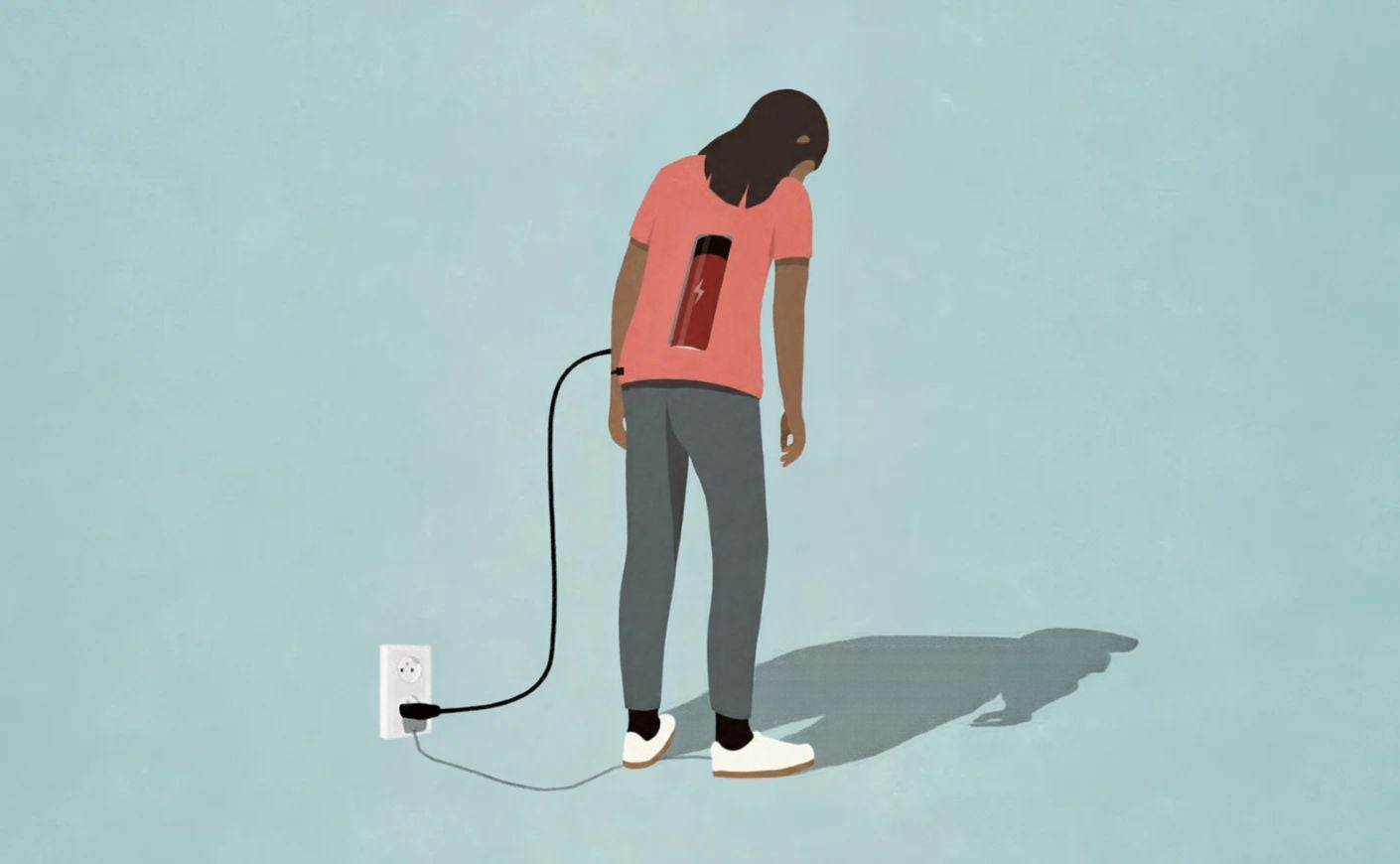
For most parents of young children, exhaustion comes with the territory. Between middle-of-the-night wake-ups, constant snack demands, and last-minute playdates, running on fumes is pretty much the default state.
But for Amber, a mother of three young children, that exhaustion felt very different, almost all-consuming. She knew something was seriously wrong when, after giving birth to her first son in 2020, she was so exhausted that she almost dropped him — on more than one occasion. “When I brought this up to some mom friends of mine,” Amber recalls, “the answer was always, ‘Well, you're a new mom. It’s tiring.’”
She didn't know it yet, but Amber was living with primary biliary cholangitis (PBC), a chronic and rare autoimmune disease in which the body’s immune system mistakenly attacks and slowly destroys the bile ducts inside the liver. One of the most common side effects is one many moms will initially write off: fatigue.
Amber had always been very active: She loved hiking, never said no to a party invite, and every Wednesday she’d spend six hours line dancing without leaving the floor. So a fatigue so intense that she couldn't even hold her son set off alarm bells. Her husband Brett noticed too and encouraged her to see a doctor.
After some tests, Amber’s doctor began treating her for a different autoimmune condition. But even after treatment, the fatigue didn’t subside. Eventually, an immunologist thought to test her for PBC. “He said, ‘You’re way too young, you probably don’t have this, but let’s check anyway,’” remembers Amber. “The test came back positive.” A liver biopsy then confirmed the PBC diagnosis.
Like anyone with a new diagnosis and an internet connection, Amber’s first move was to google PBC. “This was in 2021, and at the time it said there was a five-to-10 year life expectancy,” she remembers. “I was a new mom, and was loving the experience, so hearing that I might not live long enough to see my son go to kindergarten… It was one of the lowest points of my life.”
Amber spent the first six months after the diagnosis in a very dark place. “I didn’t know where to turn, so I really sat in my depression,” she says. Eventually, she decided to do what she’d always done when she felt down: lean on her community. She sought out support groups, and although she noticed that she didn’t exactly fit the demographic, they offered her a lot of comfort. “I was the youngest person in the group by far — there were people in there who had been diagnosed before I was even born,” she says. “But 30 years later, these people were still here, and they were thriving. That’s when I started to relax — I realized this was something I could live with, and maybe even thrive with.”
Eventually, there were improvements in Amber's liver function blood tests, but the chronic fatigue didn't improve. Now, during the worst bouts, Amber says it can feel as though someone has turned up the gravity on her entire body. “It feels like someone has weighed down all of my bones at once,” she explains. “When I feel it coming on, there’s nothing I can do but just sit — my body is too heavy.”
Unlike ordinary tiredness, fatigue caused by PBC isn’t mitigated by sleep or diet. “I wish people understood that extreme fatigue isn't fixed by eating well or sleeping enough, or even resting for a long period of time,” says Amber. Even when she does all of these things, she continues, “It strikes whenever it wants to.”
For Amber, now a mother to a son and twin daughters, a bad fatigue day means missing out on the things she loves. “I know I'm not gonna be able to be as present for my kids as I want to be,” she says. On an especially tough day, she may not have enough energy to get off the couch to help one of her children fill a water bottle. But perhaps even worse than the physical exhaustion is the brain fog that often accompanies it. “My brain and my mind are no longer mine.”
One example of the severity of Amber’s brain fog happened when she was leaving the park with her friend, son, and twin daughters. She buckled her son into the car and climbed into the driver’s seat. Her friend stopped her: The twins were still sitting in their stroller. “I was about to drive away without my twins because I forgot they existed,” she says. “I remember coming home from that day and having a horrible meltdown — How can I be a mom if I can’t even remember my kids?”
The incident forced Amber to confront something bigger than fatigue itself: that the version of motherhood she had imagined might not always match the version her body would allow. “Motherhood as a chronically ill mom means accepting that you aren’t going to be the parent that you thought you were going to be,” she says.
Living with PBC has forced Amber to accept her limitations — and accept help. “We're very blessed to have a strong network,” she says. “It does take putting aside some pride to activate that network when needed, but it has been very humbling when they respond, and they respond joyfully, and are able to be there for us.”
Her husband Brett is also always willing to step in: On difficult days, he’ll rearrange his work schedule to handle school transportation, cooking, chores, or whatever else might take something off Amber’s plate. But Brett doesn’t only help his wife accomplish the things she has to do — he protects space for the things that remind her who she is outside of being a patient or a parent.
“He makes time to ensure that I can still be me,” Amber says. “He makes sure that door doesn’t close.” One of the "doors" Brett has helped keep open leads straight to the dance floor: The couple deliberately structures their Wednesdays, when Amber goes line dancing, to give her the best possible chance of making it out that night. Amber avoids scheduling anything taxing during the day, and Brett handles school drop-off the following morning, so she has room to recover.
Amber has relaxed some of her own expectations around going out, like that she used to feel like she had to arrive fully dressed up. But now, if putting on makeup or assembling an outfit would take energy she could otherwise use to dance, she’ll show up in jeans and a T-shirt. “They’ve seen me for a decade,” she says of her fellow dancers. “They just want me to be there.”
In the five years since her diagnosis, Amber has learned not to measure herself against what she used to be able to accomplish — or against the kind of mother she once imagined she would be. She prioritizes. She moves when she can. She asks for help. And she protects the things that make her feel most like herself.
For others struggling with fatigue, Amber’s experience offers a powerful reminder: You don’t have to spend every ounce of energy you have proving how much you can still do. Sometimes, adapting your life means deciding what deserves that precious energy in the first place.
To hear more firsthand perspectives on living with PBC-related fatigue and learn more about its impact, watch Beyond Tired.
Amber was compensated by Ipsen for her time to share her PBC experience.
©2026 Ipsen Biopharmaceuticals, Inc. All rights reserved. NON-US-004884 September 2026
