







In October 2023, at 38 years old, I was diagnosed with Stage III ER-positive, HER2-negative breast cancer. Before I ever sat down for chemotherapy, I had already started mourning my hair.
As a Black woman with natural 4C hair, it wasn't "just hair." It was part of my identity, my culture, and how I recognized myself. The way I understand cancer, I immediately assumed losing it was unavoidable. My understanding of cancer, it turns out, was oversimplified.
Almost overnight, my life became a blur of appointments, scans, treatment decisions, and chemotherapy. My care team recommended chemotherapy before surgery because of the size of my tumor and lymph node involvement. Treatment began in October 2023 and continued through March 2024.
As I prepared for chemotherapy, my doctors at Memorial Sloan Kettering brought up hair preservation tools, which I didn't even know existed.
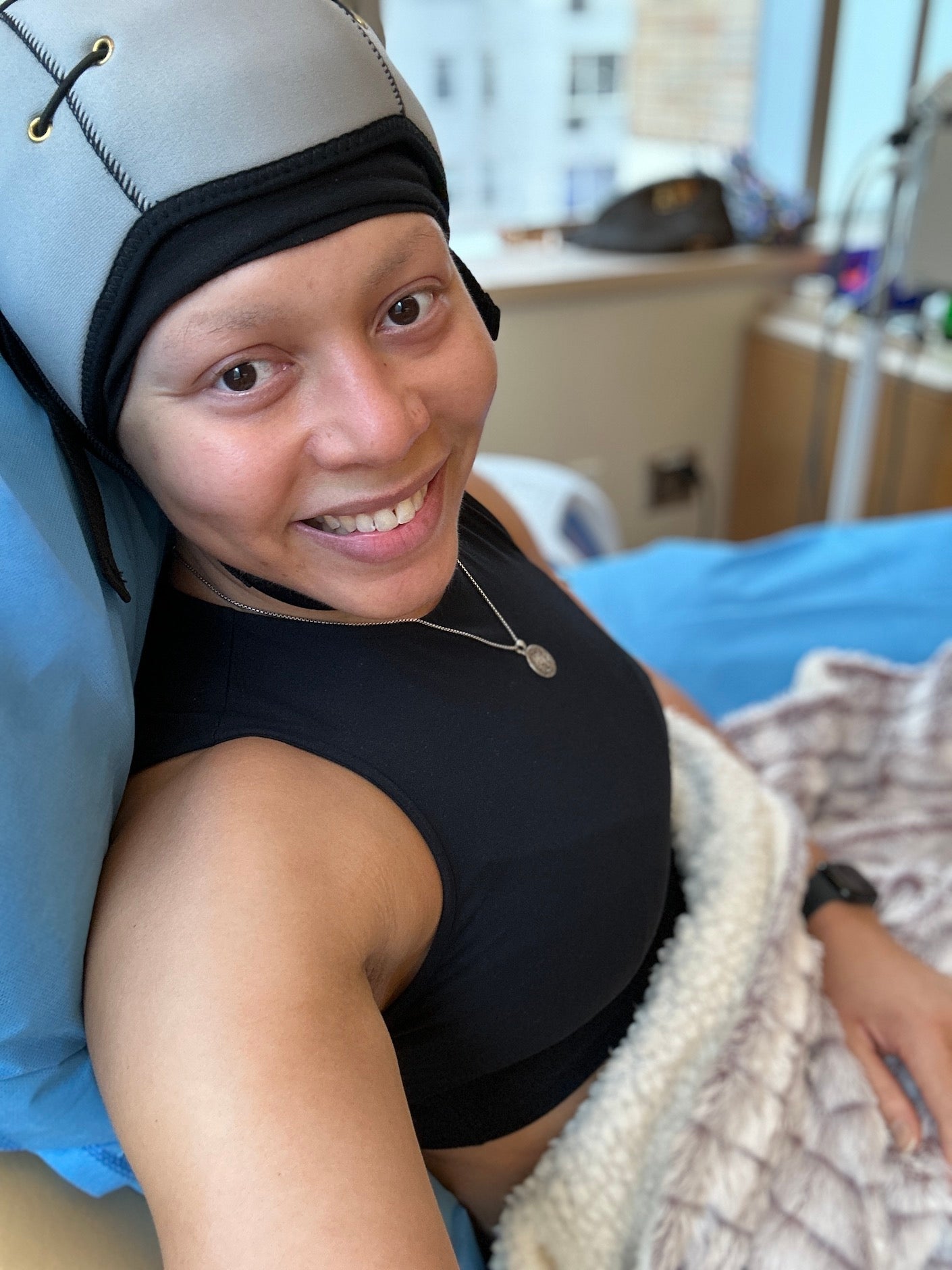
Scalp cooling is a system designed to reduce chemotherapy-induced hair loss. Patients wear a cooling cap before, during, and after chemotherapy infusions. The cold constricts blood vessels in the scalp, reducing blood flow and limiting the amount of chemotherapy that reaches the hair follicles.
I wanted to believe it would work. I just wasn't sure it would work for someone with my hair type.

My relationship with my hair
For those unfamiliar with hair typing, 4C hair is the tightest curl pattern on the natural hair spectrum. Its densely coiled texture requires customized care, patience, and understanding. Like many Black women, I spent years learning what my hair needed, embracing its natural texture, and appreciating the beauty of what made it uniquely mine.
But my connection to my hair went beyond how it looked. For many Black women, hair carries deep personal and cultural significance. It reflects identity, history, self-expression, and, for generations, has been intertwined with conversations about beauty, belonging, and acceptance.
So when cancer entered my life, the thought of losing my hair felt like losing another piece of myself on top of everything else. I told myself I had accepted it. Or at least I thought I had.
Why I tried scalp cooling during chemo
Most of the information I found online about scalp cooling featured women with straighter hair textures. There were very few stories from Black women with dense, tightly coiled textures. Because the process relies on direct contact between the cooling cap and the scalp itself, I worried that my hair would act as a barrier, preventing the cold from reaching the follicles effectively.
I kept asking myself, Would the cold actually reach my scalp? Would my hair texture create too much insulation?
I also heard mixed experiences in online patient communities and support groups. Some women described scalp cooling as life-changing. Others said it didn't work for them at all. The more I researched, the more uncertain I became.
Ironically, it wasn't the possibility of keeping my hair during treatment that ultimately convinced me; it was the possibility of protecting my hair follicles.
As I learned more, I discovered that scalp cooling wasn't just about reducing hair loss during chemotherapy; it might also help protect hair follicles and support healthier regrowth afterward. That mattered to me.
While most people experience some degree of regrowth after chemotherapy, some develop long-term or permanent thinning, known as chemotherapy-induced alopecia.
I wasn't trying to save every strand. I was trying to give my hair the best chance to recover.
To maximize contact, I wore cornrows throughout treatment to keep my hair as flat as possible. My mother and I carefully positioned the cap before every infusion, making adjustments to ensure the best possible fit.
Scalp cooling isn't passive. It requires preparation, patience, and commitment, with cooling beginning before chemotherapy and continuing after each infusion.
The results
Many people begin scalp cooling hoping it will prevent all hair loss. That wasn't my experience.
Throughout my treatment, I experienced shedding and noticeable thinning. There were moments I worried I was about to lose much more.
But I never lost all of my hair.
Looking back, I estimate I retained 65 to 80 percent of it. That may not sound remarkable on paper, but emotionally it made an enormous difference; it allowed me to move through my treatment looking mostly like myself. Most of the time, I went uncovered. When I did cover my hair, I wore hats instead of wigs because I still felt comfortable showing my own mane. That distinction — between complete loss and partial preservation — mattered far more than I expected.
Scalp cooling didn't stop cancer from changing my body or my life. But during a season defined by uncertainty, it gave me one familiar part of myself to hold onto. Not perfect preservation. But preservation nonetheless.
What happened after treatment
One of the biggest surprises came after chemotherapy ended: My hair grew back strong. My curls appeared slightly more elongated and darker than before treatment.
Everyone's experience is different, but for me, it never felt like I was starting from zero.
What I want other patients to know
If you are a Black woman with 4C hair facing chemotherapy, I want you to know this: You are not excluded from scalp cooling.
I can't promise what your results will be — no one can. But tightly coiled hair does not automatically mean scalp cooling won't work for you.
When I was making this decision, I searched for another Black woman with 4C hair who had been through it. I wanted to know if it was possible. I couldn't find many stories. So I decided to share mine.
Kia Lee is a breast cancer survivor, author, speaker, and survivorship coach.
