






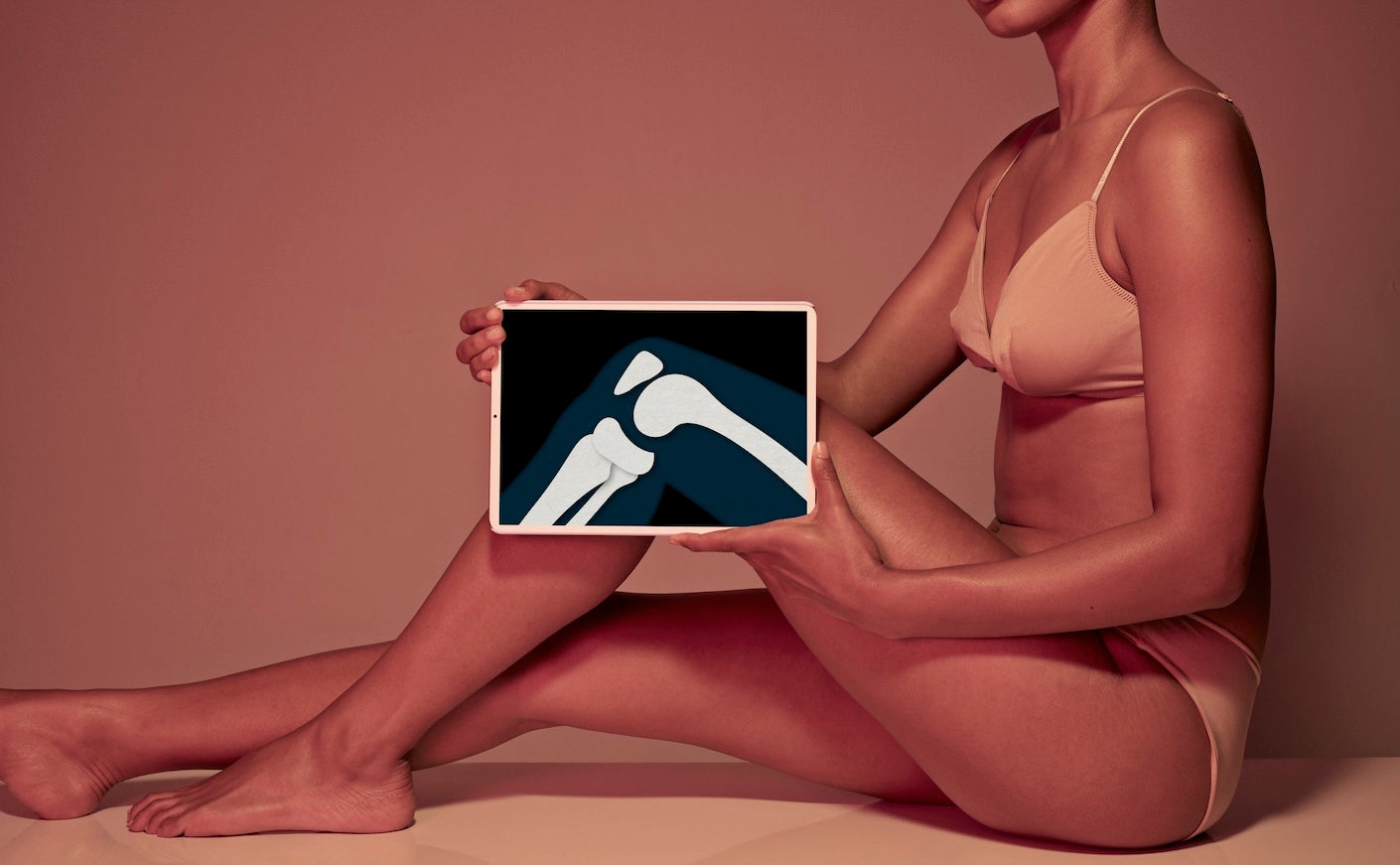
There’s a reason the “midlife crisis” is such a common phenomenon: With our youngest years behind us, it's tempting to dwell on everything from career plateaus to empty nest syndrome to, of course, the physical and mental toll of getting older. While some of these stressors are ego-driven (hello, hair loss), one age-related concern can have very real consequences for your health: Bone loss.
For women, bone loss tends to quickly accelerate around perimenopause. But hormonal changes aside, many other risk factors play into how well your bones will fare later in life. The good news is, whether you’re 35 or 75, it’s never too late to start making changes that can protect you from fractures.
That’s why we turned to Doug Lucas, DO, a double board-certified physician in orthopedic surgery specializing in anti-aging and regenerative medicine, to give us some tips on how to accelerate bone growth, no matter where you’re starting from. Dr. Lucas also serves as Clinical Lead of Hormone Optimization & Longevity at LifeMD. He explains that contrary to what you might have learned from a certain ‘90s ad campaign, there’s more to great bone health than just drinking lots of milk.
Know your risks
Let’s start with the bad news: Osteoporosis is known as a “silent disease” for a reason. “There really aren’t any warning signs,” says Dr. Lucas. “Bone pain is not generally a sign of bone loss, and there's nothing you can physically see to indicate you’re at risk of a break or a fracture until it happens.”
Now for the good news: Knowing your risk factors is one of the best ways to set yourself up for success. “If you have a family history of osteoporosis and fragility fractures, that's a big red flag,” says Dr. Lucas. “So is a history of hypo- or hyperthyroidism, or if you’ve struggled with an eating disorder or have a history of chronic dieting.”
If you’ve been treated with steroids in the past, that could be another risk factor. According to Dr. Lucas, “Systemic steroid therapy [oral or IV] can negatively impact bone. The dose and amount required to see a loss on a DEXA scan [a test that measures bone density] will depend on many variables but if you’re taking a steroid, ask your doctor about how it could impact bone health.” Additionally, PPIs taken for acid reflux are associated with increased fracture with "chronic" use. While it’s unclear at what duration this could cause damage or what lasting impacts are, it should still be considered when weighing your personal risk factors.
Finally, a sedentary lifestyle, especially a lack of resistance or impact exercise, can potentially place you at risk of osteoporosis.
Know your hormones
To fully understand when and how bone loss could affect you, we need to talk about sex — sex hormones, that is. “We mostly hear about estrogen, because it’s an approved product for the prevention of osteoporosis, but changes in testosterone and progesterone also impact bone health,” explains Dr. Lucas.
As women start to go through perimenopause, testosterone declines along with estrogen. Dr. Lucas explains that, “While the effect of testosterone on bone is not super clear in women, testosterone is anabolic, so it can help build muscle, which is crucial for bone health.” Then there’s progesterone: “A lot of women will lose progesterone in perimenopause before estrogen starts to drop,” explains Dr. Lucas. “To optimize bone metabolism, there needs to be an ebb and flow of estrogen and progesterone throughout the cycle month. That’s why, when you look at that hormonal curve that happens during menopause, you see a gradual decline and then a plummet in bone density that happens when estrogen drops.”*
But even before you hit perimenopause, your body’s hormonal history can play a role in bone health. “If women have had abnormal cycles, especially ovulatory dysfunction, they may not have the progesterone rise in the luteal phase (second half) of their cycle,” explains Dr. Lucas. So even if your estrogen levels are perfect through your reproductive years, a progesterone deficit can have a cumulative negative impact on bones. Reproductive health is tied to bone density in other ways, too. “PCOS is a risk factor for bone loss, and so is being on hormonal birth control that suppresses your cycle,” explains Dr. Lucas.
Know your numbers
Even if you’re an expert on your personal risk factors, numbers don’t lie. That’s why Dr. Lucas suggests getting a DEXA scan to establish your bone-density baseline.
A DEXA scan — a quick and painless test that can be done at many doctors' offices, wellness clinics, and local imaging centers — measures bone-mineral density to assess your risk of osteoporosis and fractures. The scan provides you with a T-score, which compares your bone density to that of a healthy 30-year-old adult of the same sex. A score of -1.0 or above is considered normal, between -1.0 and -2.5 means you have low bone density (often called osteopenia), and -2.5 or lower indicates osteoporosis. Dr. Lucas explains that osteopenia isn’t exactly a diagnosis, but more of a statistical description: “The range for osteopenia is big, but all it means is that you have lower bone density than average,” he explains. While that might sound intimidating, that categorization doesn’t actually mean much on its own. “The problem arises if you’re continuing to lose bone,” he adds.
So if your DEXA result indicates you have osteopenia, you still need to know whether that number is holding steady, or if you’re continuing to dip toward the osteoporosis range. That’s why monitoring your bone health over time — possibly with annual or biennial DEXA scans — is so important. “While a woman with a T-score of -1.1 technically has osteopenia, that’s just 0.1 away from ‘average,’” says Dr. Lucas. “For all we know, that woman could be building bone, not losing it. So while an osteopenia ‘diagnosis’ is something to pay attention to, it’s not necessarily cause for alarm.”
Dr. Lucas also urges women to understand that their T-score is just one metric of bone health: “A T-score is something to measure, but it does a disservice to women to simply say osteoporosis is the problem,” he says. “Our bones are a biomarker of health: If we're losing bone, we need to understand why.”
Know your options
Let’s say you’ve just gotten your T-score, and you’re in the range of osteopenia, or low bone density. As with any health condition, the best way to rectify the problem is to identify the underlying cause. With the right interventions, osteopenia and even osteoporosis can be reversible — you might not get back the bone density you had in young adulthood, but it may be possible to improve bone density enough to put you back within normal range.
While your and your doctor's first instincts might be to turn to prescription drugs, in some cases, natural interventions alone can make a world of difference. To optimize bone metabolism, you need to build more bone than you lose, and Dr. Lucas says the first step is to look at your lifestyle: “Building bone starts with nutrition, resistance and impact exercise, sleep optimization, and the right mindset.”
When it comes to exercise, the key is a combination of resistance and impact training. Resistance training, in the form of lifting weights, places stress on bones through muscle contractions, which stimulates bone growth. Aim for two or three times per week, focusing on the hips, legs, back, and core. And to really get the most out of impact exercise, Dr. Lucas says that jogging or pickleball alone aren’t going to cut it: Instead, try heel drops or jumping for maximum impact. Higher-impact activities generally stimulate more bone growth than lower-impact ones, but first, be sure they're appropriate for your fitness level and fracture risk.
Know your protein needs
Nutrition is also key for building strong bones and if there’s one macronutrient to focus on, it’s protein. “You need high-quality protein, and you need enough of it: that means between 0.8 and one gram per pound of ideal body weight, which is a lot more than you're probably eating,” says Dr. Lucas. “If you change nothing else but that about your diet, you’ll see an impact on your bones.” While he believes that whole food complete sources of protein (like animal protein and Greek yogurt) are best, Dr. Lucas says supplementing with a protein powder — whey is ideal, if you can tolerate it, he says — is fine, if that’s what it takes to get you to 0.8 grams per pound.
Bone health isn't something that suddenly becomes important at 65. It’s shaped by choices, habits, and health factors that accumulate over a lifetime. The sooner you understand your risks and start supporting your bones through nutrition, movement, and regular monitoring, the better positioned you'll be to stay strong, active, and independent for years to come.
*To learn more about the importance of hormones for your midlife health, listen to Dr. Lucas on the podcast Here’s Something Good on…Women’s Health & Longevity
