






According to new research, you can get stronger to live longer in as little as four minutes a day.
Sounds too good to be true, right? Well, a recent study out of Penn State found that these mini workouts can help adults 65 and older see meaningful gains when it comes to improving their balance and mobility.
“The human body is designed to improve very quickly,” said Christopher Sciamanna, Ph.D., the study's lead author. “And just a few repetitions of an exercise performed regularly can lead to huge improvements."
Here's the science behind why short bursts of exercise can lead to big gains — and the specific workout researchers tested.
The four-minute workout
The study tested a program developed by Dr. Sciamanna and his team called FAST-2 (Functional Activity Strength Training), which builds on a regimen they had previously tested called FAST-1.
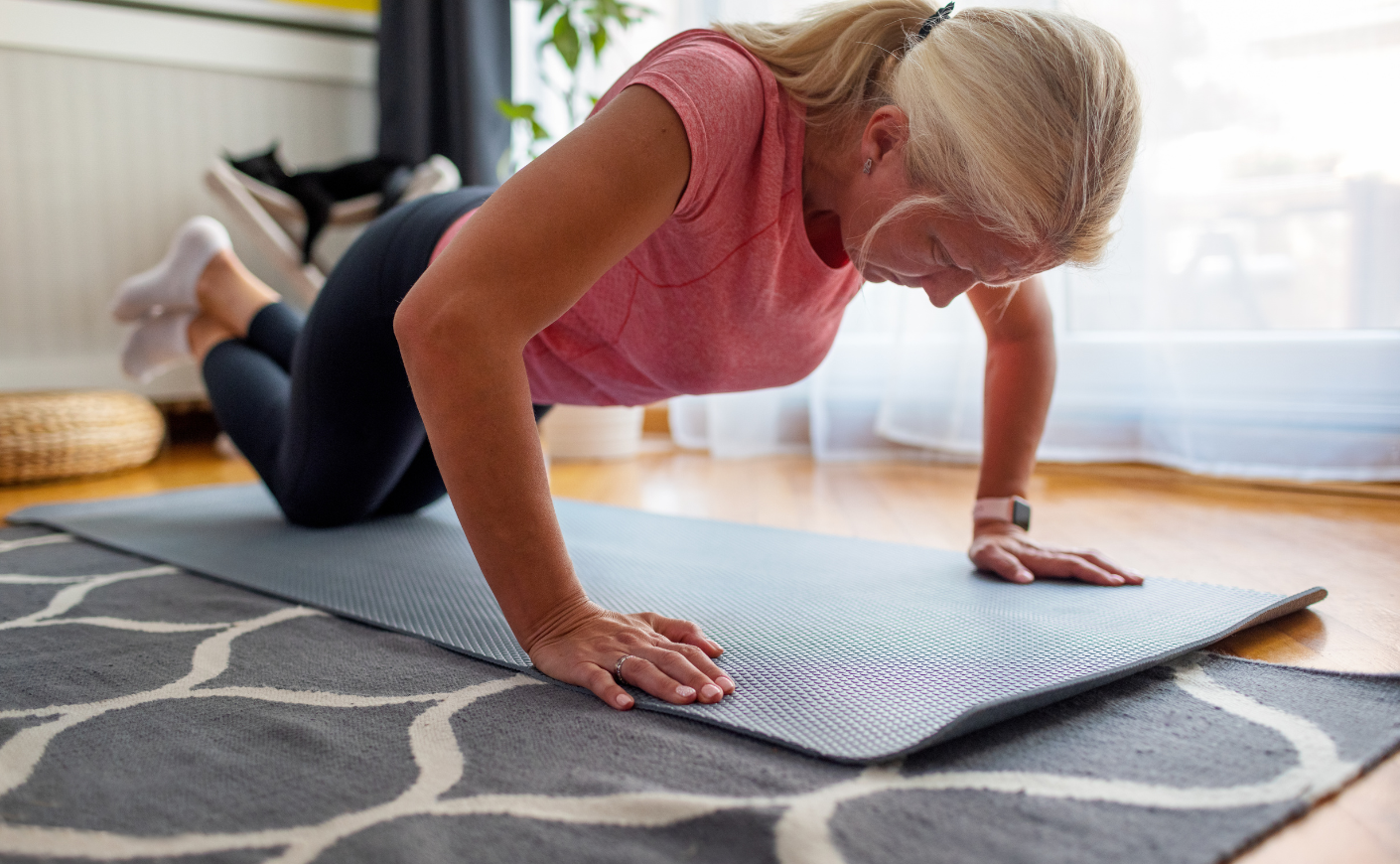
The FAST-2 program includes four exercises: push-ups, chair stands (which are a modified version of a squat), two-arm rows with a resistance band, and stair stepping. Participants performed each movement for 30 seconds, followed by a 30-second rest, for a total of four minutes. They were also provided with instructions for how to modify the exercises to make them more or less challenging — like doing push-ups on a countertop, or placing hands on their knees for chair stands to make them easier — and were encouraged to push themselves as they progressed.

To assess their progress, researchers measured how quickly subjects were able to stand up from a seated position, how long they could balance on one leg, and how many times they could rise up and down from a chair in 30 seconds — tests which predict how likely you are to need "to go into a nursing home" or whether you'll have "difficulty walking," Dr. Sciamanna said. "They give you a sense of of whether or not you're going to be able to be active in the future."
The researchers found that the 44 people (all 65 and older) who stuck to the regimen over 12 weeks decreased their sit-to-stand time by 2.3 seconds on average, were able to balance for 3.6 more seconds on one leg, and could do 4.2 more chair stands.
Though the sample size wasn't huge, these are promising results that add to the growing body of evidence suggesting you don't need to spend hours in the gym to gain muscle, stay mobile, and retain your independence as you get older. And the researchers found that this shorter, at-home routine was something that their participants could accomplish consistently, with participants completing the regimen on 81 percent of the days across the experiment.
Fewer than one in five seniors get the CDC's recommended two strength-training sessions each week. Maybe that's because exercise feels like too big a time commitment. But we'd bet that if more of them knew they could finish a workout in their living room before the coffee's done brewing, they'd be much more willing to get on their feet.
