






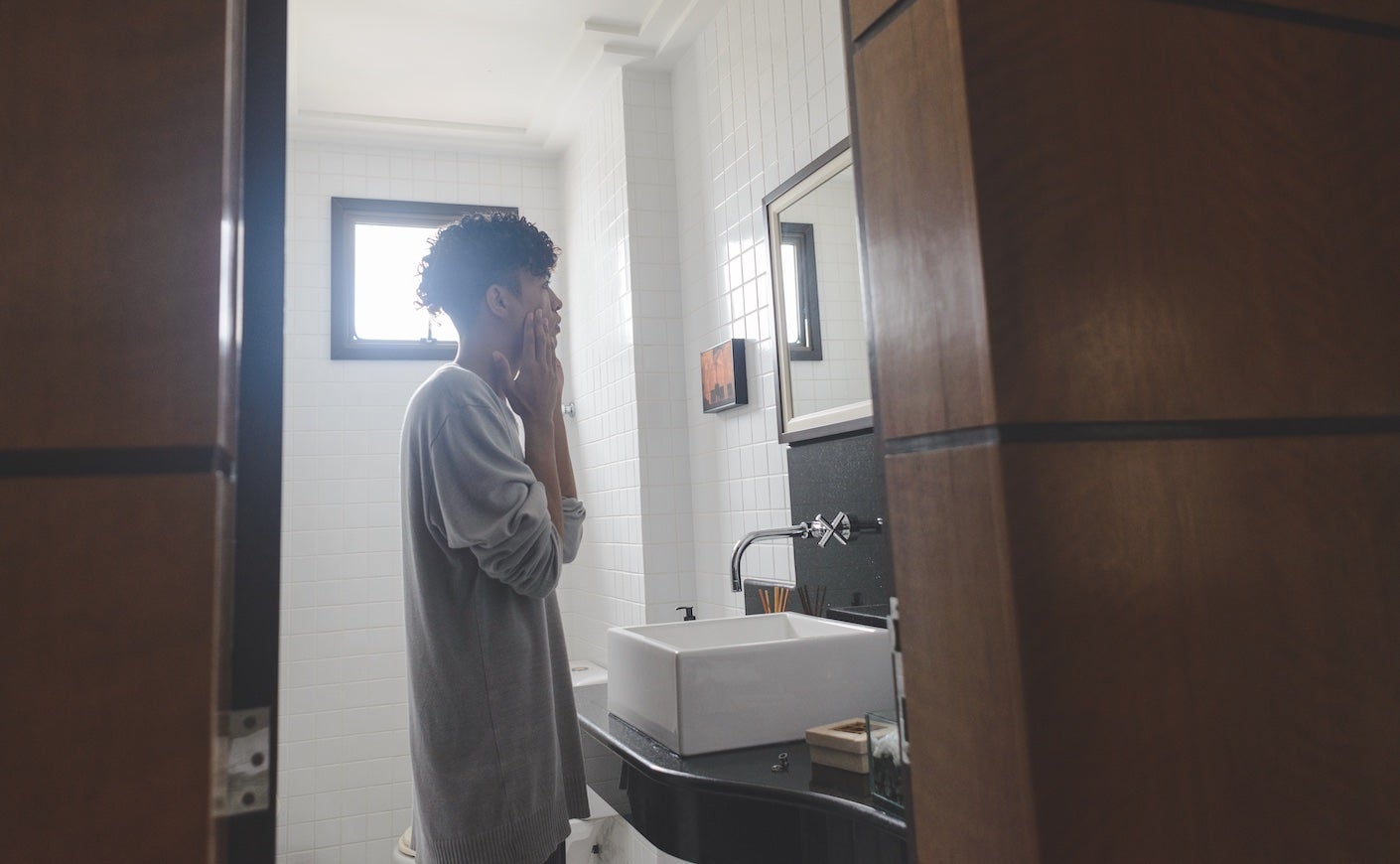
- Selfie distortion and algorithmic filters teach boys to see their faces as flawed, driving looksmaxxing and escalating cosmetic demands.
- Surgeons can change anatomy but not perception. Operating on algorithm-driven body image harms patients and usually fails to fix the underlying issue.
- Teens need time, trusted reassurance, and protection from a culture that trains them to constantly surveil and judge themselves.
A 15-year-old boy walks into my office because he wants me to fix his jaw.
He sits in my exam chair with the particular stillness of a kid who has rehearsed the conversation a hundred times. A parent waits in the corner and lets him do the talking. He has done his homework, and he describes what's wrong with him using words I usually hear from other surgeons. His jaw is weak, he tells me. It throws off the proportions of his whole face. Then he pulls out his phone and shows me a series of photographs, all of them angled and harshly lit, that he believes prove his case beyond argument.
I examine him. There is nothing wrong with his jaw. No functional problem, no asymmetry worth noting, nothing that any honest surgeon could justify correcting. What sits in front of me is a healthy, frankly good-looking kid who has taught himself to study his own face the way I study faces professionally. He is turning that gaze on himself at an age when he should be worried about anything else.
I tell him I will not operate because there is nothing to fix.
Saying no to this boy isn't particularly difficult or remarkable — what is is knowing there are surgeons in this city who would say yes.
This wasn't a one-time occurrence. Some of these conversations happen in my office, but more of them happen when I'm not working at all: at dinners and family gatherings, where a cousin barely out of childhood pulls me aside and asks me to tell him what's wrong with his face. One was sure about his jaw. Another about his nose. One was 12. The setting changes and the feature changes. What never changes is how sure they are that something is wrong.

There's a word for why these boys, who seem to get younger and younger, come seeking my expertise: Looksmaxxing. Many parents have heard it by now. Fewer understand what it's doing to their sons.
We have spent decades facing how the beauty standards we've accepted, established, or even promoted can damage girls. Women all over the world are still trying to unlearn that their natural features are not enough. While we were all rightfully looking in that direction, though, something shifted, and most of us missed it: The same machinery turned toward boys. And because boys are conditioned not to admit they care how they look, they absorbed the new pressure in silence.
Looksmaxxing started in isolated corners of the internet where young men traded tips for maximizing their features. It has spilled into mainstream adolescent life, as social media trends often do, with its own influencers and vocabulary. It can start out as adopting new skincare routines and absorbing mewing tutorials and escalate into a surgical consultation.
Here is the mechanism: A teenager picks up his phone, and the front-facing camera, held a few inches from his face, distorts his reflection. Studies have proven that selfies widen the nose and push the features forward, exaggerating the small asymmetries every face carries.
He sees that distorted face over and over, until it becomes the face he knows best, and his eye recalibrates to it. Then he looks in a real mirror, and his actual face is the one that looks wrong, because it no longer matches the version he has memorized.
Then he opens an app where a filter shows him a smoothed, sharpened version of that already-distorted image. An algorithm that has been clocking his attention starts feeding him more faces, more comparisons. The message beneath it all is the same: His real face is not good enough, and somewhere out there is a version that would be. By the time he reaches me, he has spent years learning to read his own face as a ranked list of flaws. He talks about ratios. He knows what a defined jaw is supposed to look like, and he is certain his falls short of that.
I'm not standing outside any of this. I make my living performing cosmetic surgery, and I believe in the work. I have watched the right operation give somebody their life back in a way that years of reassurance never could. Wanting to look better is not a moral failing.
But surgery is a tool, and a tool becomes dangerous the moment you use it on the wrong problem.
I was a teenager once, too, standing in front of a mirror and seeing something other people simply could not see. In my case, it took the form of bulimia. Like these boys, I had a perception problem, the same distortion they live with now. The difference is that I had to generate mine on my own, with nothing but a mirror and my own head. These kids have a device that does it for them, hundreds of times a day, with an algorithm feeding the loop. If I could convince myself the reflection was lying with none of that, I can only imagine how much harder it is for a boy holding the machine that proves it.
I'm an adult now, and a surgeon. I can measure a face down to the millimeter and tell you why it reads as balanced or why it doesn't. Becoming a plastic surgeon taught me that beauty is real and that it matters in measurable ways. It also taught me that perception, the one faculty we use to judge beauty in the first place, is the least reliable instrument in the room.
So when a teenager sits across from me, completely certain that his face is wrong, I'm not only looking at his anatomy — I'm recognizing something. I know exactly what it feels like to be that sure and that mistaken at the very same time.
I could find a way to alter nearly any feature on nearly any face that walks through my door. The skill it takes to operate is not the same as the judgment it takes to decide whether you should, and we spend enormous amounts of time training the first and almost none on the second.
With this kid, the real question isn't whether I can change his jaw. It's whether changing his jaw would change a single thing that actually matters to him, and the honest answer is no. He will heal, look in the mirror, and, within weeks, find the next perceived flaw because the distortion is not in his jaw. It lives in the lens he has taught himself to see through, and no operation can alter that lens.
This is why plastic surgeons have become frontline witnesses to what is really a mental health phenomenon. People walk in with a physical request, and sometimes that physical request is just the visible edge of something psychological that has been building for years, fed by the camera and the algorithm behind it. If all we see is the anatomy, we will operate, we will fail, and we will hand him a fresh scar to care for on top of the original wound that was never on the skin to begin with.
What that boy needs is not a knife. He needs time, the ordinary slow work of growing up that lets a face settle and confidence to grow. He needs someone he trusts to tell him he is fine. Mostly, he needs protection from a culture that has trained him to surveil himself and call it self-improvement.
Self-improvement and self-surveillance look almost identical from the outside. The difference is that one has somewhere to go. Self-surveillance is a closed loop, a permanent audit of the self against a standard that was built to be unreachable, and it does not end in improvement. It ends in my office, or somewhere worse.
The single most important thing I can do for that 15-year-old is refuse to change how he looks at all.
He leaves my office a little confused, I think. He comes in expecting a plan and a date on the calendar, and instead, a plastic surgeon in Beverly Hills, a man whose entire profession is finding things to fix, looks him over carefully and tells him there is nothing there that needs fixing. I doubt he will remember the clinical specifics of that afternoon. What I let myself hope is that he remembers that once, when he was young, and certain something was wrong with him, the person whose whole business is correction looked at him and told him he was fine exactly as he was.
Sean Saadat, MD, is a board-certified plastic and reconstructive surgeon in Beverly Hills, California. He is of Iranian descent and writes about medicine, culture, and the world at the intersection of both. Follow him on Instagram @drsean and learn more at drseanplasticsurgery.com.
