






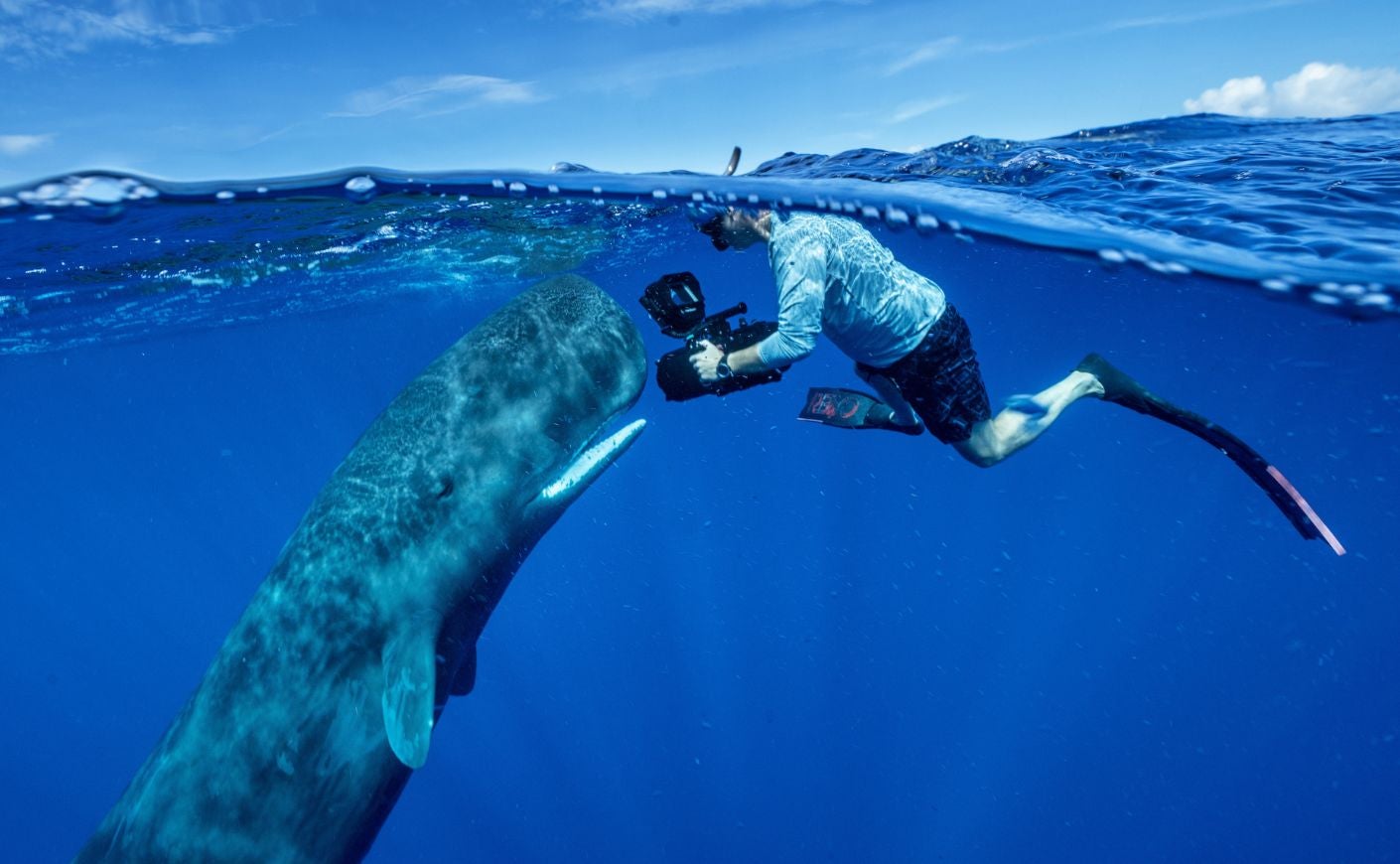
Imagine being suspended among leviathans in the open ocean, where the depths below stretch beyond the reach of light. Many might believe this to be a scene from a horror novel, but for my partner and fellow wildlife photographer, Cristina Mittermeier, and me, it was the fulfillment of a lifelong dream.
For as long as I can remember, I'd dreamed of swimming with sperm whales. As the largest of the toothed predators, they can reach up to 60 feet long and dive more than a mile deep to hunt for squid in the pitch-dark.
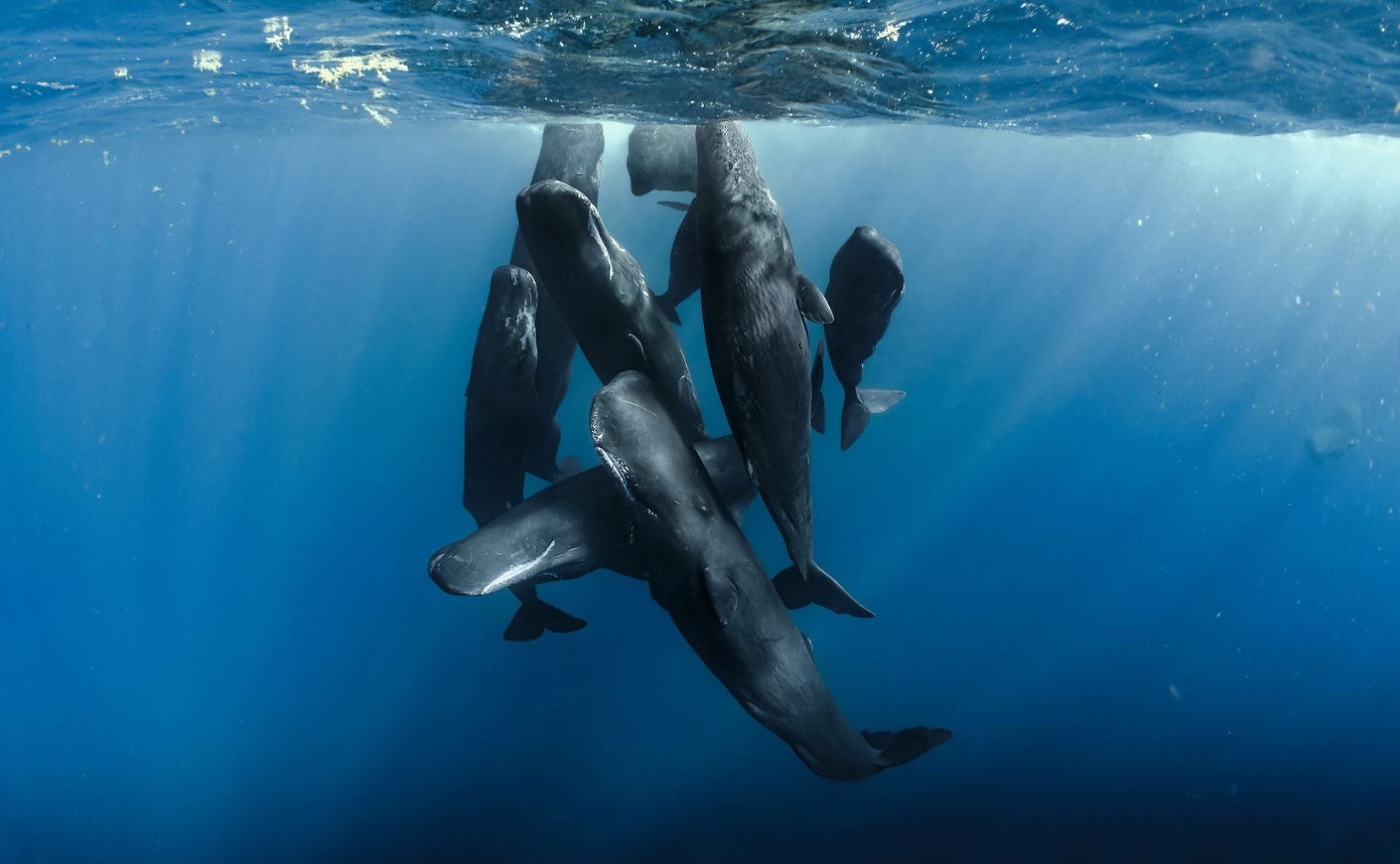
On a clear, sunny morning in Dominica, Cristina and I slipped from the dive deck of a small vessel miles offshore with our snorkels. We made our way toward a pod well known to local researchers, led by a matriarch affectionately dubbed Soursop with her small calf, Ariel.
As we approached, the scene before us brought me to a sudden stop. Each whale rested vertically in the water column with its head pointed toward the surface, floating like pillars in the cobalt haze about 40 feet deep. The pod had spent the day hunting and were now sleeping off their meals. After drawing a deep breath, I dove down to where Soursop hovered, the tentacles of a large squid still trailing from her mouth. Nearby floated Ariel, small compared to her mother, but still close to the size of an adult beluga whale.
My chest tightened. My body was screaming for air, so I began my ascent. Just as I neared the surface, Ariel, the not-so-little mermaid, had jolted awake and was looking for a toy. The gleam in her eye was all the warning I had before she launched like a torpedo straight for me.

I caught my breath, turned, and was immediately confronted by her mouth stretched wide, revealing rows of pink, toothless gums. I braced, but her impact was surprisingly polite as she attempted to mouth me. Her tongue swung side to side as loud clicks resonated from deep within. For a 16-foot toddler, she had impressive control. When she finally let go, she proudly blasted a stream of bubbles from her blowhole, and I couldn’t help but laugh.
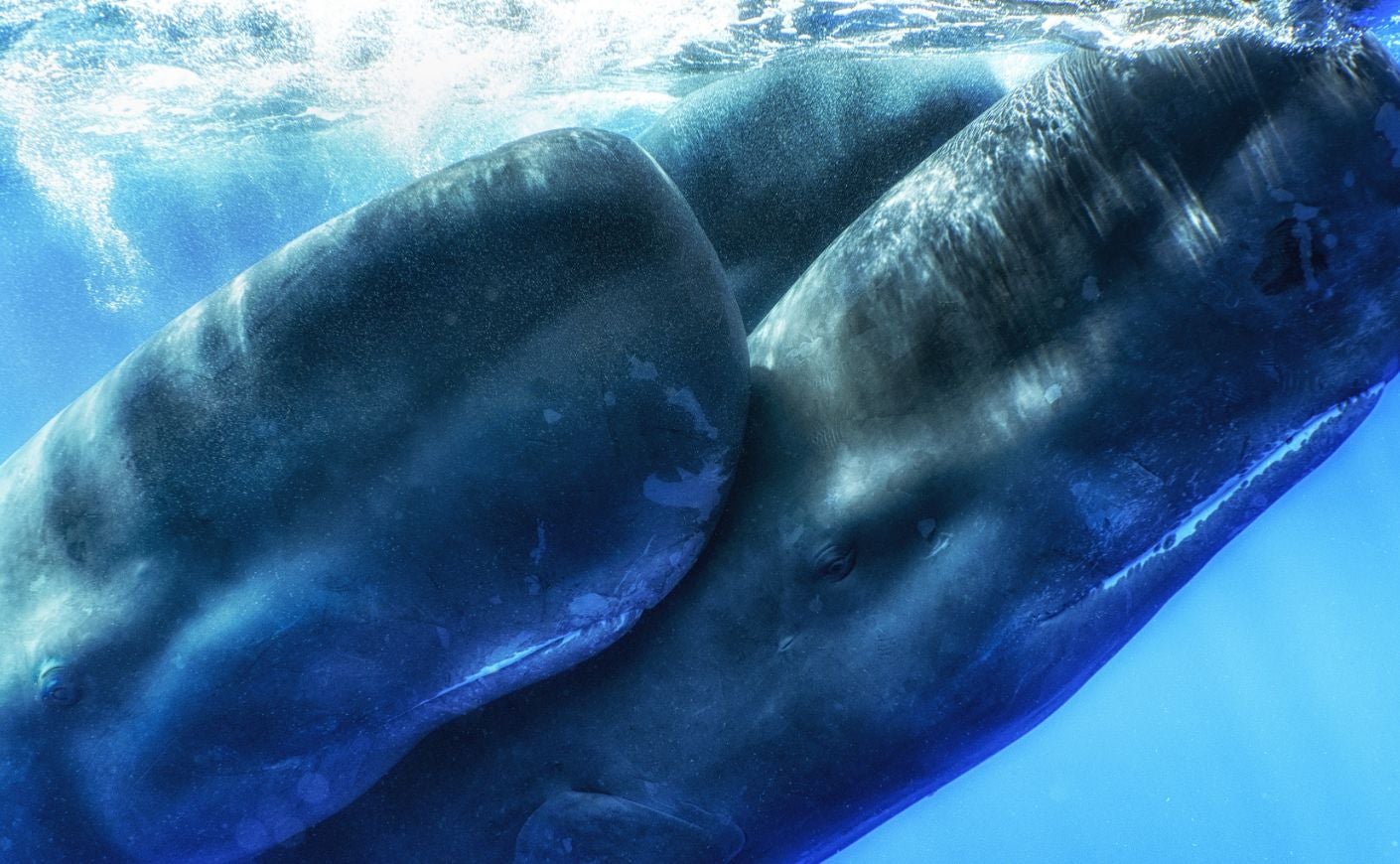
People often forget how small we are, and what a wonder it is to share this planet with species far larger and wiser than ourselves. Cristina and I are so grateful for that experience, but we did not do it alone. The opportunity was all thanks to the hospitality of an incredible team of researchers who had access to these whales through a special research permit.
Today, that team is part of Project CETI (the Cetacean Translation Initiative, a clever twist on SETI, NASA’s Search for Extraterrestrial Intelligence), which has been making waves lately with its new research on this pod of sperm whales in Dominica.
Founded and led by our guide, National Geographic Explorer David Gruber, the project brings together an unlikely combination of experts from fields such as marine biology, machine learning, language, law, and more. As you may have gathered from Project CETI’s name, the team is working to understand the language of sperm whales.
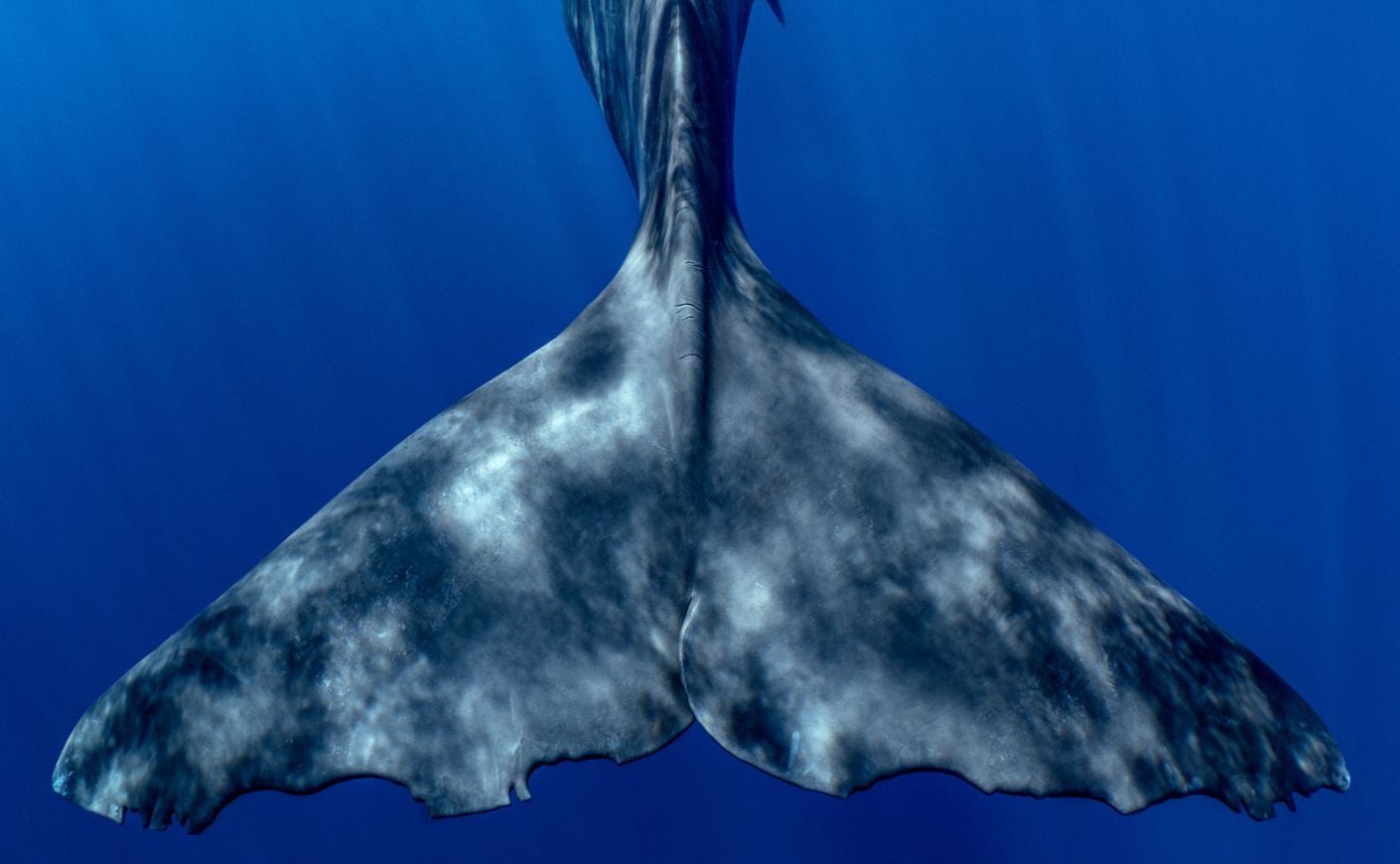
Their mission to decode sperm whale clicks, called "codas," suggests that the creatures' communication is highly complex and sophisticated, making it the most compelling sign of intelligent thought in the animal kingdom, aside from humans. According to CETI's research, the clicking Ariel produced as she mouthed me would be comparable to the babble of a human baby, still learning to speak her native tongue.
Researchers aren't translating whale speech just yet. The first step is simply making sense of the sounds, identifying patterns and structure. Their most recent breakthrough is that sperm whale language uses vowels, which is a huge deal.
The discovery suggests that sperm whales communicate on a different time scale than humans. By speeding up the clicks, they were able to pick out patterns of what they called the a-coda and the i-coda, analogous to the two foundational vowels in human language. The whales produced these sounds intentionally and consistently, exchanging them with one another in what resembled a conversation. The use of these vowels could unlock a vocabulary of hundreds of words, enough to convey complex ideas.
The key to unlocking this piece of the puzzle was to use AI to step outside our own minds. With the help of AI, researchers could pick up on patterns we've never been able to see before, simply because we're human. Project CETI's approach is unique because it combines three distinct intelligences: human, nonhuman, and machine: This convergence may finally unlock our ability to communicate with nonhuman intelligent life.
Project CETI's ambitions go beyond decoding whale communication. If we can prove that whales think and communicate at a complex level, we have grounds to fight for their legal protection. The team argues that their science could already support legal personhood for whales, meaning whales would have enforceable rights under the law, like the right to be free from harm or habitat destruction. Once dismissed as a fringe idea, it's now gaining traction in serious legal and scientific circles.
In the crushing darkness of the ocean, there are creatures with brains larger than ours, with intricate social structures and cultural traditions, conversing with one another at a level of complexity that could rival our own. We have spent billions of dollars searching the stars for intelligent life and found nothing, while all this time it has been right here on Earth, and we're destroying it. All life on this planet is a passenger on this spaceship hurtling through space. It's time we started treating our fellow passengers better.
Paul Nicklen and Cristina Mittermeier co-founded SeaLegacy in 2014. SeaLegacy’s mission is to inspire people to fall in love with the ocean, amplify a network of changemakers around the world, and catalyze hands-on diplomacy through hopeful, world-class visual storytelling. For more updates on their meaningful work, learn more about SeaLegacy, and subscribe to Ripple Effect, Katie Couric Media’s sustainability newsletter.
