






On December 20, 1956, a United States Air Force colonel sat down and typed a classified memo marked SECRET — URGENT. It was addressed to the commanding officer at Furstenfeldbrück Air Base in Germany. Most of the memo dealt with logistics: fuel loads, flight plans, and the timing of Ambassador Thompson’s arrival in Salzburg.
But buried in the middle was this instruction: “For each passenger, please purchase one small appropriate Christmas gift, value one to two dollars. Have each gift wrapped and place name tag thereon, addressed to the passenger. We will distribute these Christmas gifts during our flight home.”
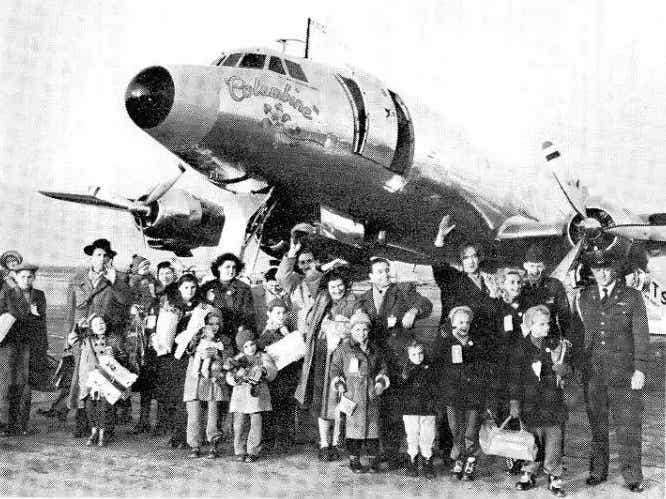
The passengers were 21 Hungarian refugees: three families from the towns of Győr and Pápa, and one from Budapest. Eight adults who had given up all their possessions and risked their lives to escape a homeland that, under Soviet occupation, no longer seemed like home, and 13 children. The plane that would carry them was the Columbine III, President Eisenhower’s personal aircraft, also known as Air Force One. The same plane that had just returned India’s Prime Minister Nehru to London. The President decided it was a pity to fly it back empty when there were exiles longing to breathe free air.
Another line in the planning memos: “Do not wish to split up families.”
My father was one of the eight adults on that plane. Three of my sisters were among the 13 children.
At 7:25 on Christmas morning, 1956, the Columbine landed at McGuire Air Force Base in New Jersey. Everyone stepped off carrying a wrapped gift with their name on it, purchased on orders from the President of the United States. A few hours later, the refugees sent a telegram authored by my father through the White House Communications Center: “We thank you, Mr. President, for this unforgettable and wonderful Christmas present with which you enabled us to arrive to a new and free country under such fabulous circumstances.”

It was signed: *The Hungarian Refugees of the Columbine.*
The New York Times covered the flight on its front page. The reporter, searching for language large enough to hold the moment, ended with a question, “What if the traditional reindeer were only four engines with numerals instead of names? What if the pilot had no long white whiskers and no red overcoat?”
I’ll come back to that.
70 years later, an echo on the Danube
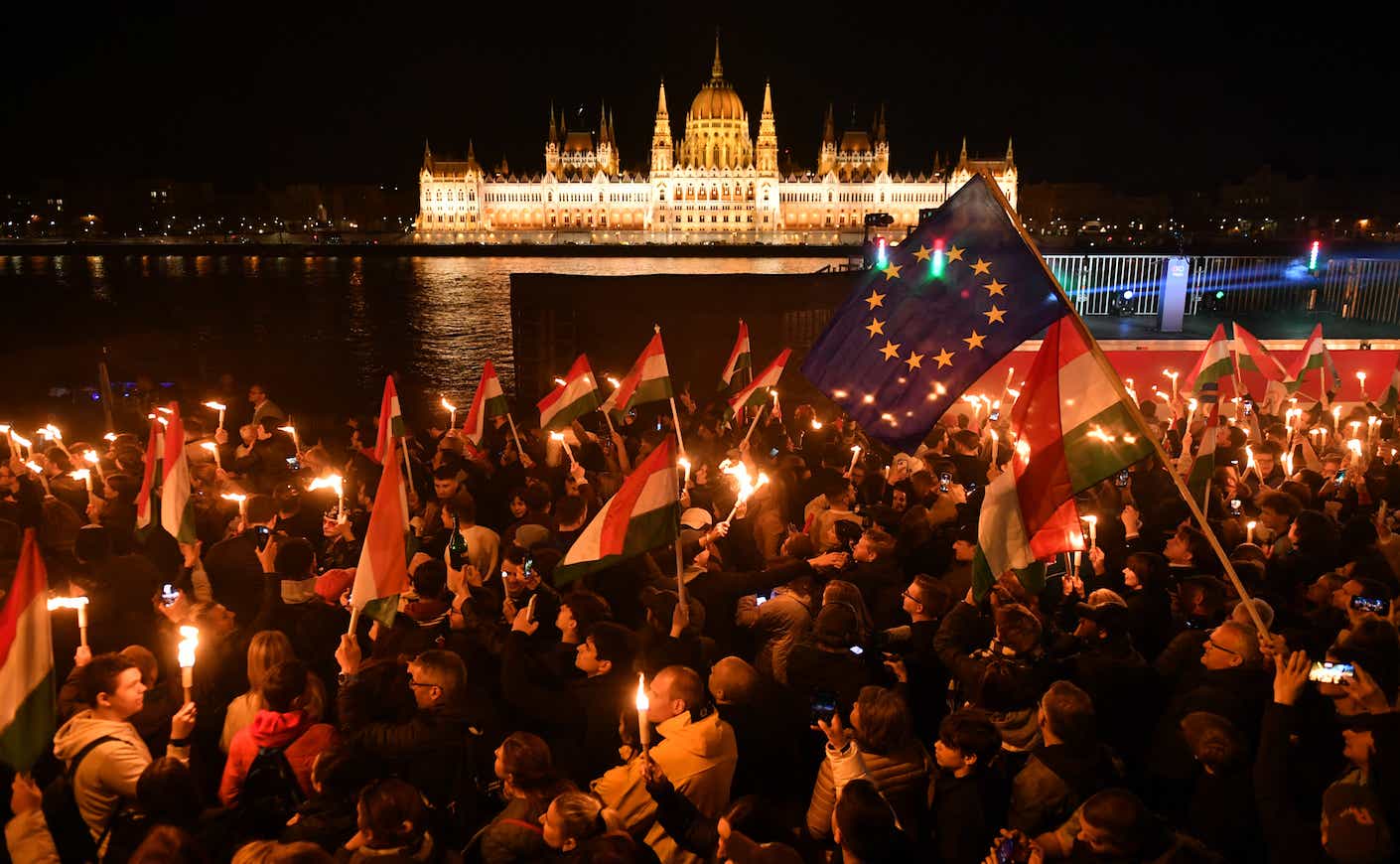
On Sunday night, nearly 70 years after my father’s flight, I watched a crowd of hundreds of thousands gather on the banks of the Danube in Budapest. They were there to celebrate the defeat of Viktor Orbán, Hungary’s Prime Minister for 16 years, who had just conceded a landslide election to Péter Magyar and the Tisza party.
Magyar stood before that crowd and named three dates he said should be inscribed in gold in the history of Hungarian freedom: March 15, 1848. October 23, 1956. And April 12, 2026.
The crowd chanted “Russians, go home!”, the same words shouted in the streets of Budapest when my father was a young man and the Soviet tanks were rolling in, and the world was deciding whether it would help or look away.
I was sitting in my living room in Denver, Colorado, weeping.
I wept for everything my family survived simply to reach Air Force One. My father, a World War II POW who had endured malnutrition so severe he lost all but four of his teeth by the age of 23, knew the cost of an unfree world. He decided it was better to risk his daughters’ lives by walking across a minefield than to condemn them to communist rule.
I wept because he wasn’t there to see this. After the fall of communism, he returned to Hungary to modernize its police telecommunications, a refugee’s final entrepreneurial act to rebuild the country that had driven him out.
And I wept because I know what oppression costs a family to the bone. To watch Hungarians turn out in record numbers to choose freedom, I wept for them, too. Because I know what comes next: the long, hard, beautiful work of rebuilding everything that was taken.
What you carry when you leave
Let me tell you what my father carried out of Hungary, because it wasn’t luggage.
He carried a conviction. Not a political one, an economic one. He believed, with the unshakable certainty of someone who had watched a country choose to lock its own people out of their future, that the measure of a nation is who it allows to participate. He had the academic pedigree to understand exactly how systems fail, holding degrees in political science, economics, and law from Hungary. But his conviction didn't come from textbooks. It came from lived experience. He was a father who walked his three young daughters, ages three, seven, and eight, onto a president’s airplane on Christmas Eve, arriving in America on Christmas Day with nothing but wrapped gifts, name tags, and whatever you carry in your body when your country has decided you are no longer welcome.
But the lesson was clear, and he taught it to his children the way refugees teach things, not through lectures but through the shape of a life. You work. You build. You contribute. And the country that lets you do that is the country that wins.
I became a gender economist because of that lesson. Not because my father talked about gender — he rarely did — but because he talked about waste. The waste of a country that refuses to use its own people. The waste of talent sitting idle because a system has decided in advance who gets to contribute and who doesn’t. In 1956, Hungary lost an entire generation of its most ambitious citizens. My father was one of them. The country he left behind spent the next three decades proving his point.
The mathematical failure of illiberalism
Orbán spent 16 years proving it again.
Orbán came to power as a liberal reformer. He left as the architect of what he proudly called “illiberal democracy”, a model studied and admired from Warsaw to Washington. But models are only as good as their balance sheets. And Orbán’s balance sheet was devastating.
Under his rule, Hungary became one of the poorest countries in the European Union. Roughly 17 billion euros in EU recovery funds were frozen due to rule-of-law violations. The young and educated left in waves, a brain drain that mirrored, in slow motion, the exodus of 1956. Corruption functioned as a participation tax: It didn’t matter what you knew or what you could build; it mattered who you knew within the system.
This is what I study for a living. When systems decide in advance who gets to participate, whether through Soviet tanks or rigged institutions, through political cronyism or structural barriers that keep talent on the sidelines, the economy doesn’t just suffer morally. It suffers mathematically. The output doesn’t show up. The growth never materializes. The books don’t balance.
Hungarians voted on Sunday in the highest numbers since the fall of communism. Nearly 80 percent turned out. They voted because the illiberal model failed to deliver. It failed to deliver healthcare. It failed to deliver wages. It failed to deliver a future for their children. Exclusion is expensive. Eventually, the bill comes due.
My father would have recognized Orbán’s Hungary. Not because it looked like the Soviet occupation — it didn’t, not exactly — but because the economic logic was the same. A system that concentrates power narrows participation. A system that narrows participation shrinks its own output. A country that decides only certain people get to build is a country that has decided to be smaller than it could be.
He would have recognized, too, the warning it carries for the United States.
My father didn’t flee to America because it was perfect. He fled here because of what was possible, because the bet this country was making, the bet that Eisenhower was making when he ordered his Air Force aide to buy 21 Christmas gifts and wrap them with name tags and load them onto his personal airplane, was that a nation grows stronger when it lets more people in, not fewer. That inclusion isn’t charity. It’s a competitive advantage.
That bet is the one I’ve spent my career quantifying. And it is the bet that some in the United States are now openly questioning.
My father, who lived the answer in his bones, would have had something to say about that.
The spirit of democracy
I have the documents now. All of them. The Eisenhower Presidential Library sent me the complete archive: the classified memos, the flight manifests, the passenger lists with every name and every age, the telegram my father sent from the plane. I have Colonel Draper’s gift-wrapping instructions on SECRET stationery. I have the order not to split up families.
I keep going back to that New York Times reporter, writing on deadline in December 1956, trying to capture what it meant that the President of the United States sent Air Force One to carry 21 Hungarian refugees home to America on Christmas Day.
The reporter asked, “What if the traditional reindeer were only four engines with numerals instead of names? What if the pilot had no long white whiskers and no red overcoat?”
And then the answer, “The spirit of Christmas, the spirit of democracy, were there, miraculously and yet very naturally, high in the clouds, not very far in a direct line from where the Pilgrims landed.”
On Sunday, that spirit was on the banks of the Danube again. My father’s country came home.
Katica Roy is an award-winning economist and Fortune columnist. Her work examines what nations lose when they lock people out. Her father arrived in the United States on President Eisenhower’s plane, Air Force One, on Christmas Day, 1956.
