






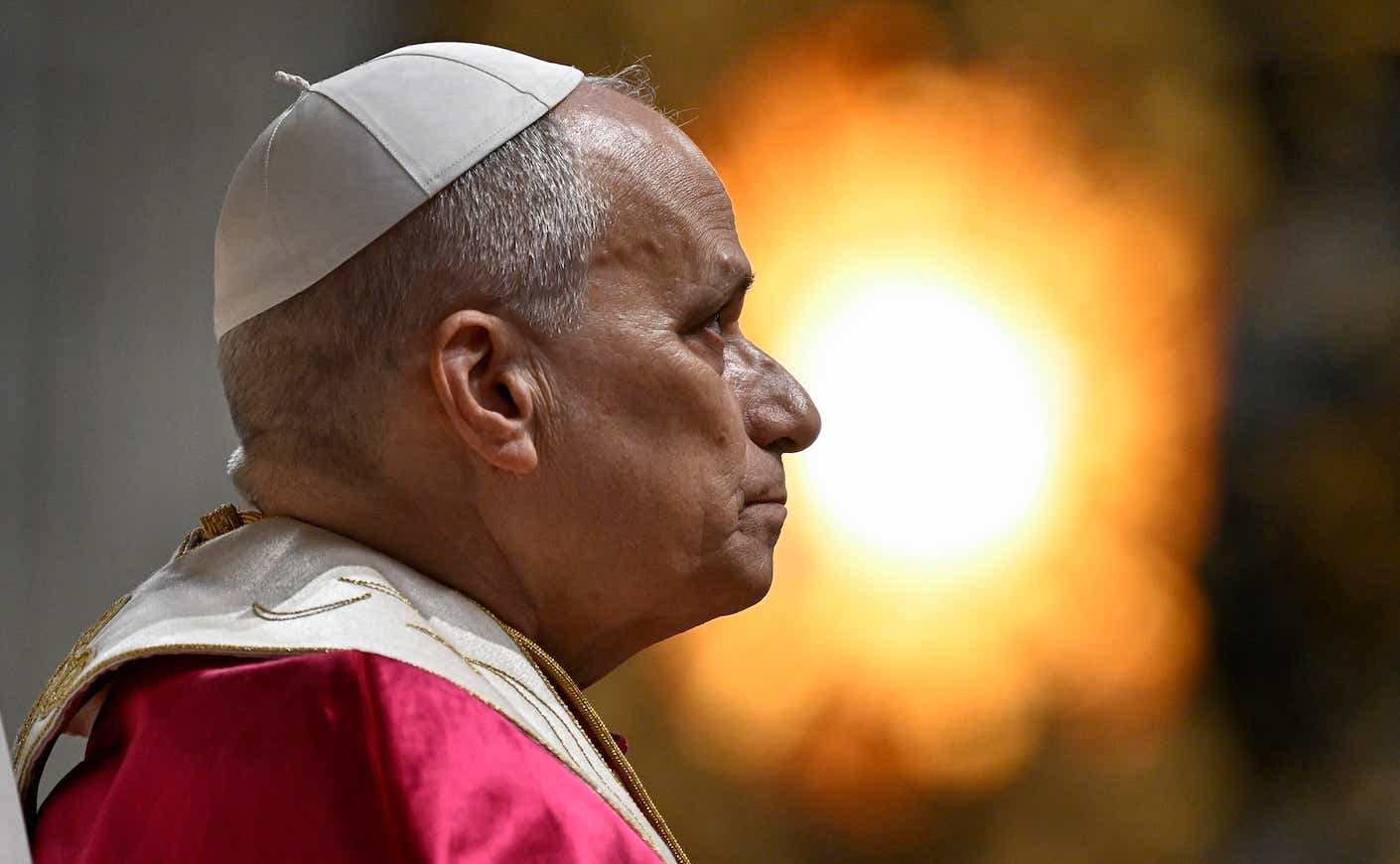
President Trump’s clash with Pope Leo XIV is spilling further into public view — and it’s becoming about far more than a typical policy disagreement.
What started as a divide over the war in Iran has increasingly turned personal — and the fallout could extend far beyond rhetoric. According to previous reports, Pope Leo XIV may avoid visiting the U.S. while Trump remains in office. The tensions are now looming over an upcoming trip to Rome by Secretary of State Marco Rubio, which is reportedly aimed in part at easing the growing rift.
The clash marks an unusually direct public confrontation between an American president and the pope, unfolding in real time with both political and global stakes. Here’s a closer look at the escalating war of words.
Trump’s latest attack on Pope Leo XIV over Iran war
In an interview with conservative commentator Hugh Hewitt on May 4, the president suggested that the pontiff’s views on foreign policy are “endangering Catholics and a lot of people” and that he is “fine” with Iran having a nuclear weapon.
Leo pushed back on the president’s comments, saying they misrepresented his position.
“Should anyone want to criticize me for proclaiming the Gospel, they should do so with the truth,” Leo told journalists, according to The Washington Post. “For years the Church has spoken out against all nuclear weapons, so there’s no doubt about it, there. So I simply hope to be listened to for the value of God’s word.”

The president's previous clash with the pontiff
This week's exchange is just the latest escalation in a relationship that has steadily deteriorated in recent months. In April, the president accused the pope of being “WEAK on Crime” and “terrible for Foreign Policy,” before adding that he doesn’t “want a Pope who criticizes the President of the United States.”
The president went on to question Pope Leo XIV's rise to the papacy, claiming the pope wouldn’t be in the Vatican if he weren’t in the White House.
“Leo should be thankful because, as everyone knows, he was a shocking surprise,” Trump wrote. “He wasn’t on any list to be Pope, and was only put there by the Church because he was an American, and they thought that would be the best way to deal with President Donald J. Trump.”
Trump continued by urging the pope to “get his act together,” accusing him of catering to the “Radical Left” and telling him to focus on being “a Great Pope, not a Politician.”
The remarks came after Pope Leo XIV condemned what he called the “idolatry of self” and a growing “delusion of omnipotence” surrounding the U.S.-Israel war in Iran during a prayer service in Vatican City. While he didn’t mention Trump by name, the pope has repeatedly criticized the conflict and urged leaders on all sides to step back from further escalation. When asked about the backlash from the Trump administration, Pope Leo XIV told reporters he's "not afraid."
The response from Catholic leaders was swift and unusually direct. Archbishop Paul S. Coakley issued a late-night statement defending the pope and rebuking the president’s comments. “I am disheartened that the president chose to write such disparaging words about the Holy Father,” he said. “Pope Leo is not his rival; nor is the pope a politician.”
Even after prominent conservative voices — including Bishop Robert Barron, who serves on Trump’s Religious Liberty Commission — called on him to apologize, Trump refused, saying the pope is wrong about Iran.
Trump's AI-generated post sparks criticism
Trump shared — and later deleted — an AI-generated image showing himself in robes, in a Christ-like pose, placing a glowing hand over a sick man in a hospital bed as if healing him. The image featured patriotic elements in the background, including the American flag, the Statue of Liberty, and bald eagles.
The post quickly drew backlash, with followers flooding the replies and arguing it crossed a line by blurring the boundary between political messaging and religious symbolism.
Others were equally outraged and didn't mince their words. “I don’t know if the President thought he was being funny or if he is under the influence of some substance or what possible explanation he could have for this OUTRAGEOUS blasphemy,” wrote Megan Basham, an evangelical Christian writer for The Daily Wire. “But he needs to take this down immediately and ask for forgiveness from the American people and then from God.”
Conservative activist Riley Gaines struck a similar tone: “Why? Seriously, I cannot understand why he’d post this. Is he looking for a response? Does he actually think this?”
Trump, for his part, rejected the characterization, saying he believed the image depicted him as a doctor, not a religious figure. “It’s supposed to be me as a doctor, making people better,” he told reporters on Monday.
Why Trump and the Pope don't get along
The relationship between Trump and Pope Leo XIV didn’t start off rocky. When the pope was elected last May, Trump called it “a Great Honor for our Country.” For a moment, it looked like the two might find some common ground.
But that didn’t last long. As Pope Leo XIV began to define his papacy — emphasizing compassion for migrants, warning against rising nationalism, and calling for global cooperation — those themes increasingly clashed with Trump’s “America First” approach.
The war in Iran has since made that divide more explicit. Pope Leo XIV has emerged as one of the most outspoken global critics of the conflict, condemning what he described as a “spiral of violence” and urging diplomacy to avoid an “irreparable abyss.”
The strain may already be shaping real-world decisions. A Vatican official told The Free Press the pope “may well never visit the United States under this administration.” Vice President JD Vance had invited Leo XIV to the White House for the country’s 250th anniversary on July 4 — an invitation he reportedly declined. Instead, he’s expected to travel to Lampedusa, an Italian island that has become a key entry point for migrants into Europe.
Behind the scenes, the divide appears deeper. Vatican and U.S. officials said a January address by Leo was viewed in Washington as a direct critique of Trump’s policies, particularly his more hardline approach to global power and diplomacy.
The fallout extended beyond rhetoric. After the speech, the Department of Defense invited Cardinal Christophe Pierre — then the pope’s representative to the U.S. — to the Pentagon. Vatican officials described the meeting as a “bitter lecture,” warning that the U.S. has the military power to act as it chooses and suggesting the Church should align with it, according to The Free Press.
How common is a feud between the president and the pope?
Direct clashes between the White House and the Vatican aren’t unheard of, but they’re typically handled quietly — or with careful diplomacy. That’s what makes this moment different.
Observers say an open, sustained war of words between a pope and a U.S. president is virtually unprecedented. As church historian Massimo Faggioli told Reuters: “Not even Hitler or Mussolini attacked the Pope so directly and publicly.”
The Catholic Church’s moral authority isn’t what it once was after decades of clerical abuse scandals. Even so, a direct clash with a sitting pope still carries real political risk, especially for a president whose standing among American Catholics has slipped.
In February, before the Iran war, a Washington Post-ABC-Ipsos poll found 41 percent of U.S. Catholics approved of Trump, down from 48 percent a year earlier. Meanwhile, a separate NBC News survey found 42 percent of U.S. registered voters had a positive view of Pope Leo, while 8 percent were negative and 50 percent were neutral or had no opinion.
All of which underscores the stakes: Trump isn’t just taking on the first U.S.-born pontiff — he’s also taking aim at a spiritual leader for a key part of his base. And it’s all unfolding in a high-stakes midterm election year, as Republicans work to maintain their slim majority in Congress.
