






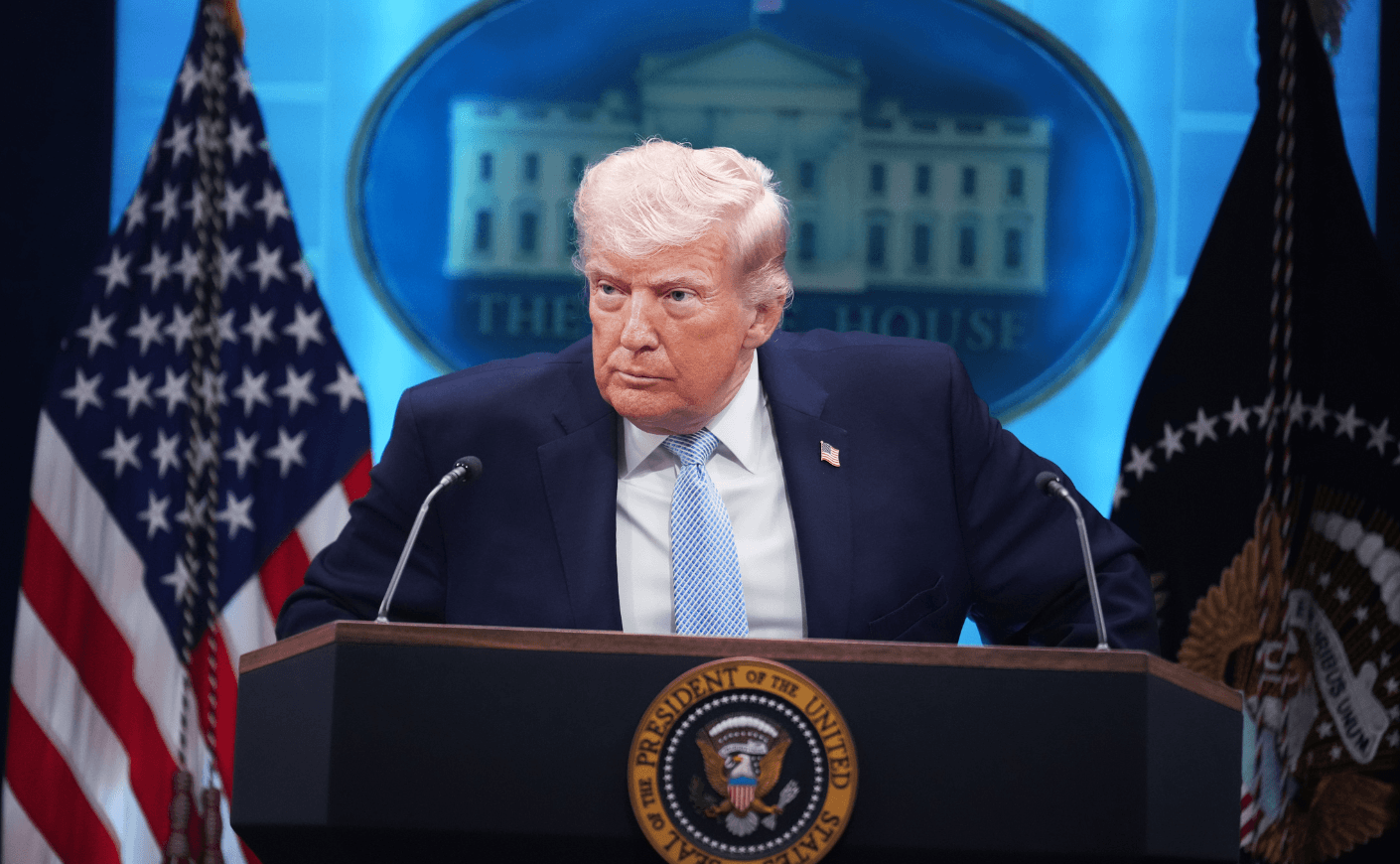
On April 7th, the president of the United States posted on social media that "a whole civilization will die tonight" if Iran did not reopen the Strait of Hormuz by 8pm Eastern. He threatened to destroy every power plant and bridge in the country. He said he wasn't worried about war crimes. His press secretary said the Iranian people "welcome the sound of bombs because it means their oppressors are losing."
I watched all of this in real time, and something shifted in me that I don't think is going to shift back.
I was born and raised in the United States and have never been to Iran. My parents came here in the late 1970s, fleeing a revolution that replaced one kind of authoritarian with another. They came here because America represented something that felt, at least from a distance, like the opposite of what they were running from. That's the story Iranian-Americans grow up with, that we left the bad guys to live with the good guys, and I grew up inside it so completely that I never really questioned it until these past six weeks.
I have never been to Iran not because I didn't want to go, but because I was never allowed. The regime made sure of that from both directions, and when I wrote about the Mahsa Amini protests in 2022, they sent death threats to make sure I understood where I stood. So I understand, in a way that is not abstract, what it means to be on their list.
None of that is new. What is new is what happened on April 7th.
When the war started six weeks ago, the Iranian-American group chats lit up. There was a feeling none of us wanted to admit out loud that something was finally happening. We knew it wouldn't be clean. We knew the costs would be enormous. But there was a desperate hope running through those conversations, the same hope my parents' generation carried into 1979, when Iranians filled the streets believing a revolution would set them free, not understanding yet what was coming to replace the Shah. In 1979, Iranians ousted something terrible and got something worse. The question nobody wanted to say out loud, but everyone was thinking, was whether we were about to watch that happen again.

The group chats have gone quiet now. And what replaced that hope is harder to name than I thought.
The Islamic Republic has been a generational catastrophe for the Iranian people. My parents didn't leave for no reason; there's no love lost between me and the men who run it. But on April 7th, the country that went to war to free those people spent the day threatening to destroy their water supply and their electricity, and the president who claimed to be liberating Iranians used language about wiping out a civilization that would not have sounded out of place coming from the regime he was bombing.
There's a tone Iranians recognize immediately, the sound of a government talking about people it has already written off, and on April 7th I heard it from my own president. For the first time in my life, the founding myth of my family's immigration story, that we traded one world for a better one, felt like a question rather than a fact.
I grew up understanding the deal my parents made: You trade the instability of a country that never really stabilizes for the safety of a place built on rule of law. You give up proximity to your culture for the guarantee that your children won't be imprisoned for attending a protest. That trade always made sense. It still makes sense in ways I can defend. But what I cannot defend any longer is the certainty that came with it, the unexamined confidence that the country we came to is simply different from the country we left.
What this war has made visible is something the Iranian-American community has known for years but rarely says out loud: that the gap between the good guys and the bad guys is not as wide as that story required it to be. That a government can claim to be liberating a people while threatening to destroy everything that keeps them alive. That the language of expendability is not a foreign language. That we recognize it. And that recognition, once it lands, does not leave.
Iran is one of the oldest continuous civilizations on earth. The country has survived Alexander, the Mongols, colonial meddling, the Shah, the revolution, the Iran-Iraq war, and 40 years of sanctions. When Trump said a civilization would "die tonight," I don't think he understood what he was threatening. I don't think he knew that the people he was threatening have been surviving exactly this kind of threat for 3,000 years.
My parents came here so that I would not have to live with that kind of uncertainty. And yet on April 7th, I watched the president of my country decide that an entire civilian population was an acceptable cost, openly, in front of the whole world, and shrug off the concern that it might constitute a war crime.
We are not going back to Iran anytime soon. And in the quiet that has settled over those group chats, the Iranian-American community is sitting with a question that has no clean answer: What does it mean to have left one country that decided your people were expendable, only to watch the country you came to make the same calculation, out loud, about the same people?
The ceasefire was announced on April 7th, roughly two hours before the deadline. Both sides called it a victory. The bombs didn't drop. The civilization didn't die. And I still believe, most days, that my parents made the right call when they came here, that the country they chose is worth the faith they put in it. I just believe it the way you believe something after it has been tested, with your eyes open, without the part where you stop asking questions.
Sean Saadat, MD is a board-certified plastic and reconstructive surgeon in Beverly Hills, California. He is of Iranian descent and writes about medicine, culture, and the world at the intersection of both. Follow him on Instagram @drsean and learn more at drseanplasticsurgery.com.
