






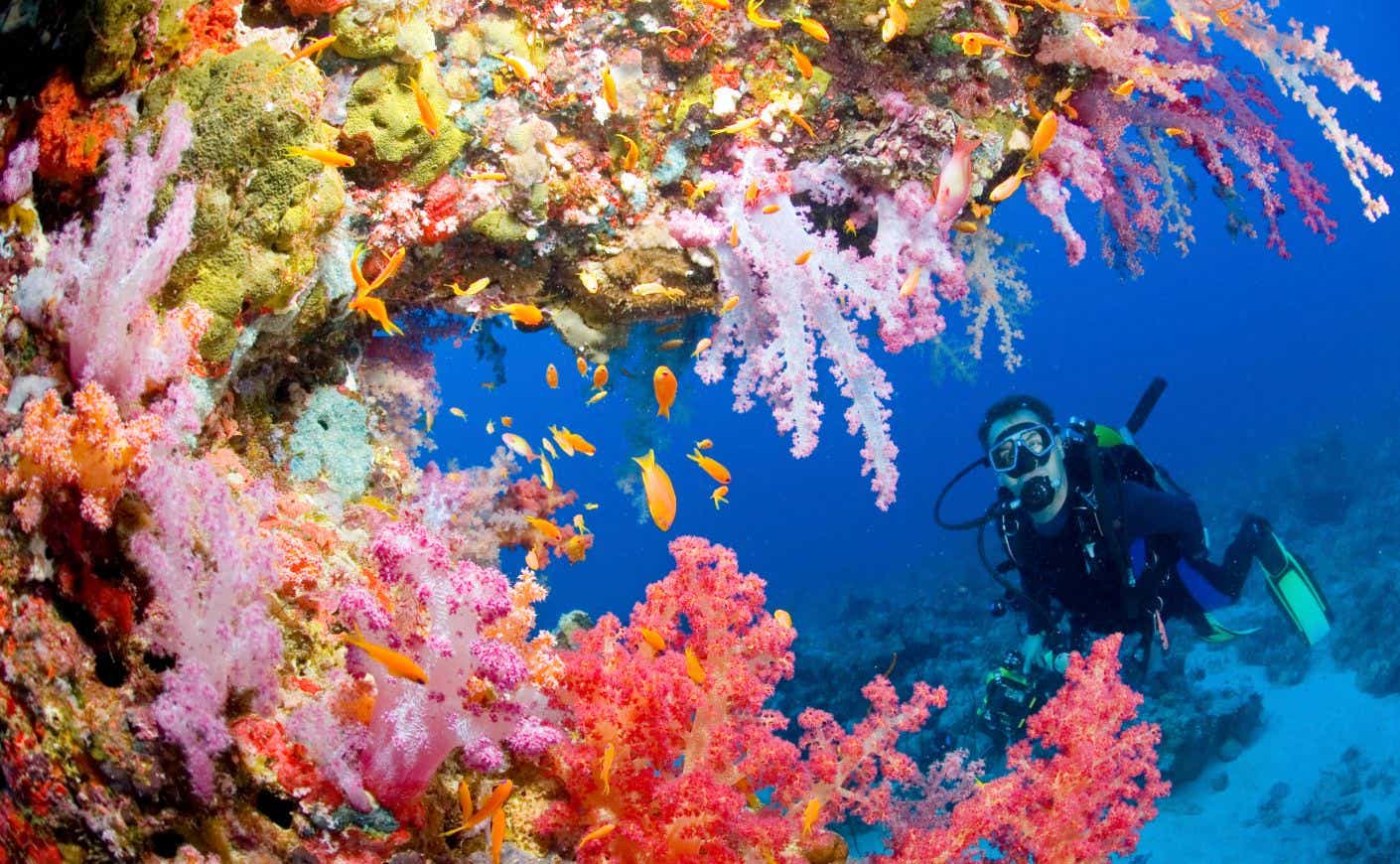
The northern coast of Jamaica is so cinematic that even James Bond couldn't resist its allure. It served as the backdrop for scenes in the high-octane 007 thriller No Time to Die. But today, beneath those same turquoise waves, a real-life mission is unfolding with higher stakes than any Hollywood blockbuster: the race to pull a dying coral reef back from the brink.
However, the tools a team of divers are carrying to the seafloor are not what you would expect to find in a marine biologist’s kit. They are installing waterproof speakers at the bottom of the ocean, and the man leading the team is not a scientist.
"It’s very different from everything I did before," says Marco Barotti, an artist from Italy.
Five years ago, Barotti began creating sculptures based on 3D scans of coral. He was inspired by emerging research suggesting that sound could be the key to reviving struggling reefs. "Sound has always been at the core of my work but never at this level," he explains.
The soundtrack of the sea
To the human ear, the underwater world might seem pretty quiet, but a healthy reef is actually a cacophony of noise. It’s a biological symphony of snapping shrimp, grunting fish, and shifting currents. A dying reef is eerily silent.
"If a reef is alive with sound, it’s more likely to stay alive, right? And repopulate. And when reefs degrade, they grow silent," Barotti says.

Fish and tiny coral organisms use sound to navigate in the vast oceans to find a home, so the logic is simple: If you bring the noise back, the marine life will follow. The project utilizes "underwater boomboxes" that play recorded sounds of a healthy reef for 14 hours a day, powered by solar panels floating on the surface.
A study published in the journal Nature demonstrated the power of what is known as "acoustic enrichment.” Researchers at the Great Barrier Reef found that playing healthy reef sounds lured fish to degraded areas, doubling the total fish population in just six weeks. Not only did more fish arrive, but the diversity of species increased by 50 percent, a critical factor for long-term reef resilience.
An ocean hot tub
Reefs cover just 1 percent of the ocean floor, but they support 25 percent of all marine life. They are the bedrock of our food supply and serve as a natural barrier, protecting coastal property from the brunt of catastrophic storms. Since 1950, the world has lost approximately half of its coral reefs due to overfishing, pollution, and climate change.
The root of the crisis is our planet-warming pollution. As we burn fossil fuels, we release carbon dioxide that acts like a heat-trapping blanket around the Earth. The ocean has been forced to absorb about 90 percent of that excess heat.
This leads to "marine heatwaves," which are prolonged periods of abnormally high sea temperatures that are essentially the oceanic equivalent of a wildfire. A record marine heatwave in 2023 turned Caribbean waters into a "hot tub," causing corals to expel the colorful algae living in their tissues. This process, known as bleaching, leaves the coral white, starving, and vulnerable to disease.
Lee-Ann Rando, a second-generation scuba diving instructor, has witnessed this decline firsthand. "It’s getting quieter," she says. "It’s really sad to say that I’ve seen the degradation a lot in the past 10 years."
Rando captured footage of herself swimming through ghostly white, bleached reefs in 2023. "You just feel hopeless," she says. "You feel like, am I ever gonna see this again?"
"Coral matchmaking"
The sound project is designed to bolster the work of the local Alligator Head Foundation. Dexter Dean Colquhoun, the foundation’s head of research, says the idea resonated with him immediately. "I’m a musician. I play piano, so I know the importance and the power of sound."
He says the acoustic approach is a vital addition to their conservation toolkit. "It fits right into what we’re trying to do, which is to restore the reefs using as many methods as possible."
While the speakers play the "hits" of a healthy reef, researcher Bethany Dean is working in the lab to provide the "guests" for the party. She grows coral fragments and experiments with assisted breeding, acting as a "coral matchmaker" to help the organisms reproduce in a warming world where natural reproduction is failing.
"We are looking at how you can bring these eggs and sperm together so you can actually have successful reproduction," Dean explains.
Eventually, these lab-grown coral fragments are attached to Barotti’s underwater sculptures. The result is a fusion of science and art that could begin to replace silence with the sounds of a thriving ecosystem.
"You gotta stay hopeful right?" says Rando. "I think there is hope. There are strands of it."
Ben Tracy is a senior climate correspondent on assignment for Climate Central. You can see more of his stories here.
