







My name is Mohamed, and I am a child of war. I was born in 1997 in a village outside of Al-Fashir, the capital of North Darfur, on the eve of the first Darfur genocide. I am Zaghawa, an ethnic group that’s been targeted by the Sudanese government and its allied militias for as long as I can remember.
In fact, one of my earliest memories is of an air assault. I was about seven years old, with my two front teeth missing; my father had asked me to take our donkey to the well for water. I was leading him back home when an unfamiliar sound — a loud, mechanical, whirring — stopped me in my tracks.
Overhead, I saw an airplane and recalled what my father had once told me to do in this situation: get down and hide. My donkey ran off, and I buried myself in the sand. I shut my eyes and plugged my ears as the ground shook with the impact of a dozen bombs around me. When all was finally quiet, I returned to a world pocked by craters and strewn with the bodies of dead and dying people and animals. My school was destroyed, as was the field where I played soccer. But my family, thank goodness, survived.
In the early 2000s, the Sudanese government under dictator Omar al-Bashir began to arm, fund, and direct Arab militias known as the Janjaweed to crush a rebellion in Darfur. This rebellion, led by members of non-Arab ethnic groups including the Zaghawa, had risen up in protest of the government’s discrimination and neglect. While the Sudanese Air Force bombed villages, they employed the Janjaweed to carry out raids on the ground.
From the day of the air raid on, my childhood was marked by near-constant violence and fear of the Janjaweed. Burning homes, destroying food stocks, and killing civilians by machine gun, they took control of the villages around Al-Fashir and the roads leading into and out of the city. It was on such roads that they disappeared my older brother, and raped my younger sister while I was bound to a tree and forced to watch.
As the bombings intensified, my family had no choice but to flee the Al-Fashir area. I was fortunate to find temporary safety in South Darfur with my older cousin in Nyala — a city then controlled by the Sudanese military.

After about two years with no formal schooling, I entered the fifth grade eager to lose myself in learning. It was in primary school where I realized my knack for math and science, sparking my journey as an engineer.
My high school years were somewhat calmer, allowing me to pursue my studies and sometimes visit my parents and siblings in the refugee camp where they lived. But this pause in the war was short, as the Janjaweed reorganized as the Rapid Support Forces (RSF). What was once a loosely organized group of local militias transformed into a centralized paramilitary force tens of thousands strong. Incorporated legally under Sudanese security forces and backed by the U.A.E. in its effort to secure gold supply chains, the RSF had salaried fighters, armored vehicles, and intelligence units. Shortly after my high school graduation, a group of them detained and beat me simply because I was Zaghawa.
Every day I left home not knowing if I would return.
In 2015, I was admitted to Nyala Technical College, where I studied electrical engineering for the next four years. I joined a vibrant community of fellow Zaghawa students of Nyala’s various institutions. Far from our tribal communities in a largely Arab city, we stuck together — speaking Zaghawa, honoring our cultural traditions, and offering each other support. This was how I made brave and brilliant friends like Mohamed Khamis Douda, a fellow engineering student who later became the official spokesperson for North Darfur’s Zamzam Refugee Camp — the largest camp of displaced persons in Sudan and the community he called home.
After graduation, I found work manning an electronics stall at Nyala’s outdoor market. It was not exactly my dream job, but I was lucky to have employment and a home with my cousin. In the spring of 2023, however, the situation in Nyala — and all of Darfur — changed for the worse.
Rooted in disagreements over whether and how to integrate the RSF into the regular military, the power struggle between Sudanese Armed Forces and the RSF exploded on April 15, when the RSF captured the airport in the national capital of Khartoum. The fighting quickly spread across the country, with clashes in Nyala killing at least 11 people that first day alone. This would mark the local start of what would be a period of protracted and brutal violence.
Over the next few months, a civilian-brokered ceasefire was followed by sporadic clashes and airstrike massacres on shops and homes. Despite the violence and uncertainty, I continued working at the market — now a site of soaring costs, looting, and kidnappings by the RSF, which had won total control of the city by October. Every day I left home not knowing if I would return.
One evening, I was heading home from work when I noticed a car behind me. Its doors opened to reveal a group of masked men wielding assault rifles. They beat me with their guns, bound my hands and feet, and blindfolded me. We drove around for what felt like hours. I was terrified that the horrible things that had happened to so many before me were about to happen to me, too.
My captors took me to an unfinished building made of straw and wood, where I would spend the next few weeks having my legs beaten with sticks and eating at most one meal of porridge a day. Too afraid to sleep, I did my best to stay awake at night by kneeling. My captors tried forcing me to reveal information about my family, but I refused. Besides, my mother could have never afforded my ransom.
I often thought of running, hatching escape plans in my head whenever my guard dozed off or seemed distracted by his phone. But then I’d change my mind, fearing he’d shoot me. One night, my captors were playing cards when I asked to go outside to urinate. Engrossed in their game, they waved me off and said to go ahead alone. Here was my chance to run.
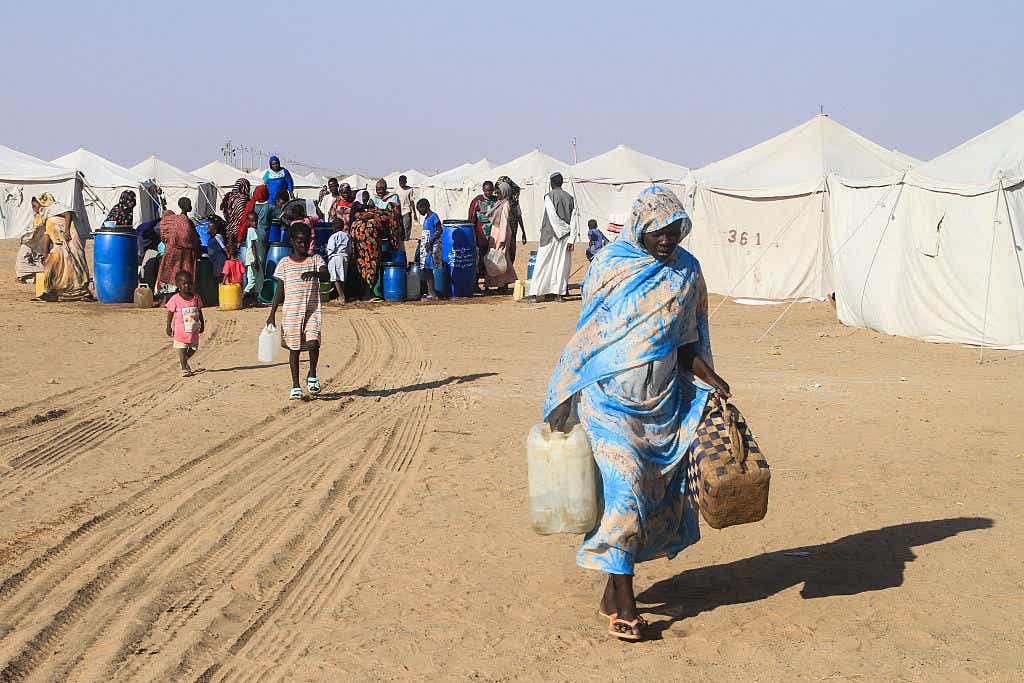
I slipped away with only the clothes on my back and a scarf they had allowed me to keep. I traveled on foot toward areas I recognized near Nyala and then continued toward the Chadian border, following tire tracks and the guidance of those I met along the way. Even after escaping, I knew I could not return home, fearing both recapture and the danger my presence would pose to my family. Throughout the week-long journey, I remained terrified that the RSF — known for killing non-Arabs without reason — would identify me by my dark skin or Zaghawa accent and execute me. Still, with no documents and no way to contact my loved ones, I pressed on and eventually crossed into Chad in early November, hoping only to survive.
I spent about three months in Chad, where I planned my second journey westward: this time across an ocean, two continents, and nine countries until I reached my destination. Traveling by plane, bus, car, and foot, I slept along the way in city parks — from Managua to Mexico City — along with men, women, and children who had also fled their homelands in search of a safer life. Walking from Tapachula to Mexico City, I sustained myself with mangoes plucked from trees along my route.
In Mexico, I heard about fellow refugees being held at gunpoint by gangs and feared for my life yet again. I had to reach the United States — the only place I knew of where people were safe, no matter their skin color, ethnicity, or religion. Throughout my whole life, I had heard that the United States was the only country that cared about human rights and human dignity. And so I made my way to Tijuana, where I crossed the border into California. The journey through the San Ysidro Mountains was treacherous: my feet bled and I felt like I would not make it.
When I arrived in America, I turned myself in to Border Patrol, who took me in, processed me, and let me go on my own recognizance. I was given a court date, about a year away. I made my way to New York City, where I knew other Sudanese immigrants lived. My life in New York has not been easy, but the city is full of kind people, like the friends I’ve made who, on my 28th birthday, took me to Coney Island where I rode the Cyclone, ate a Nathan’s hot dog, and swam in salt water for the first time.
I have been learning English and completed a culinary training program in July 2025. Today I work at a cafe in Manhattan, where I make everything from blueberry muffins to grilled cheese sandwiches to mashed potatoes. I love my job, and I love the life I have built for myself in New York. My hours are long and my back often hurts, in part because of the injuries I sustained while tortured by the RSF. But I am so grateful to be safe, experiencing the promise and joy of America.
This fall, however, my life was disrupted again when I saw the news that the RSF had captured Al-Fashir, the closest city to where I grew up. I saw on social media that my friend, Mohamed Douda, had been targeted by the militias and murdered in his home, because he dared to speak out on behalf of non-Arab groups in Darfur. Internet service had been totally cut off, but a few stories and videos made it out. The videos I saw online were horrifying. Soldiers gleefully shooting innocent civilians for no reason other than their ethnicity. In one video, posted by an RSF soldier, a tank drove through the outskirts of Al-Fashir, shooting at every man they saw; it was titled “Rabbit Hunting.”
I am afraid for my family, including my mother and sisters, who remain in Darfur. I haven't spoken to my mother since July. I am scared for myself, too: If I am sent back to Sudan, the RSF will most likely kill me.
My asylum hearing is in 2027. I worry that my case will be denied, or that I will be taken by ICE. My friend Bashir, who also came to New York from Sudan, escaping the RSF, was taken by ICE last month when he went to fix a detail in his paperwork in lower Manhattan. Now he is detained in Texas and I cannot reach him. I fear they will send him somewhere he has never been, where he does not speak the language. Bashir is no criminal; he is an honorable person who studied law at university in Nyala, where we met. He believes that all people deserve to be heard in court, including himself. I am lucky: I have a good job, dedicated lawyers, and great friends who have my back. I know that if something happens to me, my community will do everything they can to keep me safe.
But not everyone is as fortunate as I am. I ask that you, my reader, continue to pay attention to what is happening to Sudan, to Darfur, to Al-Fashir. I hope that you take time to read about the crisis there and learn what is fueling it. More than 12 million people have been displaced from their homes as a result of the war and genocide, and more than 25 million need humanitarian assistance, including my family.
My name is Mohamed, and I am a child of war. I have come to America in search of permanent safety. I am a brother, a son, a friend, a student, a classmate, a cook, an engineer, a soccer fan, and now, a resilient New Yorker. If you can, I ask you not only to remember my story, but also to stand with those who are still running, still hiding, and still waiting to be heard.
*Some names have been changed to protect subjects' privacy
