


Former Nvidia CEO Jensen Huang came under scrutiny this week after reports surfaced that he’d had multiple affairs, including one with a woman U.S. officials suspected of spying for China. His departure has rocked the tech industry, where much of the AI boom runs on the company’s chips.
Now President Trump is facing questions of his own. In the months before the news broke, Huang had been arguing to the president that Nvidia, a supplier of artificial intelligence and accelerated computing hardware, should be allowed to sell more advanced chips to China. Trump says he learned of the situation only recently, but published reports point to earlier warnings.
So what did Trump know when those decisions were being made, and how did his administration respond? Check out my interview with journalist Stephanie Ruhle below for the latest, and then read on for more context.
Why did Jensen Huang resign from Nvidia?
Huang went from apologizing to Nvidia employees to resigning as CEO within days.
It all started on Sunday, when he emailed staff to say he’d been “unfaithful” to his wife, Lori Huang, and would cooperate with an independent investigation launched by Nvidia’s board.
The email followed a New York Times report about his relationship with Alice Huang (no relation), a former executive at the Singapore-based cloud computing company Megaspeed. The Times reported that U.S. intelligence officials were concerned she was gathering information for Beijing about Nvidia’s plans, including Jensen Huang’s efforts to persuade the Trump administration to allow the company to sell more advanced chips to China.

The New York Times reported that U.S. authorities concluded Alice Huang was a Chinese intelligence asset. Beijing’s foreign ministry dismissed the spying allegations as “purely unsubstantiated and directed at smearing China.”
The fallout didn't stop there. On Wednesday, the Times reported that Jensen Huang had also been involved with an executive who reported directly to him. The next morning, Nvidia announced his resignation, calling his contributions to the company “profound.” The company named its chief financial officer, Colette Kress, as interim CEO. That same day, Reuters reported that Huang had a third affair, this time with another Nvidia employee, citing two people familiar with the matter.
What did Trump know, and when?
Last month, The New York Times reported that U.S. intelligence officials had told Trump in late 2025 that Alice Huang was gathering information for Beijing. Trump took no action at the time and was wary of disrupting Nvidia’s chip sales or straining ties with a major trading partner. That December, he announced he’d let Nvidia sell its advanced H200 chips to approved buyers in China.
The issue resurfaced in May, as Trump flew to Beijing to meet Chinese President Xi Jinping. Aboard Air Force One, Secretary of State Marco Rubio told Trump about intelligence linking Jensen Huang to Alice Huang, whom U.S. officials had concluded was working for China’s Ministry of State Security. Soon afterward, the plane stopped to refuel in Anchorage, Alaska, where Jensen Huang boarded as a last-minute addition to the delegation. At the time of the trip, Trump was weighing whether to let Nvidia sell even more advanced chips to China.
By September, Huang was back at Trump’s side, this time at the White House state dinner for Xi, where he and his wife sat at the head table. It was one public sign of a relationship that, according to The Wall Street Journal, had given Huang direct access to Trump and a say in U.S. AI policy for nearly two years.
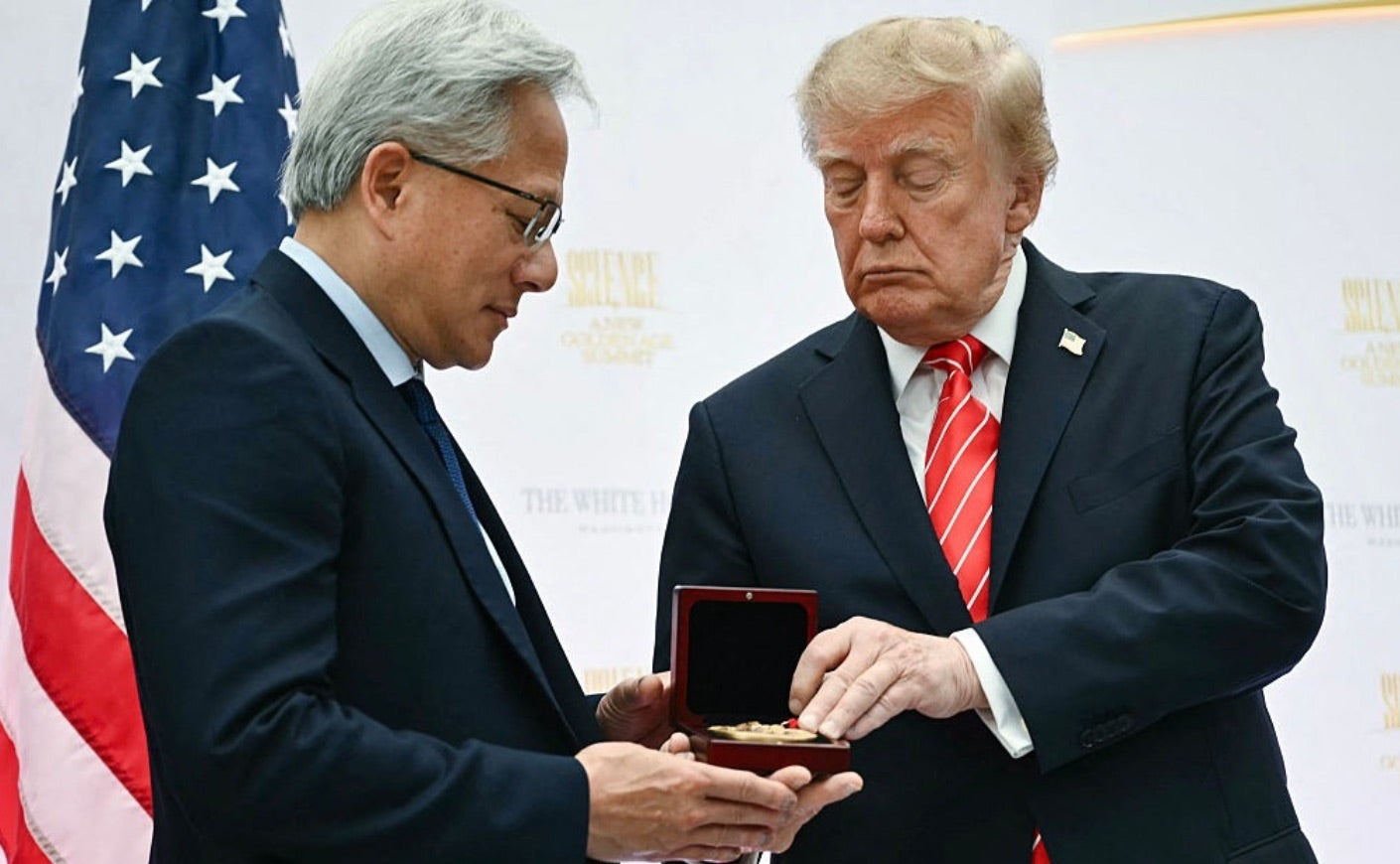
Two weeks later, Trump awarded Huang the National Medal of Science. That same day, Oct. 8, a financial disclosure showed that the president’s portfolio bought up to $1.6 million and sold up to $1 million in Nvidia stock in August. White House spokesperson Davis Ingle told Reuters that “all investment decisions are made entirely by independent managers” and that there were “no conflicts of interest.” Shortly after, The Washington Post reported that Nvidia had pledged $25 million toward Trump’s planned White House ballroom, making it one of the project's biggest backers.
On Monday, Trump told reporters he’d heard about the situation “not too long ago.” When asked whether he knew about Jensen Huang’s alleged ties to a suspected spy during his May trip to China, Trump said, “No, I didn’t hear about it then.” He said he’d spoken with Huang that day and that Huang told him he had no idea Alice Huang might be a spy. “I really believe him,” Trump said.
Ryan Fedasiuk, a researcher at the Foundation for American Innovation, told The Hill he thought Trump was trying to calm investors. In his view, “the president’s impulse was to quell markets.” Trump continued defending Huang on Thursday, even after his resignation. In a Truth Social post, the president praised Huang for doing "a fantastic job" and suggested that former Apple CEO Tim Cook take over Nvidia. "A Legend replaces a Legend!" he wrote.
Congress wants answers
Republican Rep. Brian Mast, who chairs the House Foreign Affairs Committee, told reporters that Huang has agreed to brief lawmakers. Mast said the briefing would likely be “under oath, transcribed, video recorded,” though the details are still being worked out.
Senate Democrats also want a paper trail. On Wednesday, Democratic Sens. Elizabeth Warren and Chris Coons asked Secretary of State Marco Rubio, Commerce Secretary Howard Lutnick, and White House chief of staff Stephen Miller to preserve records related to Nvidia’s chip exports to China.
The senators’ request covered “all documents and communications about the suspected Chinese intelligence operation, including the memorandum reportedly circulated to senior administration officials ahead of President Trump’s visit to China in May 2026.”
“This incident raises significant concerns about the federal government’s ability to effectively enforce our export controls and protect our national security,” the senators wrote in the letter. “Questions also remain regarding whether or not prudent defensive counter-intelligence action was taken or national security recommendations were overruled.”
The senators have requested confirmation by November 17 that the administration has taken steps to preserve the records, along with a congressional briefing on the national security concerns raised by the alleged intelligence operation.
And this could be just the beginning. When Democrats take control of Congress in January, they'll be better positioned to seek the records and call officials to testify about what Trump was told and how his administration responded.
