






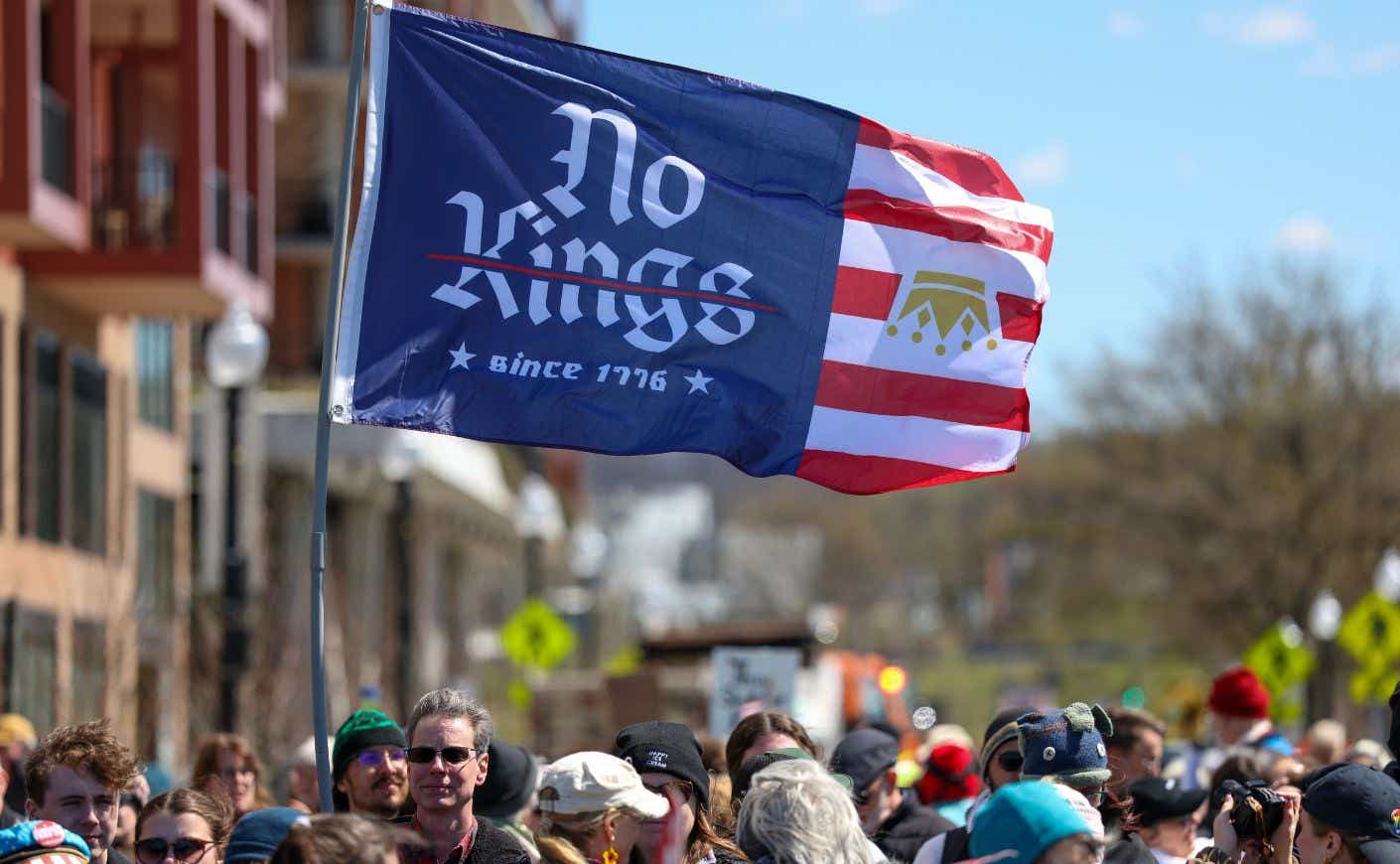
From coast-to-coast protests to a message from the Vatican, this weekend was anything but quiet.
Millions of Americans took to the streets for “No Kings” rallies in what organizers are calling the largest single day of protest in U.S. history, a sweeping show of opposition that played out across all 50 states even as the war in Iran continued to shape the national conversation.
And the effects aren’t confined to the headlines — they’re starting to show up in everyday places, including airport security lines, where staffing shortages may linger even as TSA agents prepare to get paid again.
Here’s a closer look at the biggest stories from the weekend.
No Kings protests called the largest single-day demonstration in U.S. history
More than 8 million people turned out on Saturday for the third installment of the “No Kings” demonstrations, marking what organizers are calling the largest day of protest in U.S. history.
Even as the war in Iran dominated the national conversation, opposition to President Trump’s immigration crackdown — and to Immigration and Customs Enforcement more broadly — remained a central rallying cry. In New York City, for example, tens of thousands of people marched through Manhattan, chanting “No ICE! No Kings! No War!” and carrying hand-written signs reading, “Wake up, America — we are living in a fascist state.”

But the largest gathering took place in St. Paul, Minnesota, where police estimated around 100,000 people attended, with Bruce Springsteen headlining the flagship event. Crowds in Seattle and Washington, D.C., weren’t far behind, while roughly 50,000 demonstrators turned out in Chicago.
The demonstrations didn’t just play out in the usual protest hubs. Events were held in all 50 states and every congressional district — and notably, nearly half took place in Republican-leaning areas. Texas, Florida, and Ohio each hosted more than 100 events, according to organizers.
While most of the protests remained peaceful, there were moments of tension. In Dallas, clashes broke out between marchers and counterprotesters, including pardoned Jan. 6 figures like Stuart Rhodes and Enrique Tarrio. And in Los Angeles, nine people were arrested after demonstrators hurled rocks and bottles at federal officers outside a detention center overnight, according to local television station ABC7.
Demonstrations were also planned in multiple countries across Europe and Latin America, underscoring how far the movement has spread beyond U.S. borders.
Pope Leo XIV appears to rebuke Trump administration’s religious framing of war
Pope Leo XIV opened Holy Week with a call for peace, using his Palm Sunday Mass to make clear that faith should not be used to justify violence.
“Brothers and sisters, this is our God: Jesus, King of Peace, who rejects war, whom no one can use to justify war,” Leo told worshippers, according to the Associated Press. “He does not listen to the prayers of those who wage war… your hands are full of blood.”
In a special blessing at the end of Mass, he added that he was praying for Christians in the Middle East who are “suffering the consequences of an atrocious conflict,” noting that many are unable to fully observe the holy days.
The remarks come as U.S. officials increasingly invoke Christianity to frame the conflict in Iran. After the military launched its offensive alongside Israeli forces on Feb. 28, numerous commanders reportedly told troops the operation was “God’s divine plan.” During a monthly worship service at the Pentagon, Defense Secretary Pete Hegseth echoed that language, praying for U.S. troops to carry out “overwhelming violence of action against those who deserve no mercy,” and adding, “We ask these things with bold confidence in the mighty and powerful name of Jesus Christ.”
Later that day, the Defense Department announced that military chaplains would no longer wear rank insignia on their uniforms, instead displaying religious symbols — a shift that underscores the growing visibility of faith within the military and upends longstanding norms. One senior Army civilian who has worked in the Pentagon for a decade, and requested anonymity, warned The Washington Post that framing conflict in religious terms can blur ethical lines, especially if troops are taught to believe “God is on our side.”
TSA agents could start getting paid again
TSA officers may finally see paychecks this week. White House border czar Tom Homan told CNN payments could arrive as soon as Monday or Tuesday.
Agents have been going without pay ever since the partial government shutdown began on Feb. 14, forcing ICE personnel to step in at airports nationwide to cover staffing gaps. After Congress failed to reach a deal, President Trump on Friday directed the Department of Homeland Security to begin issuing pay immediately.
Whether those reinforcements will remain is still an open question. Homan said it depends on how many workers return — and how many have already left for good.
“It depends on how many come back, how many have actually quit and have no plans on coming back,” he told CNN’s Jake Tapper on State of the Union.
For now, it may take time before travelers notice a difference at airports, even as the move comes during a busy travel stretch, with spring break trips underway and Passover and Easter approaching.
Caleb Harmon-Marshall, a former TSA officer who runs the travel newsletter Gate Access, told PBS the staffing crunch is unlikely to ease until workers feel confident their pay is stable, estimating that longer security lines could persist for another week or two. And some roles may need to be filled again: Nearly 500 of the agency’s roughly 50,000 officers have quit since the shutdown began, according to DHS.
