


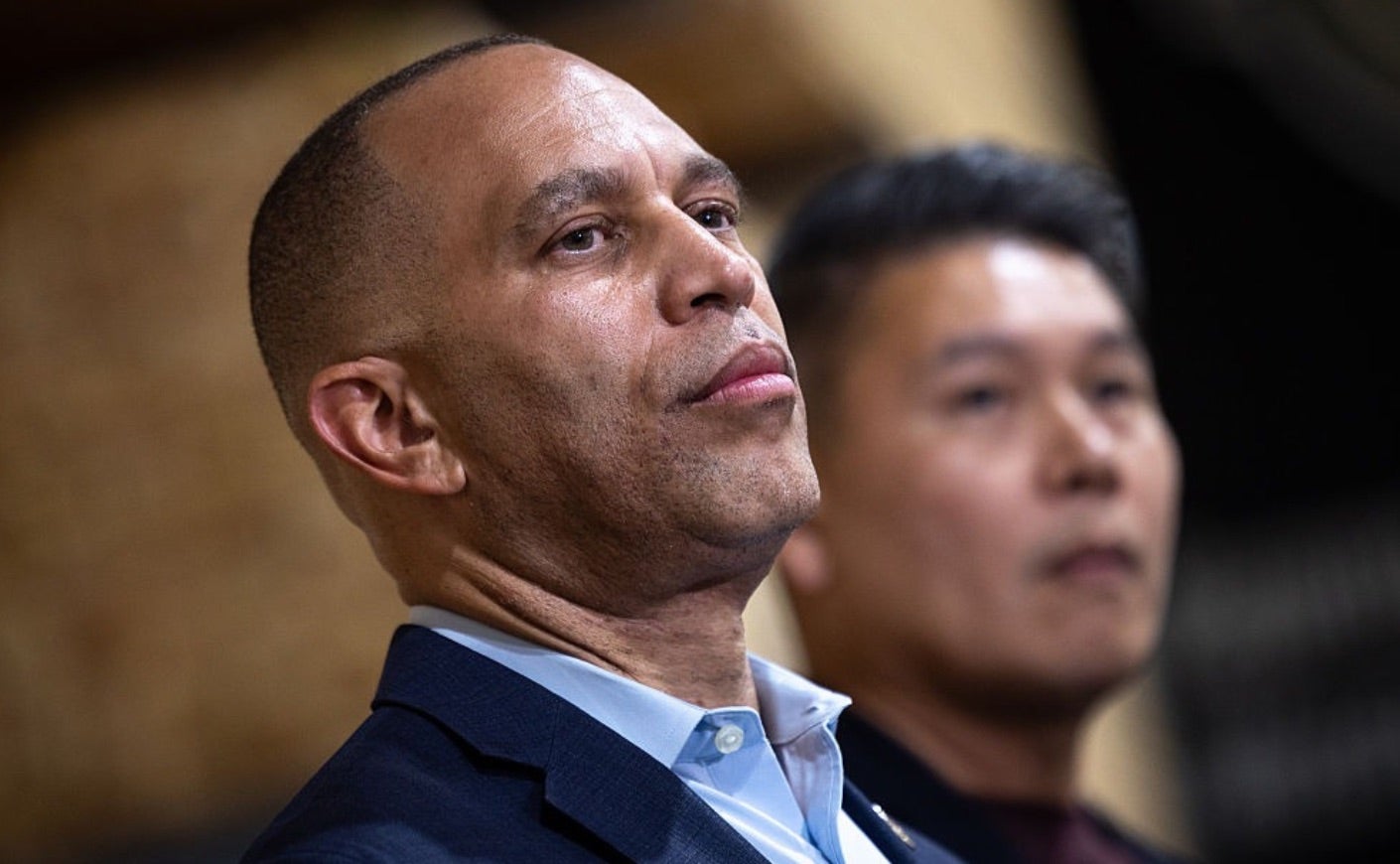
Democrats are heading into the midterms with reason for optimism — and a looming debate over what to do if they win.
An October New York Times/Siena poll found the party leading Republicans by 10 percentage points nationally in House races, and a new majority could change the course of President Trump’s final two years in office. Democrats could demand records, call administration officials to testify, and launch investigations that some Democrats hope would lead to a third impeachment.
But the prospect of a third impeachment is also exposing divisions over what the party should do with a new majority. Some Democratic lawmakers see it as a constitutional responsibility. Others see it as a fight unlikely to remove Trump — and one that could consume time and attention they'd rather spend showing voters what else their party can deliver.
How likely are Democrats to impeach Trump again?
Some of the loudest calls are coming from the party's progressive wing. New York Rep. Alexandria Ocasio-Cortez, who's reportedly weighing a White House bid, told The Floridian in March that she supports impeachment, arguing that "it's on very objective grounds of following the law or not."
California Rep. Ro Khanna, another potential presidential contender, has also voiced support, telling NBC News "it's about setting a standard." "Democrats can impeach to uphold constitutional values, and at the same time have a first-hundred-day agenda that deals with the cost of living," he added.
House Democratic Leader Hakeem Jeffries has left the door open, too, without committing to another impeachment push. "We haven't ruled anything in, and we haven't ruled anything out in terms of impeachment," he told ABC's This Week in September.

But not everyone is so eager to go down that road a third time. Last April, Georgia Sen. Jon Ossoff said he "strongly" supported impeaching Trump, arguing there was "no question" the president had committed impeachable offenses. More recently, though, he's been less willing to commit to a specific course of action.
"The president's misconduct has already exceeded any prior standard for impeachment," he told CNN in October. "If the House sends the Senate Articles of Impeachment, then I'll consider them on the merits as a juror."
Others are warning Democrats against pursuing another impeachment altogether. Former Chicago Mayor Rahm Emanuel, who's weighing a White House bid, told NBC’s Meet the Press earlier this month that Democrats should investigate Trump instead, arguing that impeachment is “not going anywhere and it’s going to be a food fight.” Kamala Harris, who ran against Trump in 2024, is also skeptical: "“I think that going in the direction of impeachment is not a good idea, just to be honest with you,” Harris told MeidasTouch. “Just because we have limited resources, and I think the energy and the resources need to be put into accountability, need to be put into investigations.”
Could Democrats actually remove Trump?
On paper, a unified Democratic majority in the House could impeach Trump without a single Republican vote. (Impeachment requires only a simple majority in the chamber.) But removing him from office would be a much tougher sell in the Senate, where conviction requires a two-thirds vote and, realistically, substantial Republican support.
Trump has already survived two impeachment trials. The first, in 2019, accused him of abusing his power by pressuring Ukraine to investigate Joe Biden and his son Hunter, and obstructing Congress's investigation. The second, in January 2021, charged him with inciting the Capitol insurrection. But the Senate acquitted him both times.
Even some Democrats who led Trump’s previous impeachments are skeptical that the Senate would vote to convict him this time. Maryland Rep. Jamie Raskin, the lead prosecutor in Trump’s second impeachment trial, has acknowledged that getting enough senators on board would be an uphill battle — even though he believes Trump has committed impeachable offenses.
"I’ve not heard a single person say to me that they think our top priority should be impeachment of Donald Trump,” Raskin told CNN. “He hasn’t been convicted, and the chances of conviction on even his most gross and undeniable offenses against the Constitution are slim because he exercises even more authoritarian control over the Republican Congress than he did in the last impeachment.”
The Senate math helps explain his skepticism. Of the seven Republican senators who voted to convict Trump in his second impeachment trial, just three remain in office — and one, Louisiana’s Bill Cassidy, will leave in January after losing his primary. That leaves Susan Collins and Lisa Murkowski.
When asked about the possibility of being impeached for a third time and being investigated, Trump told Punchbowl News that it would be “very unfair,” partly because “a lot of people are saying I am one of the greatest presidents ever.” (His approval rating recently fell to 36 percent, the lowest recorded in any New York Times/Siena poll.)
What could Democrats do instead?
The left wouldn't necessarily need to impeach Trump to weaken his presidency. If Democrats regain control of the House, they'd have other ways to challenge his agenda — and some are already laying the groundwork.
In May, Ocasio-Cortez joined Reps. Mike Levin and Jason Crow to launch the End Corruption Caucus, which aims to “bring together like-minded partners and root out corruption in government to restore the American people's trust in their leaders.”
A Democratic majority could also launch investigations, summon administration officials to testify, and issue subpoenas. House members in key leadership roles told The Los Angeles Times they’re preparing to investigate Trump’s reported $2.2 billion in gains last year, his family’s business ventures and crypto projects, and son-in-law Jared Kushner’s business dealings. Also on their radar: Trump’s pardons and commutations for allies, and how the Justice Department has handled the Jeffrey Epstein case.
But getting answers might not be so straightforward this time around. In August, the Justice Department issued a memo arguing that Trump can use executive privilege to shield certain communications with outside advisers, potentially complicating congressional probes, though Democrats don't seem fazed. "We are ready to fight to uphold our power and authority,” California Rep. Robert Garcia told the Times.
Then there's Congress's control over federal spending. California Sen. Adam Schiff, who led Trump's first impeachment investigation, suggested Democrats could use their "power of the purse" — or their influence over how federal money is spent — to push back against the president's agenda. Meanwhile, Virginia Rep. James Walkinshaw has called for greater scrutiny of the now-defunct Department of Government Efficiency (DOGE), particularly allegations that former staffers mishandled millions of Americans' sensitive Social Security data.
Perhaps the bigger threat, though, is turning Trump into a lame duck. Reuters reported in June that the president has privately expressed concerns about losing his political influence, with one unnamed former senior aide saying his talk of a third term (which the law does not allow) was partly an effort to avoid appearing irrelevant. Losing the House could only add to those worries, making his final two years in office a lot more difficult.
