






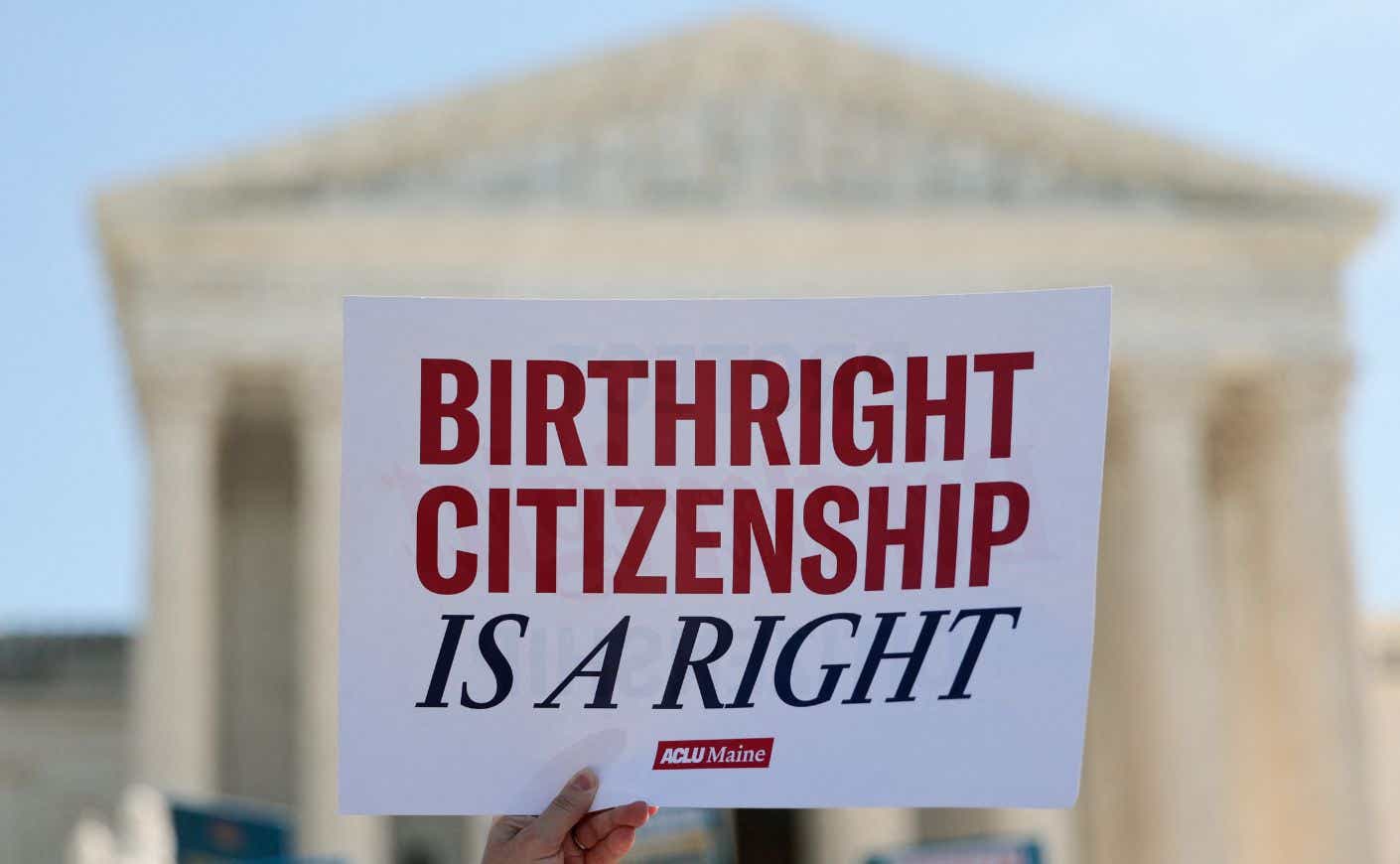
A long-settled principle of American life — that if you’re born here, you’re a citizen — is now being tested at the highest level.
Shortly after taking office, President Trump signed an executive order aimed at ending birthright citizenship — the guarantee of U.S. citizenship to nearly everyone born in the country. The order hasn't gone into effect because every federal court that has reviewed it so far has struck it down. But now the fight has reached the Supreme Court in Trump v. Barbara, where, after more than two hours of oral arguments — some of which Trump himself attended — a majority of the justices appeared skeptical of the administration’s position.
At the center of the case is the 14th Amendment, which has long been understood to grant citizenship to nearly anyone born on U.S. soil. But the administration is pushing a narrower interpretation — one legal experts say could have far-reaching consequences.
We spoke with ACLU attorney Evelyn Danforth-Scott, who's working on the case, about what’s at stake, what stood out during arguments, and why the implications could extend far beyond immigration policy.
Katie Couric Media: The 14th Amendment is at the heart of this challenge. Can you walk us through what it actually says — what this case is really about — and how it connects to broader issues like immigration?
Evelyn Danforth-Scott: The best way to think about this part of the 14th Amendment — the Citizenship Clause — is to go back in time a bit.
When the country was founded about 250 years ago, we brought over what I’d describe as some of the best parts of English law — and we threw away some of the worst parts, the ones that were tyrannical or incompatible with democratic self-rule. One of the best parts we kept was this principle: Citizenship is based on where you’re born. So if you’re born here, you belong here.

It’s not based on the blood of your parents. It’s not an inherited status. It’s based on the soil where you were born. That was the rule in England for a long time, and the colonists brought it with them when they founded the United States. There were some very narrow exceptions — Chief Justice Roberts called them “idiosyncratic” at the argument — like children of an occupying army. But for the most part, the rule was simple: Citizenship is based on birthplace.
That principle was part of American law for a long time. But before the Civil War, it was applied unevenly — and in a racialized way. It’s an inherently egalitarian idea — no inheritance, no caste, just birthright — and that was fundamentally at odds with slavery. So in the decades leading up to the Civil War, there was intense debate over how it applied to enslaved people and free Black Americans.
Then, shortly before the Civil War, the Supreme Court tried to resolve the question in the Dred Scott case. It ruled that no Black Americans were citizens — a bright-line, race-based rule. It was a shameful decision, widely regarded as one of the most discredited in the Court’s history, and it further inflamed tensions leading to the Civil War.
After the war, as the federal government worked to rebuild the country, one of its central goals was to undo that decision and restore the original principle that we don’t have castes. That citizenship is not based on race or blood.
The Citizenship Clause of the 14th Amendment was a key part of that project. It explicitly repudiated Dred Scott and restored this longstanding tenet that, with very narrow exceptions, if you’re born here, you belong here.
We’re already seeing skepticism from the justices. What stood out to you?
You heard a lot of skepticism from the justices across the ideological spectrum about the government’s position here. And just to clarify, the government’s position — as Justice Barrett described it really well — is that they don’t quite want to throw out the traditional “born here, belong here” rule, and they also don’t want to fully adopt an inheritability rule. Instead, they’re advancing a kind of hard-to-understand middle ground — a new rule that seems to map onto the president’s policy priorities, rather than any discernible principle of law or recognized mode of constitutional interpretation.
I think the justices were rightly quite puzzled by that approach and expressed a lot of skepticism. Now, with any case rooted in history — which this one certainly is — they’re going to have to look closely at the record. And I think they did that. They took these historical questions very seriously. But I heard from some of the key votes on the Court quite a bit of skepticism about the government’s historical argument, which is essentially a revisionist history to suit its policy priorities.
If the Court sides with the administration, what changes — and who is most affected?
We heard questions at oral argument that really drew out the problems with the government’s position — and “problems” is probably too mild a word. Both Justice Barrett and Justice Ketanji Brown Jackson pressed on how difficult it would be to distinguish between babies whose parents are deemed, for lack of a better term, “good enough” in the government’s eyes to merit citizenship and those who are not.
The executive order at issue purports to withdraw citizenship from two categories of children — those born to undocumented parents and those born to parents on temporary visas. But the broader “domicile” or “allegiance” framework the government endorsed at argument isn’t actually limited to those categories. It relies instead on a much more subjective, ill-defined sense of where someone’s “home” is — something Justice Jackson pointed out would be extraordinarily difficult to implement in practice.
As a result, you could end up with many children effectively stateless — born to parents who came to the U.S. fleeing violence or instability and who no longer have meaningful ties to their country of origin. In practical terms, it risks creating a caste system in which a large number of children who are in the eyes of American law not treated the same.
The administration has leaned on the idea of “domicile.” How significant is that argument?
This idea emerged as a fringe position on the far right years ago, and for a long time, it remained exactly that — fringe. The fact that it has gained so much traction during this administration speaks to how aggressive it has been in trying to push and reshape the law to fit its policy preferences. That’s an important piece of context.
In 1898, the Supreme Court decided a case that was almost directly on point and firmly established the principle of birthright citizenship. To revisit that more than 125 years later, “aggressive” almost feels too soft a word.
That’s really the key point about the domicile argument: it’s fundamentally at odds with the Court’s own precedent and with decades of settled understanding of what the Citizenship Clause of the Fourteenth Amendment means.
How much does precedent weigh here?
The precedent here is essential — and it should decide this case again. The Supreme Court addressed this question directly in 1898 in United States v. Wong Kim Ark, which we believe squarely resolves the issue of birthright citizenship.
But we also think that our position is correct as a matter of first principles. So even if the court were just writing on a blank slate, the historical record shows that when we adopted the 14th Amendment, we were adopting this, essentially this English common law rule, with the single additional exception for American Indians, and that rule doesn't permit new exceptions that are just reflections of a current administration's policy priorities.
Do you view this case as a test of the limits of executive power, especially in light of Trump’s willingness to upend longstanding precedent?
That’s part of the story. Our position is that even Congress couldn’t do this — if Congress passed a law mirroring what this executive order does, it would also be unconstitutional.
That said, the fact that the president didn’t go to Congress and instead acted unilaterally on his first day in office underscores a more expansive — even imperial — view of the presidency. It reflects an aggressive understanding of executive power and a willingness to try to rewrite foundational aspects of American life.
What does it say that a once-fringe argument about birthright citizenship has made it all the way to the Supreme Court of the United States, even if it ultimately fails?
I think it’s sad.
This is a principle that, as my boss said in the argument yesterday, everyone knows. When you’re in elementary school, you learn that if you’re born here, you’re a citizen.
That’s part of what makes this case so distinctive and important. It’s challenging something that children across the country learn in basic civics classes — something that didn’t carry a political valence, but was simply understood as a fact of American life, like the words of the Pledge of Allegiance.
Some legal experts say the goal in cases like this isn’t always to win, but to push boundaries — even create confusion or shift the conversation. Do you see that as part of the strategy here?
I think the word I keep coming back to is “aggressive.” Their view seems to be that if they can take shots on goal for positions that advance their policy priorities, they will.
We felt coming out of arguments that there was a healthy dose of skepticism about the government’s position, which was encouraging. But the broader context matters: Trump has taken aggressive legal positions in other areas and sometimes won, even when those arguments initially seemed far-fetched. The immunity case is a good example of that.
So I don’t think it’s necessarily about assuming they’ll lose and trying to shift the discourse. It’s more that they’re willing to take the risk because sometimes, they win. And that’s part of what makes cases like this so consequential.
It’s easy to get caught up in the legal arguments — who are the people this case ultimately affects?
Our clients — the people we’re representing — are a class of babies.
That’s something we try to keep front of mind every time we work on this case and every time we talk about it.
This interview has been edited and condensed for clarity and length.
