






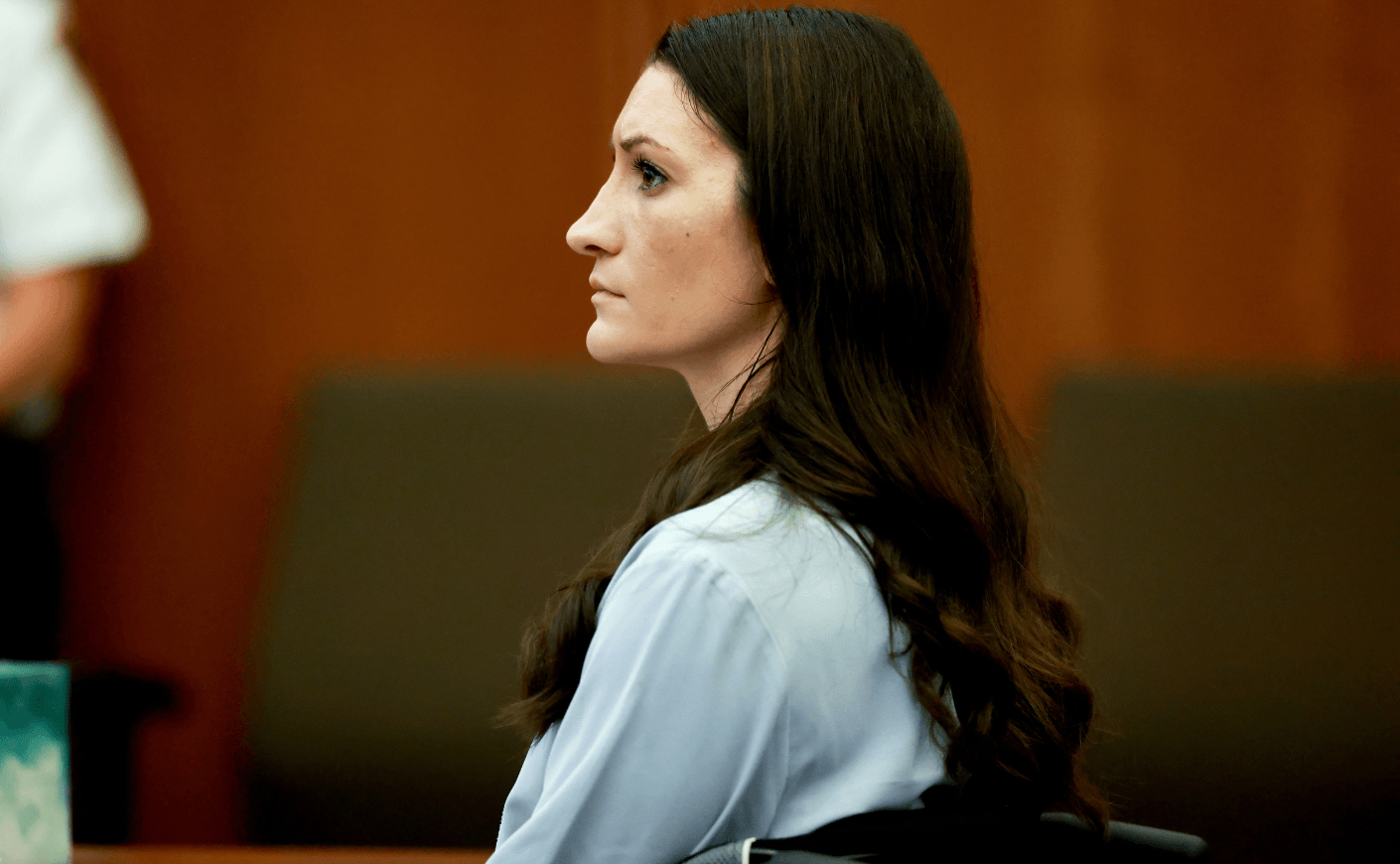
- Trial hinges on whether Clancy was legally responsible or suffering postpartum psychosis that left her unable to understand or control her actions.
- On Jan. 24, 2023, Clancy strangled her three children with resistance bands, attempted suicide, and was left paralyzed; all three children later died.
- Defense cites bipolar disorder and postpartum psychosis, a forensic diagnosis, reports of hearing a voice, and extensive but unsuccessful treatment attempts.
- Prosecutors argue the killings were planned and deliberate, pointing to premeditation evidence; jury may convict to life or order psychiatric commitment.
More than three years after Lindsay Clancy killed her three young children inside their Massachusetts home, she’s now at the center of a closely watched murder trial.
While there's little dispute over whether she committed this horrendous crime, the question at the center of the case is whether she is legally responsible for her actions. Clancy's attorneys argue that severe postpartum mental illness left her unable to understand or control what she was doing. But prosecutors tell a very different story: They say the evidence shows she planned the killings and carried them out deliberately.
Now, a jury must decide between those two accounts — a determination that could mean the difference between life in prison and commitment to a psychiatric facility.
Who is Lindsay Clancy, and what happened to her children?
Lindsay Clancy is a former labor and delivery nurse who lived with her husband, Patrick Clancy, and their three young children in Duxbury, Massachusetts. On Jan. 24, 2023, the family's seemingly ordinary day ended in a tragedy that would later draw national attention.
Earlier that evening, Clancy asked Patrick to leave the house to pick up children's medication and takeout from a restaurant in nearby Plymouth. While he was gone, prosecutors say, Clancy strangled their three children — 5-year-old Cora, 3-year-old Dawson, and 8-month-old Callan — with exercise resistance bands before attempting to take her own life by cutting her wrists and jumping from a second-story window. She suffered spinal injuries that left her paralyzed.
When Patrick returned home, he found his wife injured outside and called 911. He then discovered the three children unconscious in the basement, where first responders found them with signs of severe physical trauma. Cora and Dawson were rushed to Beth Israel Deaconess Hospital in Plymouth, where they were pronounced dead that night. Callan was still alive and was airlifted by medical helicopter to Boston Children's Hospital. He remained there for several days before dying from his injuries.

The medical examiner later determined that Cora and Dawson died from asphyxia, while Callan died several days later from related complications.
Clancy has admitted to strangling her children but pleaded not guilty to the criminal charges, with her defense arguing that she was suffering from severe postpartum mental illness. She and Patrick have since divorced, and Patrick has remarried and moved to New York City. Despite all of this, he has continued to speak sympathetically about Lindsay and her struggles with mental illness. In an unusual dynamic, prosecutors called Patrick as their first witness at trial, and he is also expected to testify for the defense.
What is postpartum psychosis, and how does it relate to Lindsay Clancy's defense?
Clancy’s attorneys argue that at the time of the murders, she was suffering from bipolar disorder and postpartum psychosis, the latter of which is a rare but serious psychiatric condition that can cause someone to lose touch with reality. Postpartum psychosis affects an estimated 1 to 2 out of every 1,000 women after giving birth and can cause hallucinations, delusions, paranoia, severe confusion, and dramatic changes in mood or behavior.
According to the defense, a forensic psychiatrist who evaluated Clancy after the killings diagnosed her with both mental illnesses. Her attorneys argue that her psychological state became so severe that she could no longer fully understand or control her actions at the time that she killed her children. Clancy has since described hearing a man’s voice telling her to kill her children and herself — something her defense points to as evidence of her psychosis.
The defense has also focused on Clancy’s mental-health treatment in the months leading up to the killings. Over roughly four months, she was prescribed 13 psychiatric medications across different providers. In messages to psychiatric nurse practitioner Rebecca Jollotta, Clancy described experiencing “intrusive thoughts I never had before” and feeling “completely hopeless.” Her attorneys say she repeatedly sought help as her condition worsened: She saw multiple outpatient providers, tried various medications, called a suicide hotline, went to an emergency room, and sought admission to a hospital-based day program for women experiencing postpartum mental-health problems, but wasn't accepted. She also voluntarily admitted herself to a psychiatric hospital for several days.
Prosecutors don’t dispute that Clancy was struggling with her mental health, but reject the argument that she was so impaired that she couldn’t understand or control what she was doing. They point to her behavior on the day of the killings — including looking up the drive time to a restaurant before sending Patrick out to pick up takeout and children’s medication — as evidence that she deliberately created a window in which she would be alone with the children. They’ve also pointed to the fact that each child was strangled with a different exercise resistance band, arguing that the method and sequence of the killings show that Clancy acted deliberately rather than during an uncontrolled psychotic episode.
Prosecutors have pointed to testimony from the clinicians who treated Clancy before the killings: Jollotta testified that Clancy reported suicidal thoughts but never disclosed a plan to harm herself or her children and did not show signs of psychosis or mania during their appointments. Prosecutor Shanan Buckingham has urged jurors not to view the case as a broader “public debate about women’s mental health,” but to focus on Clancy’s specific actions and intent. “This was not a woman in the throes of psychosis,” Buckingham argued, saying Clancy instead acted “intentionally, rationally, and swiftly.”
What happens next in the Lindsay Clancy case?
The jury's decision will ultimately come down to whether prosecutors can prove that Clancy was criminally responsible when she killed her children.
Under Massachusetts law, a person may be found not criminally responsible if, because of a mental disease or defect, they lacked the substantial capacity to understand that their actions were wrong, or to control their behavior. Once the defense raises that issue, prosecutors have the burden of proving beyond a reasonable doubt that the defendant was criminally responsible.
That distinction will determine what happens to Clancy next. If convicted of first-degree murder, she faces life in prison without the possibility of parole. But if jurors find her not guilty due to a lack of criminal responsibility, that doesn't mean she would simply walk free. Instead, she could be committed to a state mental health facility.
Legal expert Margaret McLean told Parade that the case would then move into a “civil commitment process” overseen by the court and mental health experts. Clancy could eventually be released under strict conditions if she's determined to no longer pose a danger. But if her illness is deemed “chronic and dangerous,” Clancy could remain institutionalized for the rest of her life.
NOTE: An earlier version of this article inaccurately stated that Patrick Clancy and his wife Rachel have a child. They have no children. We regret the error.
