






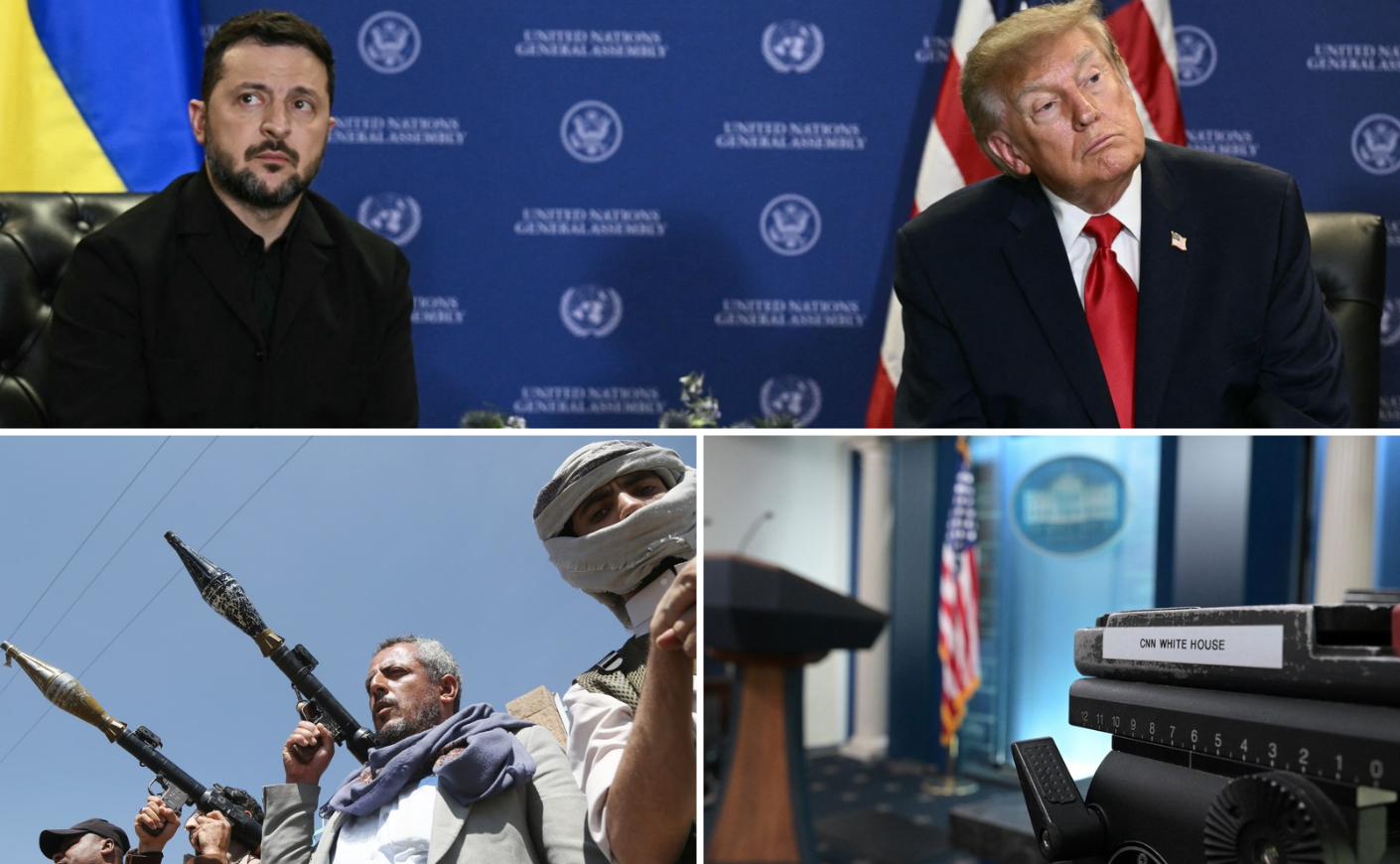
The news moved quickly over the weekend. Houthi attacks on Saudi Arabia killed over a dozen people and injured hundreds more, President Trump's announcement of a supposed breakthrough between Russia and Ukraine caused confusion, and the Department of Justice escalated its attacks on the press. Here's a closer look:
Riyadh airport struck again after Houthi attack on Saudi Arabia
On Saturday, a strike on the King Khalid International Airport in Riyadh killed 13 people, including four Saudi nationals and one U.S. citizen, and injured more than 309. The attack was the deadliest on a Gulf state since the start of the Iran war and the worst in Saudi Arabia in over a decade. It also marked the third strike on the kingdom's main international airport in a week. A day later, an "unidentified projectile" hit the same airport. It struck Terminal 4 and caused a fire, which "resulted in injuries," according to the Saudi General Authority of Civil Aviation. The agency did not offer further details on how many people were injured.
On Sunday, the Iran-backed Houthis claimed responsibility for both airport attacks and said they had “carried out four qualitative operations in the past 24 hours," also targeting Saudi energy facilities. A Houthi spokesperson said the attacks were done in retaliation for Saudi strikes, including on civilian infrastructure in Yemen, which a spokesman for the Houthi-affiliated health ministry said have killed 91 people in Yemen since Sept. 3.
The Houthis' hostilities provoked condemnation around the globe.
Israeli Prime Minister Benjamin Netanyahu condemned the “horrific terrorist attack” on the Riyadh airport, writing on X that he extends Israel's "deepest condolences to the families of those murdered and our wishes for a full recovery to the injured."
Prime Minister Benjamin Netanyahu:
I condemn in the strongest possible terms the horrific terrorist attack on King Khalid International Airport in Riyadh, Saudi Arabia, which claimed the lives of 12 innocent people and injured hundreds more.
On behalf of the people of Israel, I…— Prime Minister of Israel (@IsraeliPM) October 11, 2026
Egypt said it “stands firmly” with Saudi Arabia in a statement and "stressed its complete rejection of these attacks, describing them as a flagrant violation of international law." Qatar called the strikes, “a grave violation of Saudi Arabia’s sovereignty and a direct threat to regional security.” UN Secretary-General António Guterres called the violence “a violation of international law," and Germany and Canada also denounced the assaults.
President Trump told reporters that the U.S. would consider joining Saudi military operations against the Houthis. "We may. We’re gonna look at it,” Trump said on Saturday. “We’ll make a decision. We move very quickly.”
Saudi Arabia said it would "respond decisively" to the Houthis. U.S. officials and analysts say it is providing Saudi Arabia with intelligence support, but so far has not provided direct military assistance to Saudi Arabia's fight against the Houthis in Yemen. Two Saudi Arabian government officials told MS NOW that the kingdom is requesting “urgent defense support” from the U.S. “as soon as possible.”
The attacks and a potential response are igniting fears of a wider war in the region and could introduce more instability into energy markets as President Trump is trying to bring down fuel prices ahead of the midterms.
Trump claims Russia and Ukraine agree to energy ceasefire
Also on Sunday, Trump appeared to announce a major development between Russia and Ukraine, writing on Truth Social, "there is an ENERGY CEASEFIRE in the War between Russia and Ukraine. Both parties have agreed. Do not break it!"
The only problem? Neither side appears to know about it. Ukrainian President Volodymyr Zelenskyy told Axios the ceasefire "was news to me." Moscow hasn't commented publicly on the supposed agreement, either.
"But if Russians agree to an energy ceasefire, Ukraine will agree," Zelenskyy added.
This isn't the first time Trump made an announcement about a deal before either side confirmed a truce. He made a similar claim last month; the agreement never materialized, and both countries continued attacks on each other's energy facilities. In fact, shortly after the Oct. 11 post, Zelenskyy claimed there was a strike on Kharkiv's energy structure.
With early voting already underway in some states, the Trump administration is running out of time to address rising fuel costs, which is a top issue for voters. An October poll from Pew Research Center found that 74 percent of Americans are very concerned about gas and energy prices — and 65 percent say Trump's policies have made the economy worse.
On Friday, the administration temporarily lifted sanctions on Russian diesel and claimed that Putin would "immediately supply" the fuel "to the American and Global Marketplace.” Putin confirmed the deal. Trump has previously claimed that "The World’s Diesel price rise is mostly caused by the Russia/Ukraine War, not Iran."
The move drew bipartisan backlash. Democratic Sens. Chuck Schumer, Elizabeth Warren, and Jeanne Shaheen called the decision to lift sanctions a “total betrayal of Ukraine, our European allies and American national security," and Nebraska Republican Rep. Don Bacon (who is not seeking reelection) accused Trump of having "a moral blindness towards Putin," which he called "embarrassing." Sen. Thom Tillis said the deal may be illegal, adding, "I will guarantee you at the first opportunity Putin has to embarrass or undermine President Trump, he will."
DOJ launches antitrust investigation of TV networks
And at home, the fight over press freedom isn't over. Last month, the Trump administration barred CNN, MS NOW, and Politico from White House grounds, prompting five major television networks to suspend pooled coverage of the president. As a federal judge prepares to make a final ruling on the ban, the Trump administration escalated its attacks on the media on Saturday. The Department of Justice announced it has opened an investigation into ABC, CBS, NBC, Fox News and CNN to determine whether their decision to suspend press pool coverage in solidarity with CNN violated antitrust laws.
“Members of the television press pool have proudly boycotted covering White House events," the Department of Justice said in a statement. "Group boycotts among commercial competitors can violate the Sherman Act. The Antitrust Division is investigating to determine whether these news organizations have violated the antitrust laws.”
Two people with direct knowledge told the New York Times that on Friday, the Justice Department demanded copies of communications between network officials about press pool coverage, as well as communications about Trump banning CNN from the White House. Neither the White House nor the five outlets being investigated have responded to the NYT's request for comment so far.
Some experts don't think this probe will be successful. “The critical ingredient in successful antitrust cases is to demonstrate that there is unmistakably a commercial motive and that the commercial motive predominates,” William E. Kovacic, a former chairman of the Federal Trade Commission, told the NYT. “And I don’t think they would ever be able to do that here.”
Whether or not the investigation amounts to anything may be beside the point. “The reported investigation appears to be a pretext for seeking records from the networks about how they are covering daily White House events during a media ban the president himself put in place," Bruce D. Brown, president of the Reporters Committee for Freedom of the Press, said in a statement. "Summoning antitrust authority, on top of the retaliatory actions the White House has already taken to bar certain outlets, is another and even more brazen attempt to try to intimidate journalists.”
