






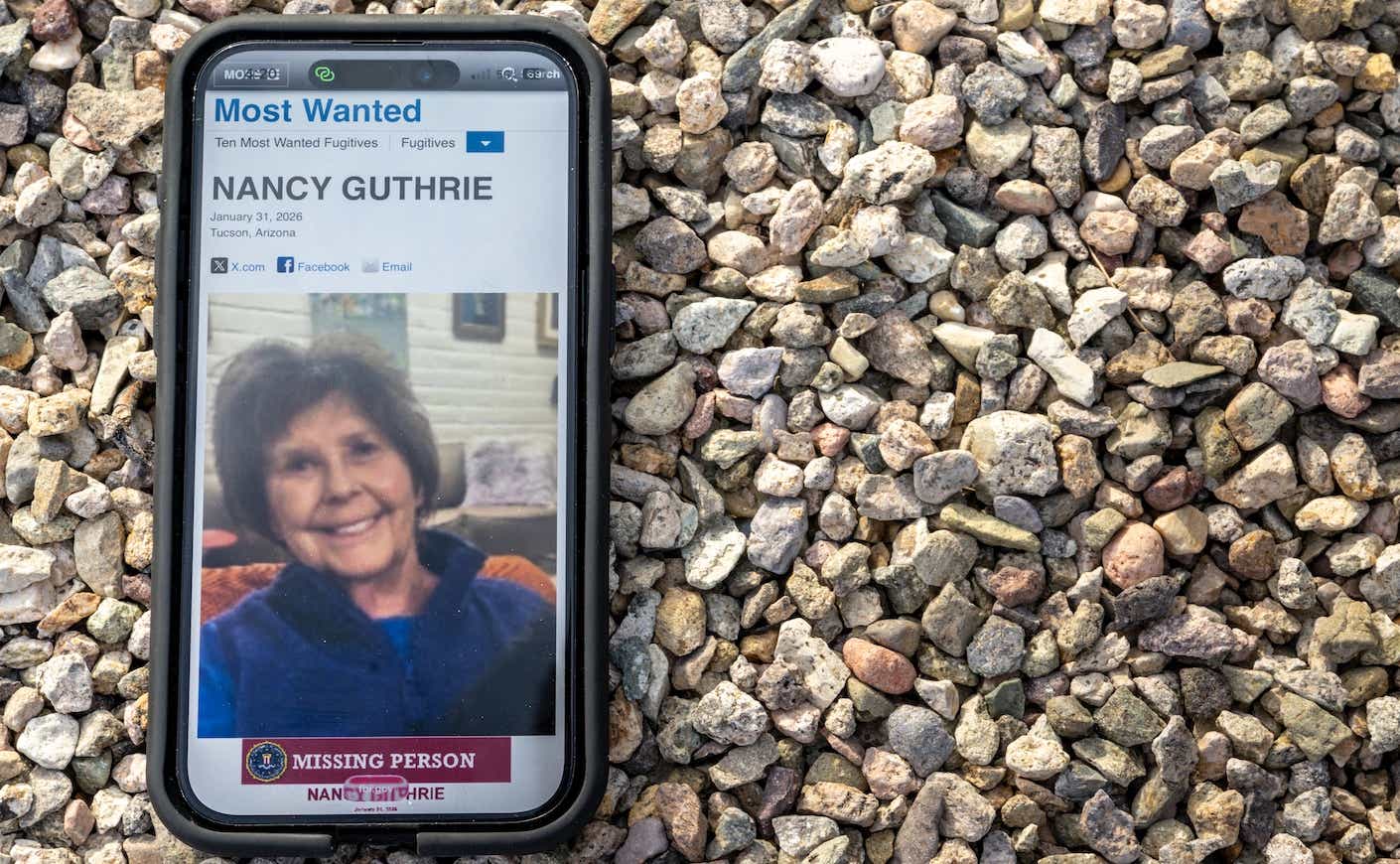
Like many of you, I haven't been able to stop thinking about Savannah Guthrie's mom. This horrifying story has reached so many people, so I made sure to discuss it on my Substack Live this week.
Savannah’s mom, Nancy — whom I’ve met on a number of occasions — was abducted from her home in Tucson, Arizona, earlier this month. As someone who worked on the TODAY Show for 15 years, I am heartbroken for Savannah, her family, and her children.
Everyone has been obsessively following this story because it is, first and foremost, incredibly upsetting. But it’s also deeply strange: that an 84-year-old woman would be taken from her home and not seen for more than a week and a half. To help make sense of some of the details, I brought in two experts.
Barbara Daly is a 31-year veteran of the FBI who has experience in behavioral threat assessment and management, with specialties in threat mitigation and active assailance. She served as a supervisory special agent overseeing the Joint FBI-NYPD Violent Crime Task Force in the New York Field Office for almost a decade. She currently serves as the president of the Northeast Chapter of the Association of Threat Assessment Professionals.
Kristy Kottis is a retired FBI agent who spent 24 years working for the Bureau. She retired from the New York division as the supervisor of the Joint Terrorism Task Force 24/7 Operational Threat Squad. She’s also now the co-host of FBI True, a show on Paramount+.
You can watch my full conversation with them and read highlights below.

Katie Couric: What stands out to you about this case and the timeline that's been released?
Barb Daley: Adult kidnappings are extremely rare. In more than 10 years working kidnapping cases, I handled about three — and all involved adult males, usually motivated by money, drugs, or revenge.
The other thing that really stands out, though, is that this is an 84-year-old mom, grandma, and community member with limited mobility. To go into a house and try to remove somebody [makes this] a very high-risk crime.
Do you think the crime scene was properly preserved? I kept thinking, wouldn't there be footprints in her house if the guy had entered it? Kris, do you think they did all they needed to do to preserve the crime scene?
Kris Kottis: They may have collected footprints. We don't know everything that they did. We shouldn't know everything that law enforcement did. They need to hold some cards. If you're looking at this as a chess match or a poker game, law enforcement can't reveal everything they know. My understanding is that they preserved the crime scene and started the evidence collection. And they've gone back a couple of times into the house, and that's not unusual either.
Also, that seemed and felt like a staged video to me.
It was an individual, we don't know whether it's a male or female, showing us what they want us to see: head down, approaching the house, clearly, to me, wearing two sets of gloves, two sets of pants, a bulky shirt, two masks. First they're like, "Head down, don't look at me." Then it's like, "Oops, look at me. I looked right into the camera." Then it's like, "I've got a gun. I want you to think it's a gun strapped right to the front in my crotch area." I've never seen a gun worn that way in any condition. And then goes to the garden, rips up some shrub, all this performative drama. If that was the lookout team or the team that's supposed to do something from the front, all you do is hide your face, walk up, and cover the ring camera, rip it off the wall right then.
So I don't necessarily assume that individual even went into the house.
Does this look amateur to you?
BD: It’s either the most amateurish thing ever — or it’s what someone wants us to think. It was very strange…I think it tells us something about the individual.
There's always an element of pre-planning. High-risk crimes like this are rarely spontaneous. There’s usually pre-planning: knowing the person’s patterns, whether there are cameras, the layout of the home, the method of egress.
We almost never see a spur-of-the-moment [kidnapping], which is what it would look like if this person is an amateur. There has to be some sort of pre-kidnapping surveillance of the person, the location, and the cameras. Do they have the Nest doorbell? Are there internal cameras? What does the setup look like? What's the method of egress? Things like that all have to be pre-planned. Otherwise, it's very hard.
Also, removing an 84-year-old woman with mobility issues from inside a house would be very difficult for one person. It would be very risky. That raises the question: were there more people involved? There had to have been a vehicle because it's not friendly terrain, especially for Nancy Guthrie.
Could this have been someone she knew?
BD: I do, I think [it could be] someone who entered her circle at some point. It could be somebody who came in briefly or is more well known. It's really difficult to say. But again, to facilitate something of this magnitude and this nature would almost require somebody with some kind of knowledge of her pattern of life. She didn't have a very public profile despite having a prominent daughter. It could be somebody who's known to her to some degree and thought this is somebody who has access to funds, and maybe we'll be able to leverage that.
One of the ransom notes sent to TMZ demands reportedly $6 million in Bitcoin. The authorities have never said whether these ransom notes were authenticated. It's unclear what kind of transactions have taken place between the Guthrie family or law enforcement and these individuals who ostensibly wrote these ransom notes. I don't understand what the motive could be besides money. How do you explain all this?
BD: Money is a powerful motive in adult kidnappings.
An 84-year-old churchgoer, community member, grandmother — the list of enemies that she could have at this point in her life, I think is very, very short, if any.
What’s notable is that we haven’t seen proof of life. Generally, it’s not advisable to pay a ransom without confirmation the person is recoverable.
Also, law enforcement may be withholding information because negotiations could be happening. There may be details only known to investigators and the abductor.
I wanted to ask you about the heartbreaking videos that Savannah and her siblings have posted. My heart breaks for her every time I see these videos. After seeing the deliveries and the word choices, I'm wondering if the family is working with the FBI on specific language that they want to use that is effective in terms of communicating with someone who might've abducted Nancy Guthrie.
BD: That would be common practice. When the FBI gets involved, they bring in behavioral experts to help craft messaging.
Those videos humanize Nancy and show the family’s pain. That kind of genuine emotion can be helpful in communicating with whoever took her.
KK: There was some verbiage in one of Savannah's messages using the word celebration, which seemed not out of place, but slightly awkward and different in its linguistic cadence. Was that a word that she was told to use in a sentence? Is that Savannah speaking directly to the individual who took her mother?
When these conversations are ongoing, one of the things that law enforcement tries to do is have the victim and the assailant have an intimate conversation that only they understand what it means. Imagine trying to have these conversations with someone who has your mother in front of millions of people and trying to be intimate with the individual who wants conversation with you.
Maybe it's somebody who is familiar with the family, maybe a twice-removed person, and they're taking the opportunity to be like, "You know her. Take a moment, talk to her."
I was wondering if all this attention, and the President of the United States chiming in and making statements about a person of interest, would make it more dangerous for Nancy Guthrie.
KK: That kind of input is not helpful at all. That could frighten the bad guy into being like, "This just became way too high stakes for me, and I don't want to play anymore." You want to keep that person calm.
It can muddy the environment.
They detained a man who was released after several hours of questioning. How common is it for them to apprehend someone so soon after releasing a photo and tell the public about it?
BD: I think certain details would be preferable to be kept quiet. It just puts so much pressure on the family, on the investigators who are working tirelessly on this case, to have it played out like that. So I agree. It's not helpful, and it's very unusual.
There's so much public attention and scrutiny on law enforcement; maybe the FBI got ahead of itself a little by publicizing that they were talking to a person of interest to convince people they were making progress in the case.
BD: I think that's a great way to put it.
KK: I agree. In our world, it would be a material witness warrant, and it would be quiet; 99 percent of the world wouldn't even know that it was done to preserve that person's privacy in case they don't have what you want. What if that person did have information and was afraid to come forward? You just blew them up, and now everyone knows that they had been in front of law enforcement.
How do you see this going? Is there any timeframe that, at some point, sets off additional alarm bells for you in terms of getting Nancy Guthrie home safely?
BD: It’s case by case. With children, the first 24 to 48 hours are critical.
In this situation, one question is whether it’s in the abductor’s interest to keep her healthy. If it’s someone who knows her, they may have access to her medication.
As long as you have hope. And I think that the investigators and the family have hope. The outcome that we're all hoping for is for her safe and swift return. It's hard to say. It's hard to put a timetable on that.
