





For millions of employees, work stress doesn’t start Monday morning — it starts Sunday night. It’s that subtle shift in mood when the weekend winds down and the workweek looms. Your brain begins running through your to-do list, and by the time Monday morning arrives, you’re already exhausted.
If this sounds familiar, you’re not alone. According to a national survey we conducted at the Center for Joyful Work, more than 80 percent of American workers report feeling work stress, and almost half say life felt easier during the pandemic than it does today. The way we’re working (and responding to stress) isn’t working.
Two common responses to stress — and why they fail
As a leadership consultant, I spend a lot of time inside workplaces. I’ve worked with more than 100,000 leaders and teams, from Fortune 100 companies and public sector organizations. These companies have different missions, but they all seem to have a strikingly similar experience of stress embedded in the workplace, where stress is disguised as drive, rewarded as resilience, and even praised as passion.
We’ve been taught directly and indirectly to deal with work stress with two default responses.
The first is to push through it: Work harder, stay later, be resilient, be grateful you have a job.
The second is to escape it: Scroll on your phone, plan a vacation, count down the days until Friday.
Both strategies might offer temporary relief, but neither addresses the real problem. Instead, they keep us trapped in the same cycle week after week: Sunday night dread, Monday morning exhaustion, Friday relief — and then the pattern repeats all over again. Employees don’t need more coping strategies; they need a proven method to finally break the cycle of stress and overwhelm.
The Un-Stressing Method
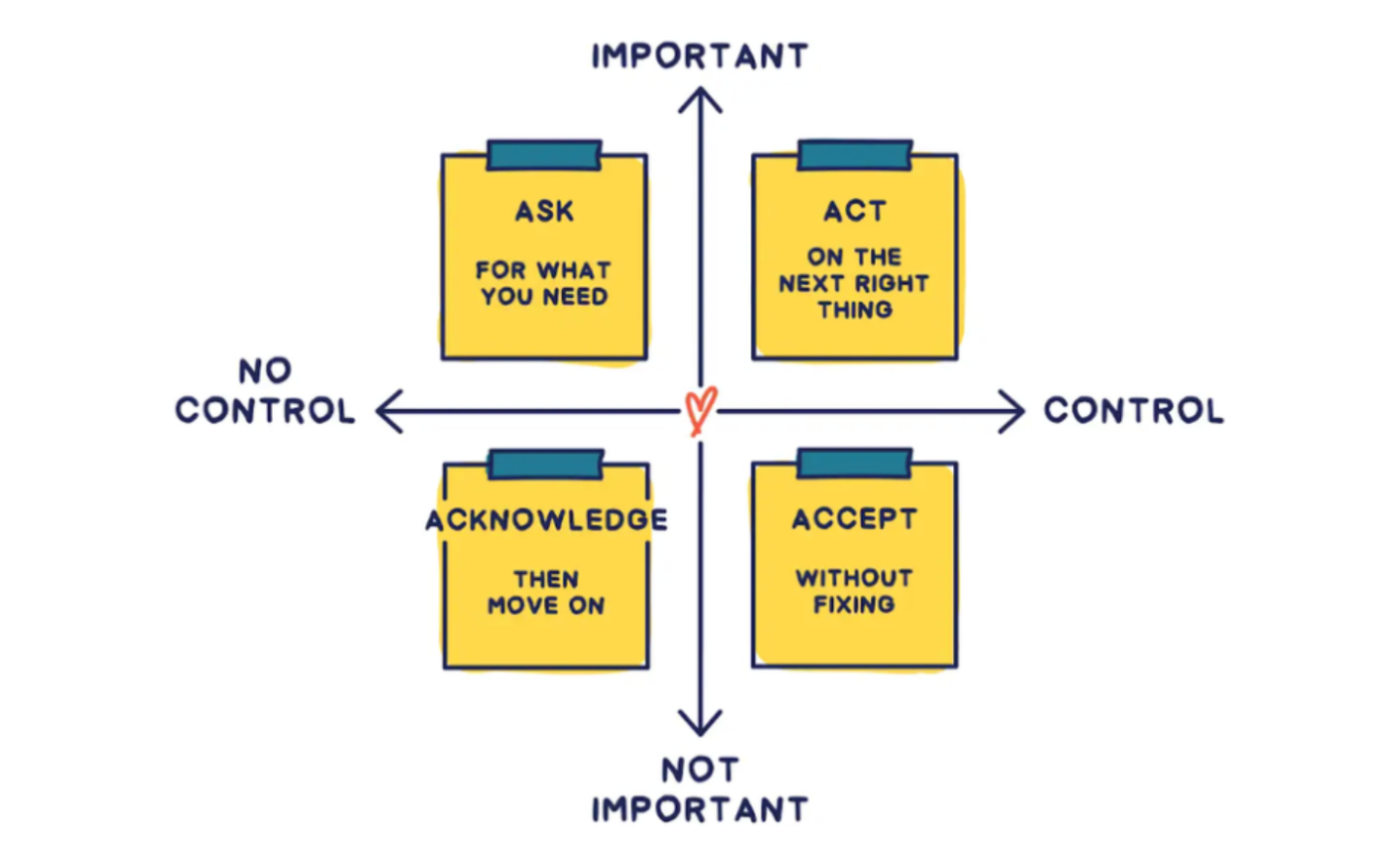
That’s where The Un-Stressing Method comes in. There are three simple steps:
- See stress differently.
It all starts with two questions that change everything: Is this important? and Do I have control over it? When you pause to name what really matters and release what’s not yours to carry, everything changes. Based on your answers to the two questions, you place the stressor in the appropriate quadrant of The Un-Stressing Matrix (see below). - Sort stress into five actionable categories.
Not all stress is created equal, and workplaces need to stop acting like it is. Research shows there are five distinct types of work stress: schedule, suspense, social, sudden, and system.
Each has its own behaviors, patterns, and solutions. A stressor can be more than one type, or even all five types. Identifying the type(s) of stress allows you to solve the root problem of stress, not just a symptom.
- Schedule stress is from having too much to do and not enough time. It’s the most common type of work stress.
- Suspense stress comes from waiting for what’s uncertain or looming.
- Social stress refers to tension in relationships and team dynamics.
- Sudden stress arrives unannounced and demands a response, such as an urgent request or a last-minute change. Of all five types, sudden stress is shown to have the most negative impact.
- System stress relates to structures, processes, and culture.
- Solve stress without spinning.
This is where we trade overthinking for doing. The matrix makes the next step visible without overthinking or analysis paralysis.
Celebrate the shift
The goal isn’t just less stress. It’s more joy. When you start using The Un-Stressing Method, you free up time, space, and energy — and that’s a shift worth celebrating.
Many people assume joy at work is something you feel after the stress is gone. But in reality, joy is already present. Stress simply makes it harder to see. In the national research study The State of Stress and Joy at Work, employees reported that three powerful drivers shape their experience of joy at work: meaning, mattering, and momentum.
People experience joy when their work feels meaningful. They feel it when their contributions matter to others. And they feel it when they can see progress in what they’re doing — when the effort they’re putting in is actually moving something forward.
But chronic stress crowds out those experiences. When the brain is overwhelmed, it becomes harder to notice progress, harder to feel connected to others, and harder to stay focused on what's most important.
When people experience more joy at work, the impact doesn’t stop at the office. It ripples outward — into families, friendships, and communities — shaping how we show up for the people and places that matter most.
That’s why what happens at work matters so much.
When employees learn how to see, sort, and solve stress more intentionally, something important begins to change. The mental space that stress once occupied starts to open up again: Focus returns, energy improves, work begins to feel more manageable — and more meaningful. And with it comes something many employees have been missing: less stress and more joy.
That’s the real shift. And for millions of employees heading into another Monday morning, that shift can change everything.
Amy Leneker is the founder and CEO of The Center for Joyful Work and author of Cheers to Monday: The Surprisingly Simple Method to Lead and Live with Less Stress and More Joy.