



For decades, American workplaces have rewarded a narrow version of leadership — one built around traits typically associated with masculinity. That may not always manifest in obvious ways, but it can be found in the everyday behaviors that get noticed, praised, and promoted. In meetings, that means speaking first, speaking often, sounding confident, and projecting charisma. The people who fit that mold most easily? Men.
Women, meanwhile, often get stuck with the “office housework”: note-taking, meeting follow-ups, emotional management, and relationship repair. In meetings, they're more likely to be interrupted, overlooked, or have their ideas “bropriated” — the term for when women's ideas are ignored when they first say them, then praised when a man repeats them. They're also often expected to project warmth and competence at the same time, while men get rewarded simply for sounding sure of themselves.
Companies have spent years saying they want to fix this. In 2025, U.S. organizations spent more than $102 billion on corporate training. By some estimates, roughly $7.5 billion a year goes to diversity, equity, and inclusion programs aimed at leveling the corporate playing field.
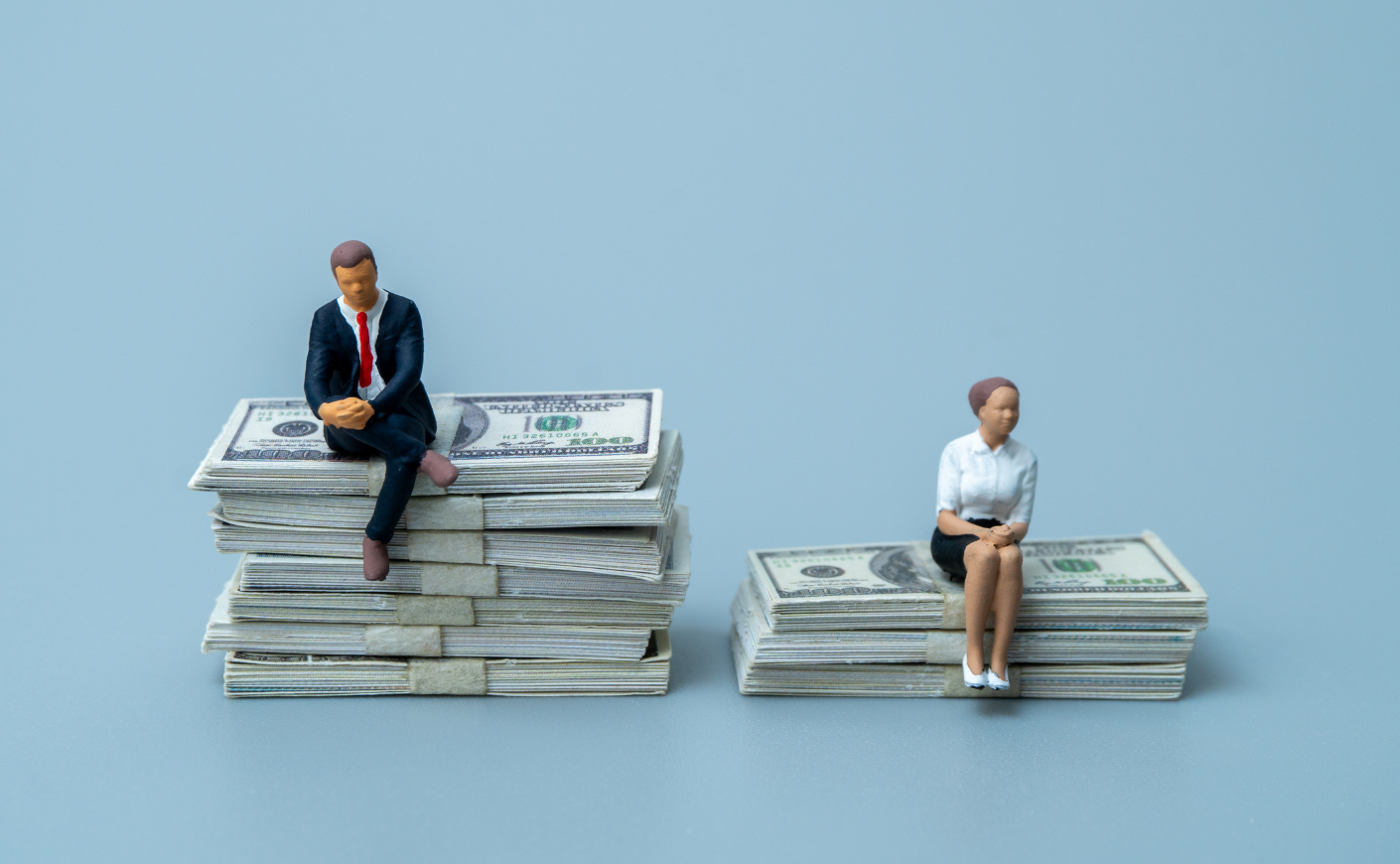
And still, the numbers remain bleak: Women make about 82 to 84 cents for every dollar men earn. They hold just 29 percent of C-suite roles, according to research by McKinsey.
Now, as many companies scale back those efforts and shovel more money — and a fair amount of wishful thinking — into AI, they're betting the technology will make work faster, leaner, and more efficient. It may. But it may end up doing something else, too: exposing the everyday power dynamics that companies have struggled to change for decades.
The meeting is a magnifying glass
If you want to understand how inequality festers inside organizations, watch what happens in meetings. That's where power gets negotiated, where ideas either move or die, and where leaders reveal whose judgment they trust.
They are also where a staggering amount of modern work now happens. Employees spend an average of 12.9 hours a week in meetings — according to data from the meeting notetaker and digital assistant Read AI — nearly a third of the workweek. Senior executives spend closer to half their working hours there. In the U.S. alone, meetings are estimated to cost more than $1.4 trillion a year in salaries alone.
And in those meetings, according to study after study, men tend to talk more, interrupt more, and exert more influence over group discussions and decisions. In many workplaces, men’s voices are still treated as authoritative on arrival, whereas women have to earn theirs.
To see how these dynamics play out at scale, I worked with Read AI to analyze opt-in, anonymized, and aggregated data from 159,870 meetings over a recent 60-day period. We measured who holds conversational power, drawing on talk time, talk speed, interruption patterns, non-inclusive language, lateness, and other behavioral signals.
We noticed an interesting phenomenon: In meetings where Read AI was recording, women contributed roughly 9 percent more airtime relative to their typical representation. We can’t say the presence of AI caused that shift, because we don't know what those same meetings would have looked like without it. But the pattern suggests that when the gendered meeting imbalance becomes more visible, it may also be harder to ignore.

Visibility can be help for gender equality — or harmful
AI might highlight the issues women face in meetings, by providing clear statistics on their airtime. The downside is that without intentionality, these AI tools can also reinforce longstanding inequality.
You can already see that happening in the collision between AI and return-to-office mandates. Both are landing in workplaces where old biases about visibility and credibility are still firmly in place.
The return-to-office push is about more than where people work. It's about who gets seen, who gets heard, and who gets taken seriously. Companies like Amazon, JPMorgan, Walmart, Ford, Dell, and Starbucks have all reportedly tightened office attendance. That hits women especially hard, since they're more likely than men to prefer hybrid or remote work, often for caregiving reasons. In workplaces that still reward proximity, that choice comes with career costs: less informal access to socializing, fewer opportunities to jump into conversations, and fewer opportunities to build trust with the people making decisions. It also can mean less time in which women are present for in-person meetings.
AI can help reduce some of that penalty. Digital transcription and record-keeping can preserve what remote employees contribute, making it easier for their ideas, comments, and follow-through to stay visible after the meeting ends. But these tools don't erase the advantage of being physically in the room. In fact, according to Read AI’s data, people in conference rooms still speak more than five times as much as people joining remotely.
So even when AI preserves the record, the people with the most presence in the room may still have the most power over what happens in it.
How AI rewrites the rules of visibility
AI doesn’t just change what gets seen in the moment. It also changes what gets documented afterward, and who gets credit.
We’ve all watched it happen: A woman proposes an idea, it gets brushed past, and 10 minutes later a man says the same thing — and suddenly it’s a great idea. While a meeting transcript won’t fix that on its own, it makes the pattern a lot harder to wave off. When there’s a record, it’s easier to see whose idea it was in the first place. And when you know your words aren’t going to vanish when the meeting is over, you’re more likely to speak up.
AI doesn't just help document work. It also helps offload it, but only if the human knows how to delegate. In my research with colleagues, one of the strongest predictors of early AI adoption was whether someone was already accustomed to delegating meaningful work to others before AI arrived. Men are more often allowed to hand off important work and still be seen as capable. Women are more often expected to prove competence the harder way: by doing the work themselves, visibly, thoroughly, and without mistakes.
That same pattern shows up in AI adoption. Just as men are more likely to apply for jobs when they meet only some of the listed qualifications, while women are more likely to hold back until they meet nearly all of them, men are often more likely to dive into AI tools before they feel fully ready. That's often framed as a confidence gap. More often, it's a penalty gap: Women have more reason to worry that if the tool fails — or if using it makes them look less capable — they'll pay a higher price.
The numbers already point in that direction. Large-scale studies find that women adopt AI tools at lower rates than men. For every 100 men using generative AI, only about 78 women do.
AI can certainly help reduce some of the hidden taxes women pay at work — by preserving credit, documenting contributions as part of a permanent record, and making patterns harder to dismiss. But it can also pile on new ones if women get judged more harshly for using AI, experimenting with it, or stumbling with it in public.
What's visible is more changeable
AI won’t rescue women from workplace inequality. But it may do something that decades of training, good intentions, and vague promises often have not: make the problem harder to dodge.
The taxes women pay at work have persisted because they’re easy to shrug off one by one. But drag them into the light and they become harder to ignore. AI isn’t going to eliminate bias but it can document it — and once something is documented, it becomes more difficult for leaders to look the other way.
Rebecca Hinds, PhD, is a leading expert on organizational behavior and the future of work and has spent a decade helping Fortune 500 companies tackle everything from meeting overload and hybrid work to the growing pains of AI adoption and organizational change. Her new book is Your Best Meeting Ever: 7 Principles for Designing Meetings That Get Things Done.