Your brain knows that flying is safe, but your heart starts racing before you’ve even boarded the plane. Or maybe one rough presentation leaves you dreading every time you have to speak at work. Knowing why you’re afraid — and why, exactly, your body is responding as if you're in a warzone, even when you're at Target — doesn’t always make the feeling go away. That gap between what you know and how you feel is part of what therapist Natalia Aíza addresses, via a treatment that many Americans have probably never heard of.
EMDR, short for eye movement desensitization and reprocessing, has been around since the late 1980s. It's often praised as a way of helping patients address traumatic experiences and memories from their pasts, but it can also be helpful for those coping with OCD, anxiety, or even phobias. A licensed professional counselor trained in EMDR, Natalia Aíza — who's also the author of the Self-Guided EMDR Workbook — uses the therapy to do just that. How does she address complex issues like panic disorder or the fear of flying via EMDR? We asked Aíza what actually happens during a session, how it can help us cope with the bonkers 24-hour news cycle, and why long-held "little-T traumas" can be overcome.
Katie Couric Media: Can you explain how EMDR works?
Natalia Aíza: EMDR was developed by Dr. Francine Shapiro, who observed that while she was going through one difficult event, her eyes were moving left and right as she looked at the leaves of a tree. She observed that this movement helped her nervous system settle down and helped her process the experience. From there, she developed her understanding of how bilateral stimulation works: rhythmic, alternating left-to-right stimulation that causes a person's brain to integrate difficult emotions in a more manageable way. Practitioners believe this is the central process that happens during REM sleep, when your eyes dart back and forth, and why we dream about hard experiences as a way for our brain to work through them.
Can you walk me through what happens during an EMDR session?
If you're doing EMDR with a therapist, you may do 10 to 12 sessions. There's a lot of preparatory work, visualizations, and grounding techniques to give you safety strategies for when you're bringing up a difficult memory. During the actual EMDR work, you're usually sitting in your therapist's office using one of three approaches. One is that you're looking left and right at a light rod or at various objects in the room, or following your therapist's finger back and forth. Another common approach is that the patient holds a buzzer in each hand, leaning back with their hands pretty far apart, and imagines the difficult memory — replaying it — while their hands buzz rhythmically, left and right. Another way is listening to tones coming from your left and right sides, which is best done with headphones. Regardless, your therapist is there, holding space and checking in: "What's coming up for you?"
What types of trauma can this practice address?
Almost any kind: People use it for dealing with memories from wars, sexual trauma, and abusive childhood experiences. I don't do that type of EMDR, because I'm an anxiety specialist: I work with the little-t traumas, like phobias. These anxieties form the basis of what we view as dangerous, anxiety-provoking, or problematic. If you had a stressful presentation at work, your body remembers that experience the next time you have to present, making it harder to do calmly.
My use of EMDR is focused on the stories you tell yourself that get in your way. Maybe someone thinks, I'm bad at presentations, or Nobody wants to talk to me at parties. Doing EMDR helps you let go of some of the raw feeling behind those statements — you replace the negative cognition with a positive one. So "I'm bad at presentations" could become an affirming statement like, "I struggle, but I get through it."

If I came to you and said, "I've been afraid of flying for years," where would you start?
You would be my typical client. With a fear of flying, there's usually a disconnect between the brain and the body. You might logically know it's completely safe, but your body experiences flying as dangerous. So I'd design an exposure hierarchy to provoke that feeling of fear in your body without you actually being on an airplane. For example, we'd watch videos with the sounds of being inside a plane or videos of turbulence. We'd activate your nervous system, then use bilateral stimulation to help your body stay with that uncomfortable feeling, process it, and release it. We'd also look at your formative experiences: We'd look at your earliest memory of feeling fear on a plane, then do EMDR for that memory.
Some people find EMDR more effective than traditional talk therapy. Why do you think that can be true?
Despite being a therapist, I'm not really a fan of talk therapy. I feel that it can be less effective than other forms, because it keeps us attached to our story. And if a patient tells a therapist about a terrible experience, the talk therapist doesn't have a lot of "moves" there. They're supposed to be client-centered — to validate and connect to your emotional experience. But often, emotions are based on distortions and unhelpful thoughts like, "I'm going to die in a plane." And we can't really connect to that emotion without accidentally reinforcing the belief.
Also, telling a difficult story can feel somewhat relieving, but it can also feel like reciting a series of events without getting to the root of your emotional and physical experience. Language is sometimes our coping mechanism. But trauma lives in our bodies.
How do things change after people receive treatment for a phobia, for example?
Let me use emetophobia, the fear of vomiting, which people come to talk about often. I do exposure to the sounds and smells — I keep an artificial smell of vomit in my office — and an EMDR exposure to their earliest memory of vomiting or the beginning of the phobia.
At first, these people can't even say the word "vomit." They can't watch news videos about norovirus being on the rise. To someone with a phobia, the trigger feels like life and death. But by the end of treatment, it can almost feel silly and light. They completely shift their stance toward it.
I've seen people online saying you can do EMDR on yourself. Are there risks around trying it without a trained therapist?
I would not want anyone to try EMDR on themselves for a big-T trauma, like a sexual assault. The emotional intensity may not be safe without somebody guiding you. But I believe most therapies are DIY-friendly, and I advocate for people to try them — that's partly what my book is about. Not because I don't believe in therapy, but because it's not affordable or geographically accessible for so many people. If there's a way to make treatment self-guided, let's find it, because we're not meeting society's needs as is.
Given how scary the news can be right now, this seems well-timed.
Thanks to social media algorithms, we can get inundated with our fear "story" and different versions of it, whenever we click on a topic. Our brains get drawn to exciting stories, and our nervous systems feel like, Oh, I have to read about this dangerous thing, so I can keep myself safe from it. It's so important to figure out how to read and digest the news in a way that doesn't disrupt your nervous system — for all of us.
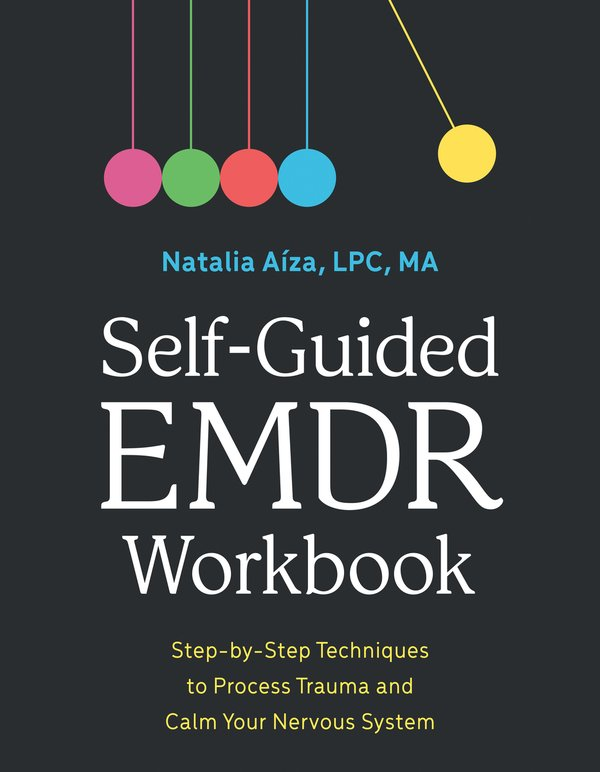
The Self-Guided EMDR Workbook is available now: