






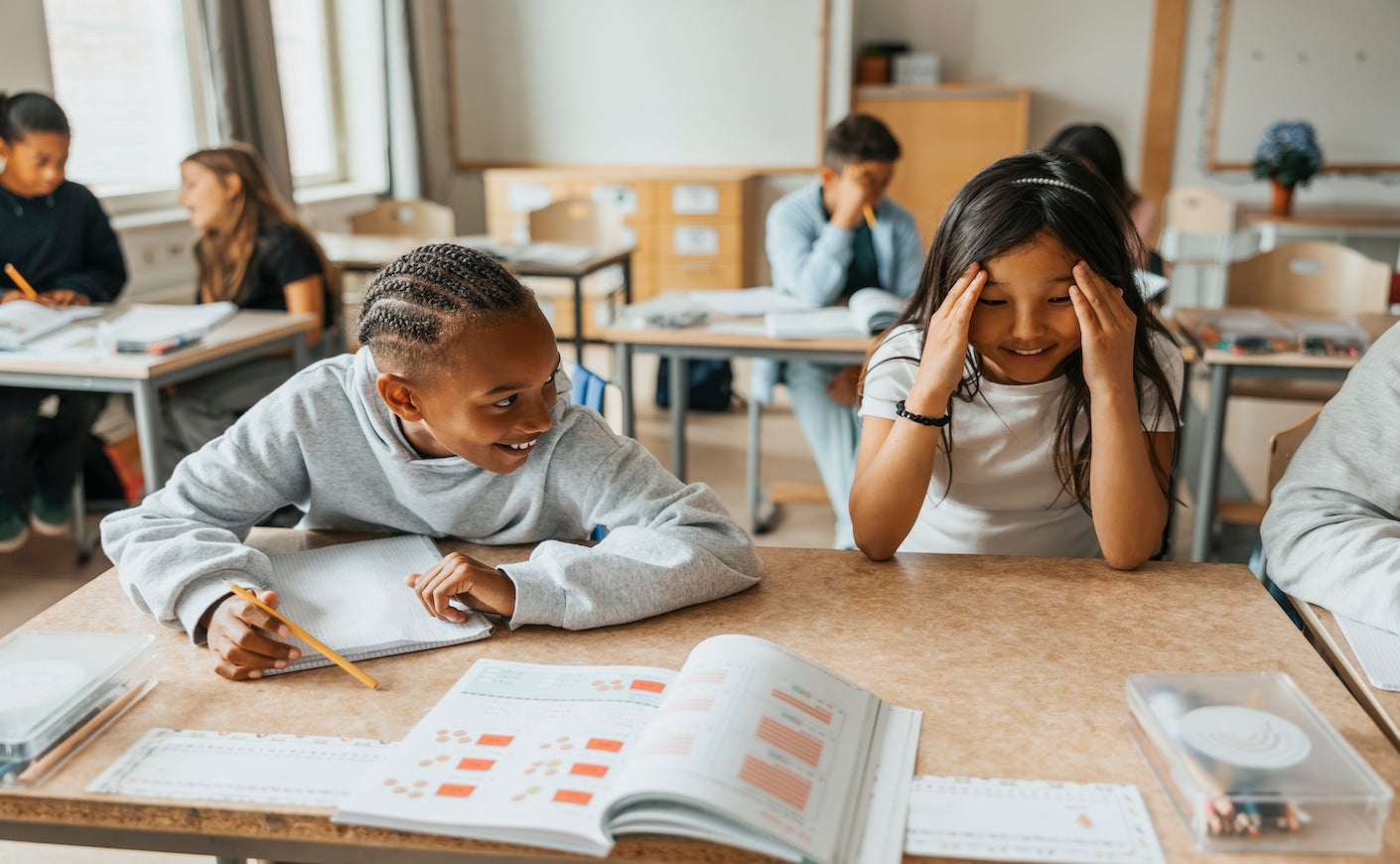
In the United States, mental health challenges affect millions of school-age children. According to the CDC, approximately 11 percent of children ages 3 to 17 had a current anxiety diagnosis in 2023–2024, while 4 percent had depression and 8 percent had a behavioral disorder.
The challenges are particularly pronounced among teenagers. In 2023, 40 percent of U.S. high school students reported persistent feelings of sadness or hopelessness, including 53 percent of girls.
While home life, friends, social media, and body image all have an impact on the mental health of children, school itself can also be a source of unhappiness. Yet a growing body of research from around the world shows that schools can actually help children lead happier lives — if they value such outcomes.
Under pressure
Many education systems around the world — including the U.S. — are geared toward competition. International rankings such as OECD’s Programme for International Student Assessment (PISA) rate the performance of education systems, placing pressure on administrators, teachers and pupils. As a result, schools seem to value the academic achievement of students over their mental health and well-being, which is reflected not only in the way students are taught, but also in how they are assessed.
Teachers also face a lot of pressure to ensure their students obtain the highest grades possible. This is also contributing to poor mental health among teachers, with many developing mental health problems such as burnout, which negatively impacts their performance and can ultimately lead them to quit the profession.
While many U.S. schools have introduced social-emotional learning and mental health initiatives, all too often, academic demands on pupils provoke a sense of rivalry, rather than teaching them how to enjoy life and cultivate positive emotions. Yet educational performance does not need to come at the cost of children’s happiness and well-being.

Education systems have the capacity to respond to the growing mental health crisis among children. And research shows that promoting mental health and well-being in schools, on a par with core skills such as maths and literacy, has a positive impact on the self-esteem, academic achievement, social relations, motivation and career prospects of pupils.
The Nordic way
To see how schools can teach pupils to be happy, consider the education systems of some of the happiest countries in the world. For instance, Nordic countries consistently rank among the happiest in the World Happiness Report, with Finland and Denmark regularly near the top.
It’s well known that Nordic countries place a greater emphasis on social-emotional learning, which gives children the skills and knowledge to recognize and manage emotions effectively. This forms the basis of well-being and can significantly improve academic achievement among students.
In Denmark, schools have a longstanding tradition known as klassens tid, or “class time,” in which children discuss problems, resolve conflicts, and learn to understand one another’s perspectives. According to Denmark’s Ministry of Education, schools should generally set aside about one lesson a week for these activities. While it’s sometimes described as a mandatory empathy class, it’s not a separate required subject with a standardized national curriculum.
Nordic countries also value the judgments of teachers over national examinations, and schools are not rated or ranked as they are in the UK or U.S. This prevents the education system from placing needless pressure on schools, leading to less rivalry, stress and anxiety among students, and lower rates of burnout among teachers.
Finding happiness
When it comes to being healthy and happy, research suggests that money only matters to a certain extent. What matters most is developing self-knowledge — that is, knowing how you think, behave, and manage your own emotions — and positive social relationships. This is evident in some Latin American countries. For example, Costa Rica and Mexico have performed well on international measures of happiness and well-being, including the Happy Planet Index.
These nations have a culture of promoting social networks of friends, families, and neighborhoods. Despite living on the most unequal continent in the world, research indicates that Latin American people are extremely resilient, meaning they have the ability to successfully overcome adversity and enjoy life in spite of difficult circumstances.
According to recent UN reports, schools in Latin America are also doing a good job in promoting resilience among children. Environmental sustainability is also a key part of education policies in places like Costa Rica. This promotes empathy toward other members of society — a core skill of social-emotional learning.
My own research has found that education systems in both developing and developed countries value forming responsible citizens through valuing equality, harmony, and diversity, among others. Yet none of the countries included in the analysis — China, England, Mexico, and Spain — seem to place an explicit value on mental health in their education systems.
Research in the U.S. also points to the importance of these relationships. A CDC analysis found that 22 percent of high school students who felt connected to people at school reported poor mental health, compared with 40 percent of those who felt less connected.
Education systems around the world can tackle the mental health crisis among children — if they set out to do so. And countries that prioritize children’s happiness and well-being offer a strong starting point. By promoting positive relationships over rivalry, and learning over league tables, children around the world can be given the chance to flourish.
Angel Urbina-Garcia, Assistant Professor in Early Childhood Studies, University of Hull
This article is republished from The Conversation under a Creative Commons license. Read the original article.
