



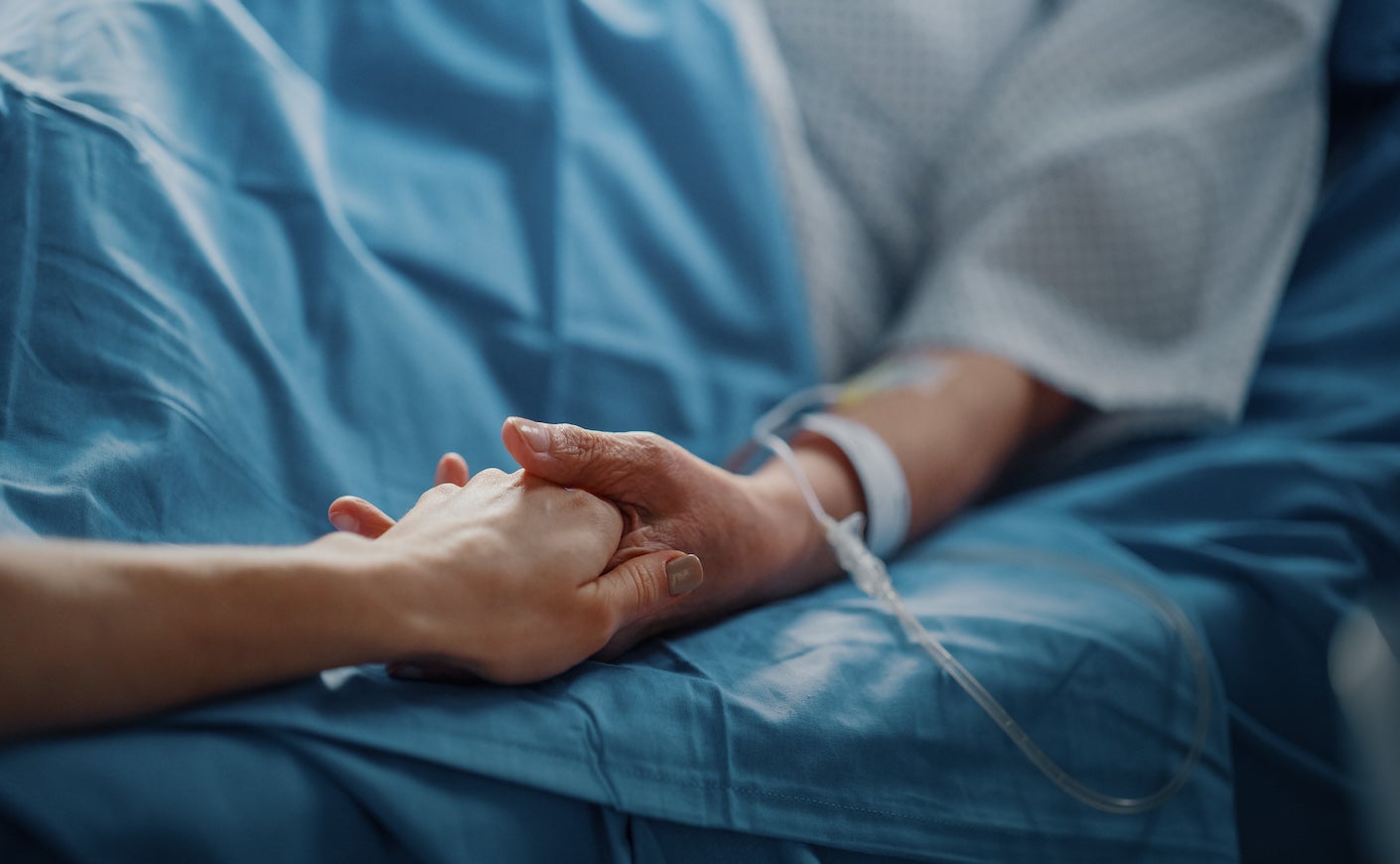
When my husband, Conrado, was lying in a coma after a catastrophic accident, one of my closest childhood friends came to visit him in intensive care. And she proposed having a threesome.
I'll back up: We are Argentine, but by then we had been living in New York for years, raising our two children. We had gone back to Argentina, as we did every winter, to ski in the mountain town where I had spent my childhood vacations. But instead of flying home at the end of the trip, I suddenly found myself in the nearest major city of Buenos Aires, with my husband unconscious in an ICU, our children temporarily enrolled in my old school, and our entire American life suspended thousands of miles away.
Conrado had been skiing in Bariloche, in the Argentine Patagonia, when he lost control on a sheet of ice and began tumbling down the mountainside. His helmet came off, and he struck a rock, suffering a severe traumatic brain injury with diffuse axonal damage. On the Glasgow Coma Scale, he scored a three — the lowest possible score. Doctors warned me that even if he survived, the chances of meaningful recovery were frighteningly small.
That was when my childhood friend Marina appeared.
Marina is spectacularly beautiful — blonde, voluptuous, and glamorous in the old-fashioned sense — the sort of woman my family refers to as the Brigitte Bardot of the Americas. She had recently returned from Provence several pounds heavier — most of them, she informed me, concentrated in her breasts — and decided this new development might have medical applications.
Her proposal was straightforward: She would put Conrado’s head between her breasts while I was in charge of the oral sex. Surely, she reasoned, if anything could wake my husband from a coma, it was the prospect of a ménage à trois — even in what had to be one of the least erotic settings imaginable. Her own husband — French, decadent, beloved — had, of course, already given his blessing.

This is the first thing nobody tells you about having a spouse in a coma: You become receptive to ideas you would previously have classified as insane.
By then, I had heard every method under the sun for waking up a coma patient. Music. Prayer. Familiar voices. Favorite songs. Family recordings. Elaborate theories involving memories, smells, and sounds. We were living in that terrifying borderland between medicine and miracle, where you will listen seriously to almost anybody who begins a sentence with, “I knew someone who…”
And Conrado had always liked sex. So for a brief moment, Operation Arousal seemed no more ridiculous than anything else. We only abandoned the plan when another friend pointed out that the ICU was separated from the nurses’ station by glass and monitored by cameras from several angles. Doctors, guards, and, because this was a Catholic hospital in Buenos Aires, quite possibly nuns would have had excellent seats.
The three of us laughed so hard at the realization that, for a moment, the ventilators, alarms, and pumps disappeared. That laughter taught me something else nobody tells you: Horror does not cancel out humor.
Sometimes humor is the only thing that allows you to reenter ordinary life, if only for 30 seconds. There is an expectation that catastrophe transforms you into a different species. The Wife of the Man in the Coma should presumably become grave, wise, and interested in meditation.
People recommended yoga. They recommended mindfulness, a more spiritual life. They recommended — at the very least — long walks in which I could contemplate my new reality. But what I needed, for brief moments at least, was the opposite: somewhere my mind could stop circling the hospital, the prognosis, the children, the insurance, the next decision. I needed short intervals of normality to gather enough strength to go back and face it all again. I wanted to play tennis.
Several weeks after the accident, when nobody could tell me whether he would walk, speak, or even be recognizably himself again, I began slipping out to play matches all over Buenos Aires.
I dug an ancient Fischer racket out of my parents’ closet and had it restrung and regripped in neon. I needed energy from somewhere.
Tennis lessons did not work because my mind wandered back to MRIs, insurance companies, hospital machinery. Matches did. For the length of a point, only the ball mattered. Where was it going? Could I reach it? Was it in or out?
One afternoon an opponent angrily challenged one of my line calls. Everyone else had been treating me like porcelain because I was “the woman whose husband is in a coma.” This woman was furious with me over a tennis ball. I could have kissed her: For a few minutes, I had an ordinary problem.
Books did something similar. I read compulsively: Joan Didion, novels, academic books, mysteries, books about sex, books about tennis, anything capable of taking me somewhere outside the hospital. I did not necessarily need literature to reveal profound truths. Sometimes I needed it simply to get me through the next 20 minutes.
What surprised me most was the discovery that beneath the terror, I was still there. I still liked books. I still laughed at inappropriate jokes. I still cared whether a ball had landed two inches outside the line. Caregiving can swallow your identity so completely that recognizing yourself becomes an act of survival.
There was another thing nobody had warned me about: When your partner suddenly disappears from ordinary life, other people begin occupying pieces of the enormous space he or she has left behind.
Conrado and I had been married for almost 20 years. Suddenly I was making decisions alone about our children, hospitals, money, schools, insurance, medical flights, two countries, and a future I could not imagine. But “alone” turned out to be a misleading word.
Friends flew across continents. My children’s temporary school in Buenos Aires produced uniforms, birthday invitations, and sports equipment, and told me my only job was to take care of Conrado. His colleagues battled the insurance company. Other families in the ICU waiting room taught me the unwritten rules of hospital life. Friends organized prayers. Doctors gave their cell-phone numbers. People I barely knew offered apartments, contacts, meals, rides, expertise. Years later, Conrado would say that if anything miraculous happened in his recovery, it was that the miracle acted through people.
I came to think that the familiar expression “it takes a village” applies not only to raising children. Sometimes it takes a village to keep an entire family that has been shattered upright.
And then Conrado survived. He woke up and began the long process of rebuilding his life. We moved back to New York. Slowly, almost imperceptibly, things began to feel less provisional. There were schools and work and dinners and ordinary problems again; the future, which for so long had seemed impossible to picture, started to look like something we might actually have.
But less than two years after Conrado’s accident, just when I had stopped expecting catastrophe around every corner, my mother went into a coma — septic shock. She was thousands of miles away in Buenos Aires. Apparently, tragedy does not consult your file to check whether you have already fulfilled your quota. By then, absurdly, I had expertise.
My mother eventually recovered, too. Conrado returned to his office, to swimming, to our children, to me. There is nothing typical about those outcomes; we were extraordinarily lucky.
But the years around his accident taught me something I wish I had known at the beginning. A catastrophic illness does not arrive with the dignity or narrative coherence we assign it afterward.
It is terrifying, but also administrative and boring and occasionally hilarious. You can be devastated and worry about your backhand. You can lose your partner and discover 100 people holding up pieces of your life. You can think you have disappeared entirely into somebody else’s medical emergency and then, suddenly, recognize yourself in a book, a joke, or a yellow ball coming across a net.
I wrote my memoir Downhill because, once Conrado was well enough for us to look backward, and my mother was relatively stable, those were the parts I kept wanting to explain. Not how to survive a coma — or two. But how, strangely, messily, humanly, life keeps happening while you do.
Juana Libedinsky is the author of DOWNHILL: A Memoir of an Accident, Two Comas, Many Books and Starting Over. Follow her on Instagram and Facebook: @jlibedinsky