






If you already tend to pile your plate with produce, you probably think you’re covering your nutritional bases. After all, if you’re following standard dietary guidelines by eating your recommended daily servings of fruit and vegetables, it’s natural to assume you’re getting all the bioactive compounds your body needs. But new research is challenging that assumption — at least when it comes to the specific, heart-protective plant compounds known as flavanols. In fact, this eye-opening study revealed that fewer than one in four adults who successfully meet daily fruit and vegetable guidelines are actually reaching the 500 mg daily flavanol threshold associated with better circulation — and improved heart and brain health.
What are flavanols, and how much do I need?
Flavanols are naturally occurring compounds found in foods and drinks such as tea, cocoa, apples, pinto beans, grapes, and some berries, and research shows that they support cardiovascular health by allowing blood vessels to function properly.
A study published in the journal Food & Function** set out to answer a simple question: If you’re already eating the amount of fruits and veggies recommended by national dietary guidelines, are you automatically consuming the levels of flavanols that have been studied for heart-health benefits?
Rather than relying solely on food diaries or self-reported eating habits, which can be imprecise, researchers analyzed data from two cohorts totaling more than 30,000 participants. They used validated urine biomarkers to objectively estimate flavanol intake, in order to gain a more accurate measure of exposure to these compounds.
The benchmark that researchers examined was 500 milligrams of flavanols per day, which is the daily level used in COSMOS, a large five-year randomized clinical trial that followed more than 21,000 older adults. The new analysis found that even among participants with the highest fruit and veggie intake — including those meeting or exceeding national recommendations — fewer than one in four reached 500 milligrams of flavanols per day. Among the broader study population, fewer than one in five did. In 2022, an expert panel convened by the Academy of Nutrition and Dietetics recommended 400 to 600 milligrams of flavanols per day for potential cardiometabolic health, a range many never reach through diet alone.
The researchers also modeled diets using the most commonly consumed produce, such as apples, tomatoes, and carrots. Their findings suggest that those simply eating five servings of these fiber-rich foods may not reliably reach the 500-milligram threshold, in part because plant foods contain varying amounts of flavanols.
Why it's tough to get enough flavanols from food alone
Part of the issue with consuming the right amount of flavanols comes down to chemistry: These delicate compounds don’t always survive modern food processing methods. For example, in cocoa, fermentation and roasting can reduce flavanol levels, while heavy alkalization has been shown to remove most of its naturally occurring flavanols. The amount of these compounds in a cocoa product, therefore, can vary substantially depending on how the plant was grown and processed.
The study’s authors also note that the flavanol content of an everyday food, such as an apple, can differ dramatically depending on the variety, growing conditions, and even the climate of that season. So two people eating what looks like a similar “healthy” diet could end up with very different flavanol intakes without realizing it.
The difference between essential nutrients and bioactives
The researchers from the study and a growing number of nutrition scientists draw an interesting distinction: the difference between essential nutrients and bioactives.
Essential vitamins and minerals (think: vitamin C and iron) follow a deficiency model. You need a baseline amount to prevent illness, and a balanced diet is generally excellent at delivering that. Bioactives such as flavanols work differently. They aren’t considered essential nutrients, meaning there’s no recognized flavanol deficiency. But research increasingly suggests that they play an active role in optimizing how well your body functions, particularly by supporting healthy blood flow and circulation.
Because bioactives aren’t evenly distributed throughout the food supply — and their levels can vary based on the food itself and how it’s processed — even people who eat a generally healthy diet may not consistently consume the amounts tested in clinical research.
A simple way to achieve optimal daily flavanol levels
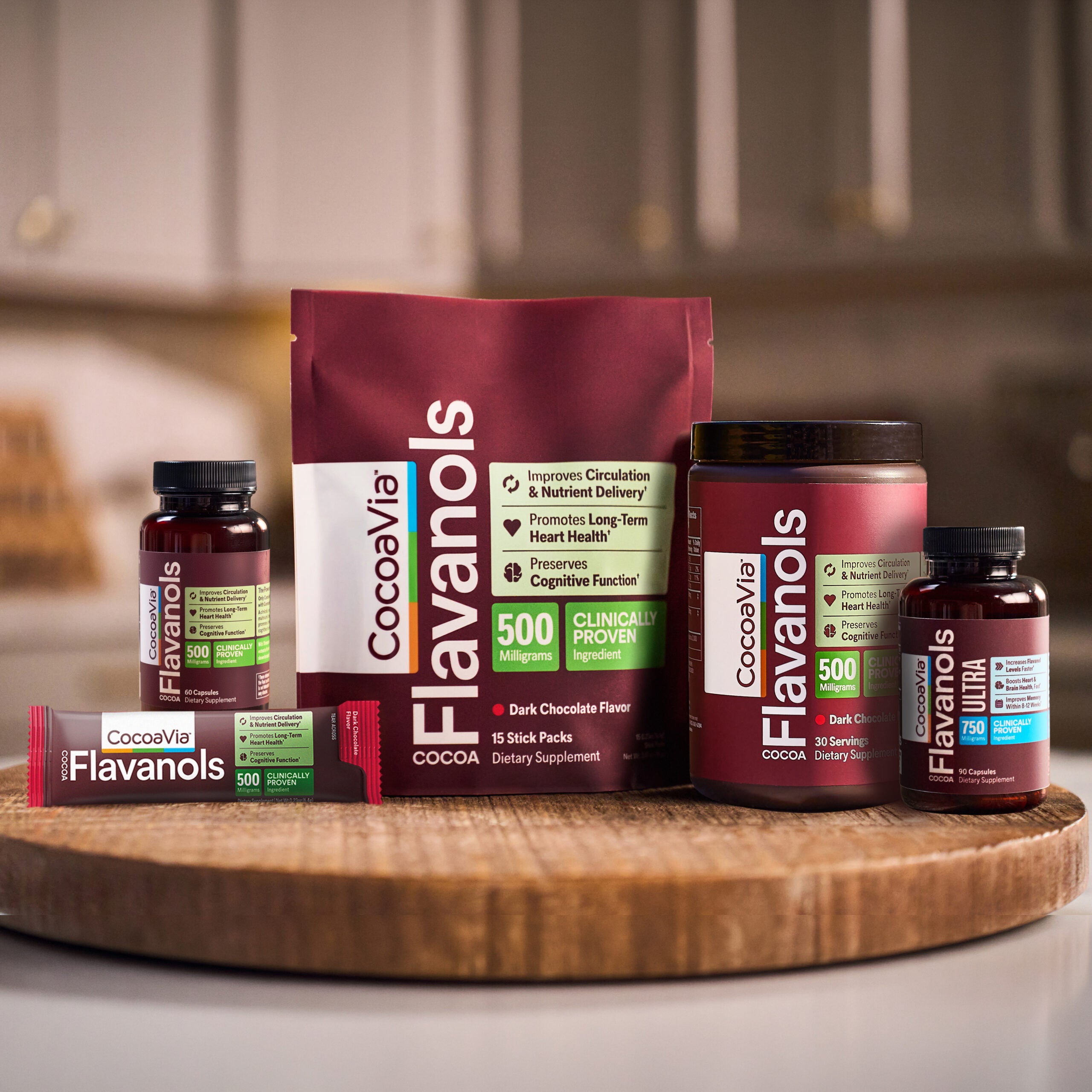
For people who want the heart and brain-health benefits of flavanols without trying to calculate the levels in individual foods, a standardized cocoa flavanol supplement offers an easy solution. That’s the idea behind CocoaVia, which uses the same Cocoapro™ cocoa extract studied in the COSMOS trial to deliver precise, consistent flavanol levels.
CocoaVia’s core 500-milligram formula — available in capsules, powder, and convenient stick packs — mirrors the exact level shown to support heart health. For those looking to go further, CocoaVia also offers a 750-milligram Ultra capsule. This level was studied in Columbia University-led research on cognitive aging, which showed it supported three types of memory — word recall, spatial memory, and long-term memory — in as few as eight to 12 weeks.
None of this is a reason to eat fewer healthy foods (a produce-rich plate is still doing plenty of good for your health in ways that have nothing to do with flavanols). But if you’re specifically interested in the potential cardiovascular benefits associated with these compounds, the new research highlights an important nuance: Eating a healthy diet and consistently consuming the amounts of flavanols studied in clinical research aren’t necessarily the same thing.
Closing that gap may require paying closer attention to flavanol-rich foods — or considering a source, like CocoaVia, that provides a standardized amount in an easy-to-take formula. Either way, you certainly shouldn't stop eating fruits and vegetables — but if you're looking to increase your levels of heart-healthy flavanols, it may take more than adding another serving of broccoli to your dinner.
Reach Your Flavanol Goals
CocoaVia
For a limited time, you can enjoy an extra 20 percent off single, bulk, or subscription purchases of CocoaVia. Just use promo code KCM2026 at checkout.*
These statements have not been evaluated by the Food and Drug Administration. This product is not intended to diagnose, treat, cure, or prevent any disease.
*This offer is valid until December 31, 2026, on any single, bulk, or subscription order of CocoaVia products sold at cocoavia.com; Limited to one use per e-mail.
** Ottaviani JIa, Erdman JWb, Steinberg FMc, Manson JEd, Sesso HDe, Schroeter Ha, Kuhnle GGCf. “Adhering to dietary guidelines does not yield flavanol intake levels associated with beneficial cardiovascular effects.” Food Funct, 17(12):5715-5725, 22 Jun 2026.
aMars Food & Nutrition, a segment of Mars, Inc., McLean, VA 22101, USA, bDepartment of Food Science and Human Nutrition, University of Illinois at Urbana-Champaign, Urbana-Champaign, IL, USA, cDepartment of Nutrition, University of California Davis, Davis, CA 95616, USA; dDivision of Preventive Medicine, Department of Medicine, Brigham and Women’s Hospital and Harvard Medical School, 900 Commonwealth Ave East, Boston, MA, USA; eDepartment of Epidemiology, Harvard T. H. Chan School of Public Health, Boston, MA, USA; fDepartment of Food and Nutritional Sciences, University of Reading, Whiteknights, Reading RG6 6AP, UK
