






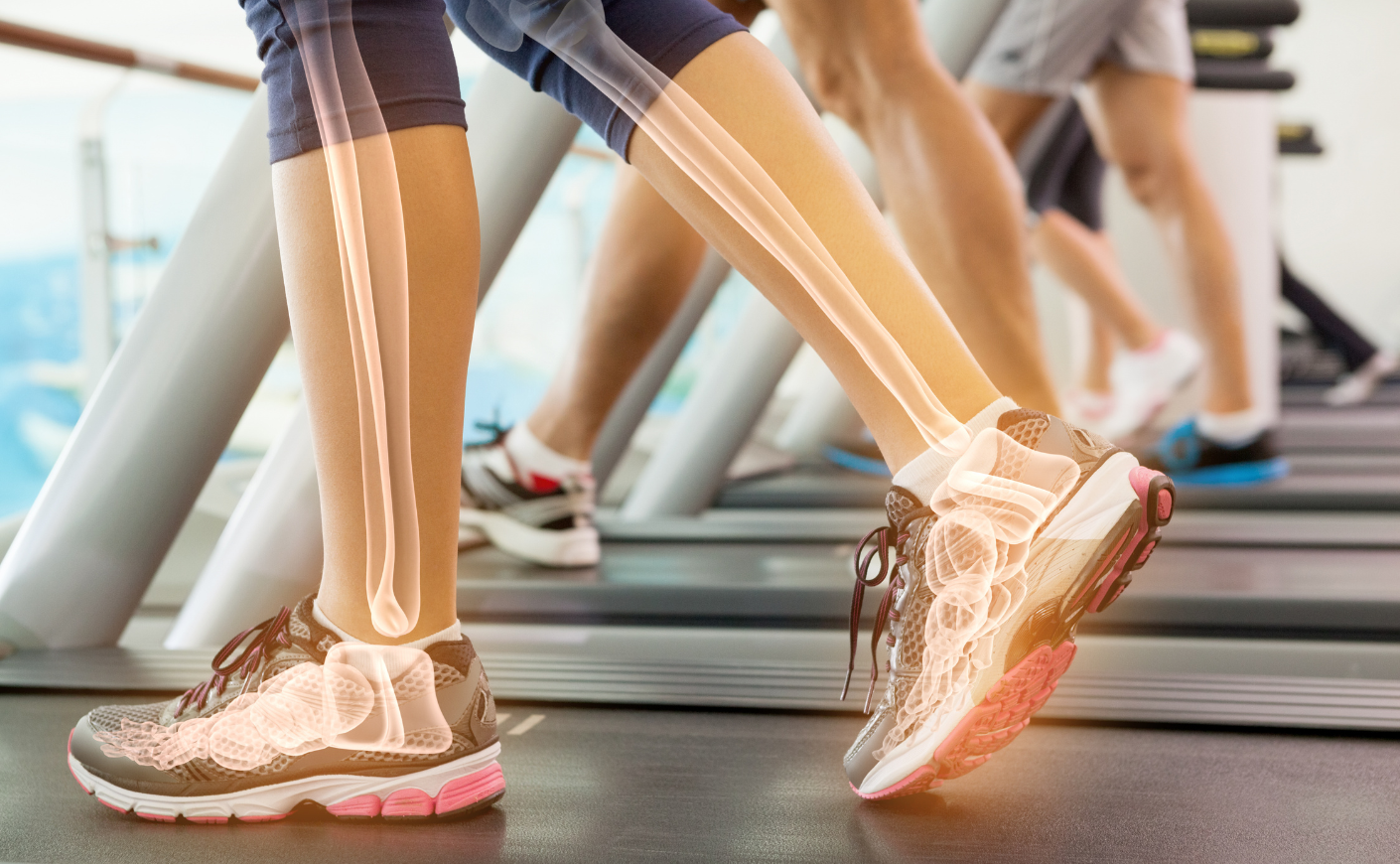
Physical activity is one factor we can leverage to our advantage. We influence our bone health by how we move — or don’t move.
Like muscle, bone is a use-it-or-lose-it tissue. The more our movement stresses our skeleton, the more the body reacts by making our bones stronger and denser. Increased loading on a bone will lead to increased bone density, while decreased loading will result in bone loss.
But not all movements stress the bones equally. This is something professor Belinda Beck, who has conducted bone research for over 20 years, emphasizes. All types of physical activity are good and valid, but not all types of physical activity are equal when it comes to maintaining and building bone. We need to be savvy in incorporating exercise that puts enough stress on the skeleton to stimulate bone growth. Pilates, swimming, cycling, light weight training that is never progressed — I love you, and I respect you, but you do not cut it.
So what should we do? Since there’s never been a study conducted with sufficient statistical power and duration to answer this, we cannot provide definitive guidelines for the precise amount, intensity, and duration of every exercise to stimulate optimal gains in bone for every individual. Overall, though, randomized controlled trials and meta-analyses indicate that two types of physical activity are best for building bone: resistance training and certain types of weight-bearing exercise with impact.
Resistance training
Resistance training is when we move our muscles against some kind of external resistance, which can be something of a buy one, get one free deal for our bones, too. The same progressive training you’re undertaking to build muscle, strength, and power can also boost your bones and aid in fall prevention. And that’s super important because fractures tend to happen when someone falls. If we can leverage resistance training to keep us strong and less likely to fall, it’s a win-win.
The potential of bone to adapt when the stimulus to change is right is pretty remarkable, and the Lifting Intervention for Training Muscle and Osteoporosis Rehabilitation (LIFTMOR) trial — on which Beck was one of the researchers — illustrates it brilliantly. The purpose of this randomized control trial was to monitor brief, supervised, high-impact resistance and impact training (HiRIT) comprising heavy compound lifts and jumps in postmenopausal women with low or very low bone mass and determine its efficacy.
This is a groundbreaking study that showed us that bone can continue to respond even when osteoporosis is present if the stimulus is right. It’s never too late.
We do need to be careful about what this study cannot tell us. There was no moderate-load resistance training group for comparison, so we cannot say that only heavy lifting is effective. Nor can we say whether it was the heavy lifting, jumps, or the combination of the two which made the difference. What we can say is that supervised, progressive resistance and impact training proved safe and effective for this population — something many women (and some clinicians) still assume isn’t possible. (Please bear in mind that the LIFTMOR trial was carried out under close supervision. If you have osteoporosis, do not embark on a training plan without professional guidance and support.)
Every woman needs to know about this! It’s even more impetus for us to get lifting. If lifting heavy combined with jump landings after the onset of osteoporosis can essentially reverse it, it’s a logical conclusion that starting before the onset may prevent or protect against it — and will be more accessible and less risky.
In fact, before I got into lifting, I used to regard it as risky. Now I believe that not lifting is a much bigger risk. Women, please do not avoid lifting weights because you’re worried about injuring yourself. Worry about falling and fracturing your hip in your seventies having not lifted weights because you were worried about injuring yourself.
Certain types of weight-bearing exercise with impact
We are weight-bearing whenever we are on our feet.
When we talk about impact, we’re referring to putting extra force on your joints and bones during movement. Activities like jogging, running, skipping rope, dancing, and playing sports like tennis are all considered impact activities. Unsurprisingly, high-impact exercises apply more force to your joints than low-impact exercises. The higher the impact, the greater the stress — and remember, our bones need to be exposed to stress in order to get the memo to adapt.
Walking for bone health?
Depending on your baseline, walking may provide enough stimulus for the first few weeks or months, particularly if you were previously very sedentary. Beyond that, though, according to Beck, walking is not enough for bone health. Despite the benefits of regular walking on aerobic fitness, simply walking in isolation is insufficient to optimize bone health and has little or no effect on other fall- and fracture-related risk factors such as muscle mass, strength, and balance in post-menopausal women.
I love walking, and I don’t intend to stop — it’s an important form of movement. But I know that my bones need more. Yours do, too.
Running for bone health?
My fellow runners, I’ve got some important news for you, as well. Beck told me that running, done well and with efficient form, is fairly low-impact and therefore — like walking — not enough stimulus for our bones. So, again, we are not saying running is bad or that you should stop running — absolutely not. But if you are a keen runner and you are considering your bone health box ticked, know that you probably need more. Bones need higher impact and multidirectional loading, not the same pattern again and again and again.
Plyometrics and jump training for bone health?
True plyometrics are characterized by explosive muscle extension and contraction using a quick eccentric motion (the part of a movement where the muscles lengthen) followed immediately by a quick concentric contraction (the part of a movement where the muscles shorten). The quick transition from the eccentric to the concentric phase is known as the stretch-shortening cycle.
A typical example of a plyometric exercise could be stepping off a small platform, quickly absorbing the landing, and then immediately jumping; there’s quick eccentric loading and minimal ground contact time. That reactive tendon quality, the ability to react to the impact with the ground, is a hallmark of plyometric training. Other examples involve various types of hopping and bounding, including jumping rope, where rebound from the ground is rapid.
Now, I want you to take a moment to ponder when you last jumped. Children incorporate jumping into their day-to-day life so intuitively. As adults, unless we specifically and intentionally incorporate some kind of jumping into our exercise programs, it seems to get phased out altogether. Often, we then come to fear it. Plyometrics and jumps are a way of bringing this kind of impact loading back into your life.
Perhaps most importantly, plyometrics and jump training can help us to improve coordination and to develop rapid force production. On a practical level, this is crucial in situations when balance needs to be corrected quickly — for example, after tripping. A recent systematic review found plyometric training to be a feasible and safe training option with potential for improving various performance outcomes in older people. As the researchers nicely put it, “If increasing or maintaining rapid force production and power output of the lower limbs can help to maintain independence and decrease the fear or risk of falling, plyometric training may help maintain or increase one’s quality of life.”
If you don’t currently have an established training habit and are new to plyometrics and jump training, my advice would be to focus on a phase of consistent, progressive, full-body resistance training for at least eight to 12 weeks first. When you do begin to add in plyometrics or jump training, start modestly. For example, you could pick two different exercises (e.g., lateral hops and broad jumps) and do two sets of them once a week. By starting small in this way, you can see how your body responds to a small dose before increasing. Quality trumps quantity.
You now have all the information you need. Go forth, spread the good word, and apply it. Seriously — tell your friends! Imagine groups of women of all ages catching up over lunch and chatting together about how they are safeguarding their bone health instead of swapping tips on thinness and weight loss. Let’s start a revolution.
Excerpted from Training for Your Old Lady Body by Elizabeth Davies. Published by Chronicle Books. Copyright © 2026 by Elizabeth Davies
