


We’ve all seen the social media scroll delivering an endless repertoire of "booty band" routines designed to sculpt and shape. You’ll watch a fitness influencer pumping and squeezing away, quietly implying that the booty blaster band they happen to be selling is the secret behind their impressive physique.
Let’s be clear: I’m not here to completely bash mini-bands. They have their place for lateral hip activation, joint pre-hab, and dialing up the neuromuscular connection. But if your actual goal is to grow your glutes and build true lower-body strength, bands aren't going to cut it. You have to load hip extension with a meaningful, progressive stimulus.
That means stepping away from endless isolation fluff — side-lying kickbacks, abduction machine supersets, and banded monster walks — and locking in on compound movements that force the glutes to do what they were actually designed to do: extend the hip under a heavy load.
Setting the stage: The ribcage and pelvis
Before diving into the iron, we have to address a missing link in lower-body training: the stack.
To facilitate true hip flexion and extension, you must establish and maintain an ideal position in which your ribcage and pelvis stay stacked directly on top of each other. This requires active core stabilization so that your hip extension comes entirely from the hip joint, rather than through compensation at the lower back. A stacked torso also lets you create a true intra-abdominal brace throughout the lift.
If you can’t keep your pelvis and ribcage stacked, your lower back will inevitably extend. This lengthens the abdominals, downregulates core tension, robs you of power output through the hips, and leaves you with an achy lower back.
Pre-requisite stability staples: Master the dead bug, bird dog, and stability ball plank. The unifying goal of all three is resisting lumbar extension — the exact challenge your core will face during every heavy lower-body movement that follows.
The exercises
1. Kettlebell Romanian deadlift
Primary targets: Hamstrings and glutes
Execution: Take a hip-width stance with a kettlebell held tightly against the front of your body between your legs. Tuck your chin slightly to help keep your ribs down and your core braced. Set your shoulders by actively reaching them down while squeezing your upper arms into your lats. From here, push your hips straight back. Allow your knees to bend naturally as your hips travel backward. Once your hips stop moving backward, you’ve hit your end range of motion — do not force extra depth by rounding your lower back. Drive your hips forward to return to the start.
Why it works: Unlike standard deadlifts pulled from the floor, Romanian deadlifts keep constant tension on the hamstrings and the glutes. Using a kettlebell keeps the load locked close to your center of mass, reducing shear stress on the lower back while teaching you how to master the hip hinge pattern.
2. Dumbbell step-up
Primary targets: Quads and glutes
Execution: Set up in front of a sturdy box or bench at a height that places your thigh roughly parallel to the floor (a 90-degree knee bend). You can start from a lower step height if the 90-degree knee angle is too strenuous. Hold dumbbells in both hands, place one foot fully on the box, and commit to completing all reps on that single leg before switching sides. Get tight through your shoulders and core, and pre-load your weight into the box before moving. Drive yourself up and forward until you’re standing completely tall on the box. Lower yourself down under control — don’t let your back foot crash into the floor.
The supported variation: For extra stability, hold a Smith machine bar with the hand of the working (stepping) leg, and hold a dumbbell or kettlebell in the opposite (contralateral) hand.
Why it works: Single-leg training exposes and eliminates strength imbalances. Adding external support allows you to bypass balance limitations and truly push the target musculature to its mechanical limits without tipping over.
3. Stationary lunge
Primary targets: Quads and glutes
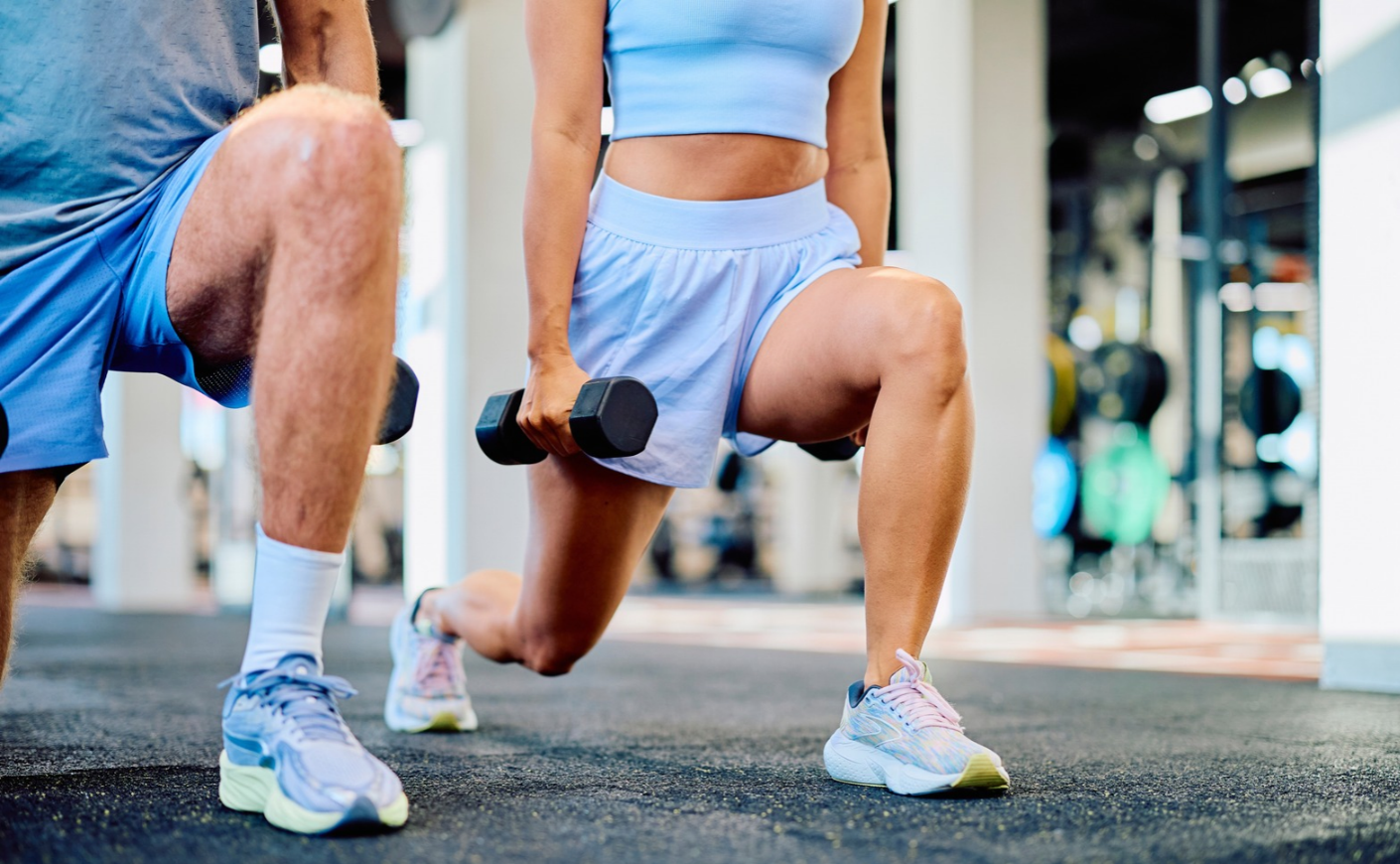
Execution: To heavily bias the glutes and quads, adopt a stance featuring a slight forward torso hinge at the hip. Take a step length that allows your back knee to track directly beneath your back hip while permitting a slight forward translation of the front knee as you descend. Maintain horizontal space between your feet — don’t walk on a tightrope. Keep roughly 80 percent of your body weight in the front leg, ribs pulled down, and core locked. Lower yourself smoothly until your back knee gently touches the floor (or as low as you can comfortably descend), then drive forcefully through your front foot to return to the start.
Why it works: Unilateral leg training lets you build equal strength on both sides without letting one side compensate for the other. The split stance also builds exceptional balance and core stability, allowing you to load the lower body heavily without compressing your spine the way a traditional barbell back squat might.
4. Supported single-leg deadlift
Primary targets: Hamstrings and glutes
Execution: Stand alongside a stable surface — like a heavy bench or a Smith machine bar — at roughly hip height. Hold onto the anchor point with the hand corresponding to your working leg, and hold a dumbbell in the opposite hand (contralateral load). Stack your ribs and pelvis, brace your core, and push the hip of your stance leg straight back. Allow a soft bend in the knee to maximize hip travel without letting your lower back flex. Drive the hip forward to return to the start, maintaining full-foot pressure and a firm grip on the dumbbell.
Why it works: Single-leg work is often limited by balance rather than true muscular fatigue. Using a light external hand support lets you competently load the hamstrings and glutes with heavier weights, bringing you closer to true muscular failure while ironing out side-to-side asymmetries.
5. Dumbbell hip thrust
Primary targets: Glutes
Execution: Position your upper back against a sturdy bench so that your shoulder blades rest right across the edge. With your hips fully extended and glutes squeezed, your knees should form roughly a 90-degree angle. Load a dumbbell across your hip crease, holding it securely with your hands. Tuck your chin, brace your core, and pull your ribs down. Lower your hips toward the floor as far as you can while maintaining your pelvic position — if your lower back starts arching or you lose your brace at the bottom, cut the range of motion slightly short. Drive your hips up explosively and lock out with a hard glute squeeze at the top.
Why it works: Unlike squats or deadlifts, hip thrusts place peak tension on the glutes in the shortened position, providing a unique strength curve. Using a dumbbell avoids the awkward digging and bruising of a heavy barbell across the pelvis. Doing these off a bench also yields a superior, deeper range of motion than a standard floor bridge, all with minimal eccentric soreness so you can recover quickly for your next session.
Daniel Stransky is a personal trainer and nutrition coach based in New York City. He also offers online fitness coaching — reach out to him right here.
