






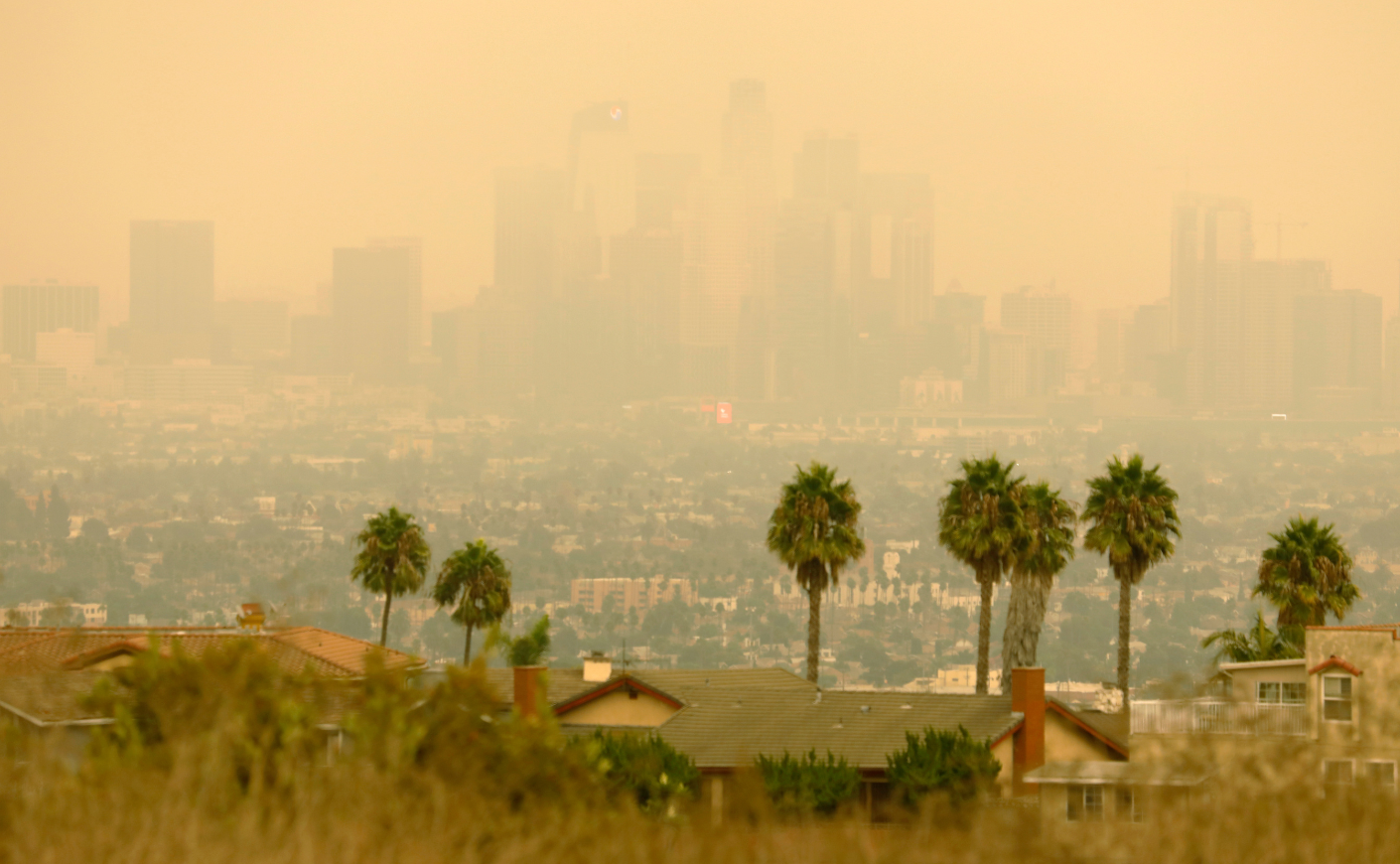
More than 150 million Americans are living in areas with dangerously polluted air, according to a new report from the American Lung Association.
Each year, the nonprofit analyzes ozone and particle pollution data to score cities and counties based on the quality of their air. This year, it found that 44 percent of Americans are living in a region that received failing grades for at least one of three measures of air pollution — and that 10 percent of children live in counties with failing grades across the board.
Research shows that the air we breathe has a significant impact on our health. It can severely impair respiratory function, trigger chronic conditions like asthma, and has also been linked to cardiovascular disease, diabetes, and Alzheimer’s.
Here’s a closer look at the report, how pollution can harm your health, and a ranking of the cities with the worst and best air quality.
The State of the Air report
This report uses local, state, and federal data to examine three types of air pollution: ozone (smog), long-term particle pollution (consistently high levels of particulate matter that clogs the air), and short-term particle pollution (brief unhealthy spikes). Based on these scores, the American Lung Association grades the major metropolitan areas across the U.S. You can find your region’s report card right here.
The organization has released the annual report for the past 27 years. Initially, its aim was to track the progress of the Clean Air Act, a federal law regulating emissions, says Will Barrett, the ALA’s assistant vice president for nationwide clean air policy. Since then, we’ve made considerable progress in clearing the air, but this year’s report reflects “a bit of a crossroads,” he tells us.

“Climate change in the form of extreme heat, which drives up ozone formation, or drought and wildfires, which drive up particle pollution, are making the job of keeping our air clean and maintaining that momentum much more difficult,” Barrett says. “On top of that, the leadership at the U.S. Environmental Protection Agency is now delaying, weakening, and repealing critical clean air measures.”
How air pollution impacts your health
Ozone, a colorless, corrosive gas, is a powerful lung irritant and can damage the delicate lining of our small airways. Chronic exposure has been linked to asthma and COPD, as well as increased risk of death. One large study conducted in China found that even a small increase in ozone levels was associated with a significantly higher risk of dying from heart disease.
Particulate matter, a mixture of liquid droplets and solid particles, can be especially dangerous — particularly fragments that are so tiny, they can get deep into your lungs and slip into your bloodstream. This type of particulate matter, referred to as fine particulate matter, measures 2.5 micrometers or smaller, according to the EPA. (For context, the average human hair has a diameter of about 70 micrometers.) Fine particles are mostly produced by burning wood or fossil fuels, and can include toxic compounds.
Particle pollution has been implicated in a wide range of serious conditions, including increased risk of heart attack, stroke, lung cancer, and even dementia. In pregnant women, it can lead to preterm birth, low birth weight, and is believed to increase the risk of fetal and infant mortality. It’s also been strongly associated with increases in mortality. Researchers estimate that fine particulate matter is responsible for more than 50,000 premature deaths every year in the U.S.
How to protect yourself from unhealthy air
Barrett recommends making sure you’re monitoring the air quality in your community, by checking resources like Airnow.gov, which provides real-time data on pollution levels in your zip code.
The American Lung Association also suggests limiting how much you’re exercising outdoors on an unhealthy air quality day. You should also make sure you’re not exposing yourself to particulate matter inside your home, by limiting use of wood-burning stoves, air fresheners, and sprays with harsh chemicals. A HEPA air purifier can also help filter out particulate matter.
Cities with the most air pollution
Two of the most polluted areas are in Southern California and the San Joaquin Valley, a roughly 250-mile stretch that runs through the center of the state and includes Bakersfield, which ranks in the bottom five in all three measures of air quality, along with Fresno and Visalia. The valley has historically had high levels of truck and train fumes, oil-drilling exhaust, and farming chemicals — and is surrounded by mountains, which keep the pollution trapped in the region.
Southern California has to deal with pollution from millions of passenger vehicles, diesel trucks, and ships — along with sizzling heat and wildfires, Barrett says. But there’s a silver lining: Bakersfield had one of its cleanest years ever in this year’s report, while Los Angeles had its lowest level of long-term particle pollution, Barrett says.
Cities with the highest ozone pollution
1. Los Angeles-Long Beach, Calif.
2. Visalia, Calif.
3. Bakersfield-Delano, Calif.
4. Phoenix-Mesa, Ariz.
5. Fresno-Hanford-Corcoran, Calif.
Cities with the worst short-term particle pollution
1. Fairbanks-College, Alaska
2. Eugene-Springfield, Ore.
3. Bakersfield-Delano, Calif.
4. Brownsville-Harlingen-Raymondville, Texas
5. Visalia, Calif.
Cities with the worst year-round particle pollution
1. Bakersfield-Delano, Calif.
2. Brownsville-Harlingen-Raymondville, Texas
3. Eugene-Springfield, Ore.
4. Fresno-Hanford-Corcoran, Calif.
5. Visalia, Calif. (tied for fifth)
5. San Diego-Chula Vista-Carlsbad, Calif. (tied for fifth)
Cities with the least air pollution
The ALA compiled lists of the cities with the lowest levels of ozone and short-term particle pollution, but didn’t rank them because they all earned the same A grade, for having zero days of unhealthy air. However, it did rank cities based on their year-round particle pollution, as calculated by the EPA.
This year, Bozeman, Mont. ended up on top. But Bangor, Maine, which ranked 10th, is considered the cleanest city in America, because it’s the only one to have the distinction of having zero ozone days, no spikes in particle pollution, and one of the lowest overall levels of particulate matter.
“Just a few years ago, there were 10 cities that achieved that,” Barrett says. “It really speaks to these changing conditions.”
Top 10 cleanest cities by year-round particle pollution
1. Bozeman, Mont.
2. Casper, Wyo.
3. Kahului-Wailuku, Hawaii
4. Urban Honolulu, Hawaii
5. Burlington-South Burlington-Barre, Vt.
6. St. George, Utah
7. Anchorage, Alaska (tied for seventh)
7. Cheyenne, Wyo. (tied for seventh)
9. Grand Junction, Colo.
10. Bangor, Maine
