






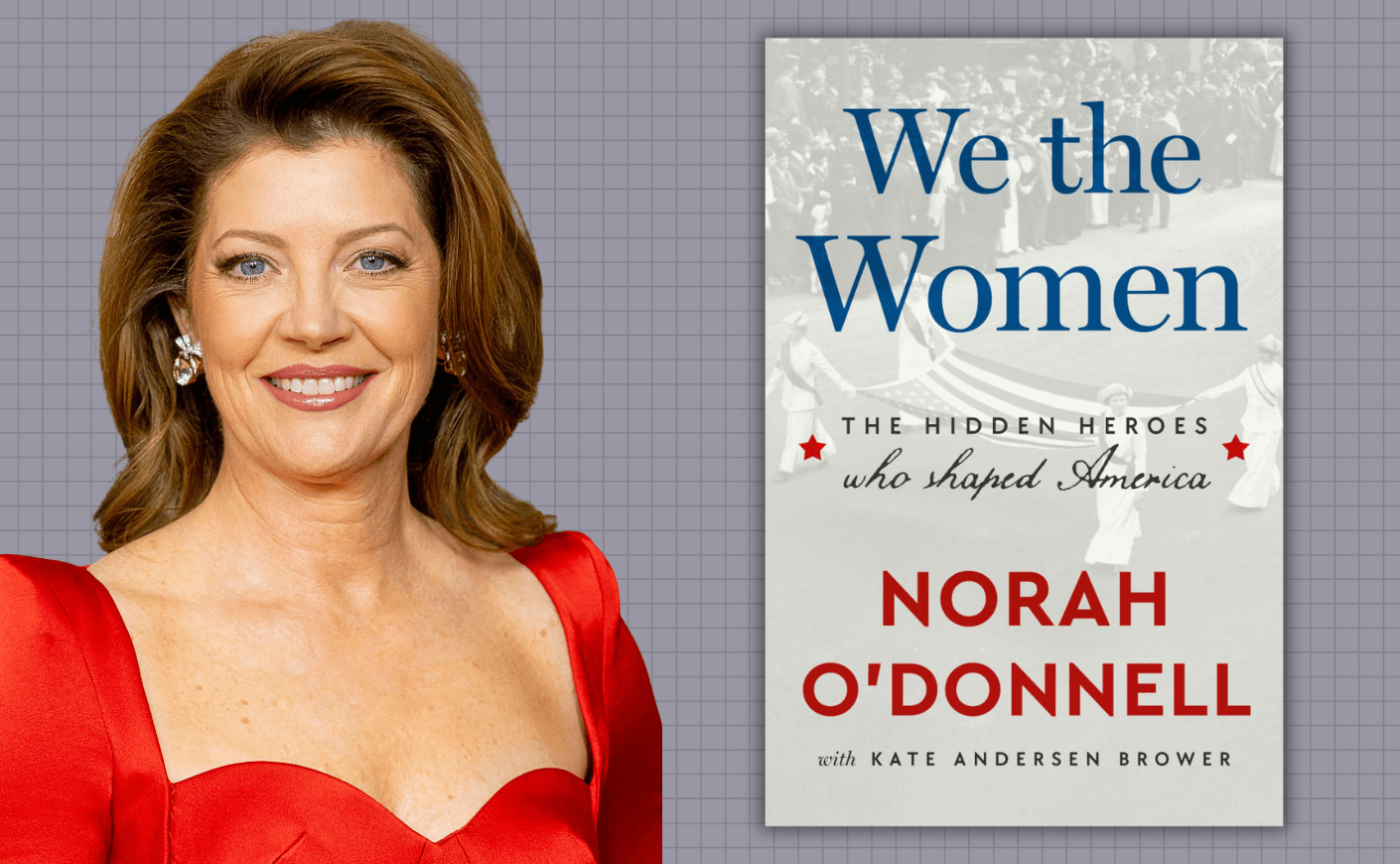
When Norah O’Donnell thinks about America, she thinks about her grandmother stepping onto Ellis Island in 1930 with $20 in her pocket and grit in her bones. In her new book, We the Women, O’Donnell traces that same spirit through 250 years of American history, illuminating the women who helped shape the nation — and who were too often relegated to footnotes. From suffragists who commandeered the stage at Independence Hall to intellectual powerhouses like Mercy Otis Warren, she reframes the founding story we thought we knew and asks a pointed question: Who gets remembered, and who gets erased?
A veteran journalist who has spent decades questioning presidents and covering wars, O’Donnell brings both reporter’s rigor and a mother’s urgency to this project. Writing for her daughters as much as for her readers, she argues that the stories we elevate shape what feels possible — and that expanding the American narrative isn’t about ideology, but accuracy. In this conversation, she reflects on hidden heroes, complicated legacies, and why reclaiming women’s place in history is, at its core, a promise to the next generation.
Katie Couric Media: You write about your grandmother arriving at Ellis Island and how that story shaped your understanding of America. How did becoming a mother influence the urgency or emotional core of this project for you?
Norah O’Donnell: My grandmother, Mary Teresa Monaghan, arrived at Ellis Island from Northern Ireland in 1930 with just twenty dollars to her name. She had started working at age 12 in a Belfast linen factory, traveling through barbed wire and barricades every day. She never made it past 8th grade, but she was smart enough to know she had to leave Northern Ireland and brave enough to cross the Atlantic alone.
When she entered New York Harbor, she was greeted by a woman! Yes, the Statue of Liberty holding a torch! The poem on Lady Liberty’s pedestal was written by a young female poet, Emma Lazarus. My grandmother believed there would be opportunities for women in America not provided for her in Ireland. She was right.
Becoming a mother — and now watching my daughters navigate the world — gave this project a profound urgency. I dedicated this book to my mother and my daughters, and to the women in history who remind us that nothing is impossible. That dedication isn’t just a sentiment. It’s a statement of purpose.

I wrote this book because I wanted my daughters to grow up knowing that women have always been at the center of America’s story. I wanted them to know that when Mary McLeod Bethune was told as a 10-year-old girl, “You can’t read that — put that down,” she went home determined to prove that girl wrong. And with $1.50, she started a school that became Bethune-Cookman College.
The bold spirit and bravery that brought my grandmother across the Atlantic lives inside every woman I profile in this book. I wanted my daughters to inherit that same spirit — to know that the obstacles they face aren’t new, that women before them have overcome even greater challenges, and that their voices matter.
As Oprah says, you have to look back to see how far you’ve come. This book is my way of helping my daughters — and all young girls — look back and see the long line of courageous women who paved the way for them. It’s my way of saying: You come from strength. You come from resilience. You come from women who refused to be silenced. Nothing is impossible.
You open the book with the 1876 suffragists storming the stage at Independence Hall — a moment you say you didn’t learn about in school. As a journalist, how did writing this book change the way you think about the stories we elevate — and the ones we sideline?
This is a dramatic scene that should be in an opening scene of a movie right?!
Well I didn’t learn about this extraordinary day in school or from the many history books I’ve read. It took following my curiosity about America’s Independence Day through the years, and a lot of research, to uncover this story. That led me to wonder: Why is this moment a mere footnote to our country’s story rather than a centerpiece of our lessons?
Writing this book fundamentally changed how I think about historical narratives. As a journalist for nearly three decades, I’ve learned that the stories we tell shape our understanding of who we are and what we can become.
The fact that I never learned about Susan B. Anthony and Elizabeth Cady Stanton storming the stage at America’s 100th birthday — standing in front of Independence Hall, reading their own Declaration of Rights while thousands watched — revealed how deliberately women’s contributions have been sidelined.
This wasn’t an accident of history. The National Women’s History Museum found that less than 15 percent of what is taught in America’s schools highlights the achievements and history of women.
What strikes me most is how these omissions shape possibility. I wonder how my own sense of self, power, and courage might have been shaped differently if I had learned as a young girl that Mary Katherine Goddard’s name appears on the Declaration of Independence, or that Phillis Wheatley’s poetry helped inspire the nation’s founding document, or that women weren’t just witnesses to history—they were at the center of every pivotal moment!
The stories we elevate become the blueprint for what seems achievable. When we only celebrate men as founders, inventors, and leaders, we teach young girls that power is a masculine domain. But when we tell the full story — that women have always been essential to America’s progress — we expand what feels possible for the next generation.
You describe these women as “hidden heroes” and acknowledge that many were complicated and imperfect. How did you balance admiration with accountability in telling their stories?
I approached this book with the understanding that greatness and imperfection can coexist. These women were revolutionary in their thinking and actions, yet they were also products of their time — which means some held views that are troubling today.
For instance, some of the suffragists who fought brilliantly for women’s rights failed to champion the rights of Black women and Indigenous women with the same fervor. Those failures are part of their story, too.
My goal was to celebrate their courage and impact while being honest about where they fell short. Their stories remind us that progress is messy, that even our heroes had blind spots, and that the work of building a more just America is never finished — each generation must push further than the last.
Mercy Otis Warren went toe-to-toe intellectually with John Adams and paid a personal price for it. As a woman who has questioned presidents and power brokers on national television, did you feel a particular kinship with her story?
Absolutely. Mercy’s story resonated with me deeply, both as a journalist and as a woman who has spent decades in rooms where I was often the only woman — or one of very few.
Mercy Otis Warren was called “the most accomplished Lady in America” by John Adams himself. She was the leading intellectual of the Revolution, the “secret muse of the Bill of Rights,” and someone who shaped the founding of this nation with her pen. Her 1788 pamphlet, “Observations on the New Constitution,” was so influential that 1,700 copies were distributed in New York alone — compared to just 500 copies of The Federalist Papers. That's a big deal!
But when she published her three-volume History of the American Revolution in 1805 and offered an honest assessment of John Adams — describing him as having “a partiality for monarchy” and noting that “his prejudices and passions were sometimes too strong for his sagacity and judgment” — Adams was furious. He felt stabbed in the back.
His response? “History is not the Province of the Ladies.”
That dismissal was particularly cruel because he knew better. He had been one of her greatest champions. But when she refused to back down, when she insisted on her right to tell the truth as she saw it, he tried to undermine her greatest achievement by suggesting women had no business writing history.
I’ve lived a version of that dynamic. As one of only three women to ever solo-anchor an evening news broadcast, I know what it’s like to ask tough questions and face backlash for it. Even in my own company, I’ve also had to fight for equal pay and challenge misogyny.
What I admire most about Mercy is that she stood by her convictions, even when it cost her a valued friendship. She demonstrated that the highest form of patriotism sometimes requires speaking uncomfortable truths to those in power — even when they’re your friends. That’s journalism. That’s integrity. And yes, that’s a price women often pay for refusing to be silent.
Mercy proved definitively that history was, indeed, the province of this lady. And every woman who has dared to speak truth to power stands on her shoulders.
You’ve covered wars, elections, and constitutional crises. In researching 250 years of women's history, did you come away more optimistic or more sober about where the country stands now?
Always optimistic about the future of America! No question. Why? Writing this book gave me a deeper understanding of just how long and hard-fought the battle for equality has been and how much progress we’ve made.
The optimism comes from seeing the undeniable arc of progress. When this nation was founded, women couldn’t vote, couldn’t own property in their own names, couldn’t serve on juries, couldn’t practice law or medicine, couldn’t control their own earnings. Today, I’m one of only three women to have anchored a network evening news broadcast — following in Katie's footsteps!
Today, women make up almost 40 percent of federal judges. Women are the majority of medical school students — and research shows patients are less likely to die when treated by female surgeons. Women’s increased participation isn’t just about equality; it’s saving lives.
I’m optimistic because I’ve seen how each generation of women has built on the victories of the one before. Deborah Sampson disguised herself as a man to fight in the Revolutionary War. Dr. Elizabeth Blackwell was rejected from eleven medical schools before she was accepted — as a joke. Mary McLeod Bethune started a school with $1.50 that became Bethune-Cookman College. Eleanor Roosevelt transformed personal pain into unstoppable political power, becoming “the world’s foremost female political force.”
Each of these women faced rejection that could have crushed her. Each refused to shrink. Each opened doors that millions of women have walked through since.
But I’m also sober about the work that remains. Throughout this project, when I felt discouraged by challenges in my own life, these women filled me with a sense of grit and resilience.
The women in this book teach us that progress requires persistence, that setbacks are temporary, and that each generation must pick up where the last left off.
Dr. Martin Luther King Jr. said, “The arc of the moral universe is long, but it bends toward justice.” Women have been essential to bending that arc. And as long as we keep fighting, keep telling our stories, and keep refusing to be silenced, I believe we’ll continue bending it toward a more just and equal America.
If you were to write another chapter for this book 25 years from now — as America approaches its 275th birthday — what progress would you hope to document?
Twenty-five years from now, as America approaches its 275th birthday, I hope to document a chapter where the phrase “the first woman to…” is no longer remarkable because women’s leadership is no longer the exception, it’s the norm.
I hope to write about a time when women hold at least half the seats in Congress, half the governorships, and when we’ve had multiple women serve as president.
I hope to write that women’s stories are no longer “hidden heroes” but are taught as central to American history. That every schoolchild learns about Mary Katherine Goddard printing the Declaration, Phillis Wheatley inspiring it, and the suffragists who stormed the stage in 1876. That young girls grow up knowing women have always been essential to America’s progress.
I hope to write about a generation of girls who grew up seeing women in positions of power across every field — so that when they dream about their futures, they don’t have to imagine breaking barriers because the barriers have already been broken.
That’s why we must keep telling these stories. Because our daughters’ futures depend on knowing the past. And because "We the People” can no longer ignore, “We the Women.”
Are you concerned that contributions by women and people of color are being marginalized in public spaces like national parks and Arlington National cemetery as part of an “anti-woke” agenda? Why is it important that these stories are not erased?
It is vital that these histories are not erased, because public spaces are some of the most powerful classrooms we have: what we choose to commemorate determines what is remembered and that shapes our culture. This isn’t about politics — it’s about accuracy. When the stories of women are left out, we’re not just losing history, we’re negatively impacting the future.
I’ll end with this: When Susan B. Anthony and the suffragists stormed the stage at Independence Hall on July 4, 1876, they declared: “We ask justice, we ask equality, we ask that all the civil and political rights that belong to citizens of the United States be guaranteed to us and our daughters forever.”
Our daughters forever.
That’s what’s at stake. Telling women’s stories is about keeping a promise to our daughters — a promise that their voices matter, their contributions count, and their place in American history is secure.
